Mastering the Restaurant Wine Taste Test

You’ve ordered your wine, now what?  Your server is approaching the table with a bottle in his hand, and you are entering the zone of the taste test ritual.  Now is not the time for high anxiety…it is only a taste test, and you are not the one on trial. Relax and let me demystify this stage of restaurant wine service for you.

To begin with, a well-trained server will start the proceedings by standing to the right side of the host (code for whoever placed the wine order), and presenting the wine bottle to him or her, label side up.  Your server should verbalize the producer, wine variety, and vintage.  Something along the lines of, “Sir, the 2005 Brookswood Cabernet Sauvignon you ordered” would be ideal.

If this is indeed the correct wine, the server will remove the foil capsule from the neck of the bottle, and place it in his or her apron pocket.  After extracting the cork from the bottle, the server should place it on the table to the right side of the host.

A word to the wise: don’t smell the cork!  There’s not much to be gained by smelling (or squeezing, for that matter) the cork. If a server presents the cork to you, glance at it and set it aside. Some say sniffing the cork or feeling a cork for dryness can indicate whether excessive amounts of oxygen have crept into the bottle, but you’ll smell and taste that soon enough.

Next, your server will pour you a 1 ounce taste.  Then, the server stands aside and waits for your approval.  Don’t despair…you are not expected to come up with a brilliant bon mot or wax poetic about the wine.  All you have to do is determine whether or not the wine is flawed.  That’s right…this is not a Roger Ebert moment where you get to give a “thumbs up/thumbs down” judgment or award gold stars.  And trust me; you are probably not going to need to send that bottle back.

There are really only two ways a wine can be reject-worthy:  if it is oxidized, or it is corked.   An oxidized wine will have a spoiled, flat, prune juice-like smell.  It may also appear cloudy, have a chemical-like odor, or taste vinegary.  A wine with cork taint will show musty, funky, dirty-basement, wet-cardboard-like smells.  Don’t worry if you don’t know what oxidized wine or cork taint smells like…they make themselves known a mile away.

The polite thing to do if you suspect a flaw in your wine is to ask the server to sample the wine.  You might say something along the lines of, “I’m not sure about this wine…could you take a taste and tell me what you think?”  This is usually all it takes to have the bottle judged by the resident expert, and if there is any doubt, the bottle will be replaced.

But let’s not get bogged down with what to do with a bad wine.  Chances are very high indeed that the wine will be faultless, and you can offer your nod of approval.

Proper service begins with the guest to the left of the host and proceeds clockwise around the table.  Women should be served first and pouring should continue clockwise until all the women are served, and then the server should run another lap around the table to pour the men, ending with the host (male or female.)  This gives the host a chance to order more should the bottle be on the wane.

Now, all you have left to do is relax and enjoy your meal.  Notice the star-bright clarity and gorgeous color of your wine.  Swirl your glass and breathe in the aromas, take a sip and savor the flavor.  Note how the wine leaves impressions on your palate long after you have swallowed…this is the wine’s finish and aftertaste.  But mainly, just enjoy.  You have survived the wine ritual, from wine list to wine glass, and that in itself is worth a celebration.


The More the Meritage

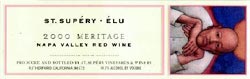
Take the word “merit” and combine it with the word “heritage.”   Put in the hands of a master wine maker and blend well.  What you have is Meritage, a relatively recent addition to the wine lexicon, coined in 1988 to describe new world wines made with the grape varieties of, and in the blended style of, the noble wines of Bordeaux.

The name “Meritage” was originally intended to give the wines of California a little much-needed marketing moxie at just about the time that California wines were beginning to be gain international acceptance. Since the inception, winemakers in California, Australia, Israel, and Argentina have embraced the name, and wine makers all over the world craft some of their finest wines with the Meritage blend and use a catchy proprietary name like “Opus One” or “Insignia” on the label.

The story of Meritage begins in the 1980’s.  Wines from California had stunned the wine world at the Paris Tasting of 1976, and the eyes of the world had begun to be opened to the fact the some darn good wine was coming from the New World.  The American public had started to embrace wine, and wine lovers from Oregon to New Jersey were happily slurping the Cabernet Sauvignon, Merlot, and Sauvignon Blanc coming out of Napa and Sonoma.
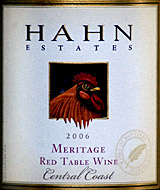
So here’s where the plot thickens:  due to labeling laws set forth by the Bureau of Alcohol, Tobacco, and Firearms, wine from the U.S. must be at least 75% the named varietal grape in order to be labeled using the name of the grape, such as “Cabernet Sauvignon”.  If a wine was not 75% one grape, it had to be called by a “made up” or proprietary name, or use the generic term “Table Wine.”

This proved vexing for a very good reason:  At the time, Americans equated generic wines or proprietary wines with bad, bad wine, which there was plenty of in those days.  Many of the first wines out of California post-prohibition were “mystery blends” of grapes grown in the warm Central Valley, distributed in big, round bottles reminiscent of a bootlegger’s stash.  These wines were labeled with generic names such as “Table Wine” or they sported proprietary names.  Who can forget Gallo Hearty Burgundy, Carlo Rossi Paisano or Italian Swiss Colony Red Table Wine?  The 75% rule was, and still is, the labeling law in the U.S. Thus, if a winemaker was making a top-flight blend in the style of the finest blended wines of Europe, no matter how expensive or delicious it may be, it had to be labeled like a jug wine.

The truth is that the ability to blend grape varieties gives a winemaker an added tool with which to create wines of complexity and balance.  Some of the finest wines in the world, such as those of Bordeaux, Chianti, and Chateauneuf-du-Pape, are blends of many different grape varieties.  So, it seemed that American winemakers were at a competitive disadvantage compared to the wines of Europe.  In order to label their wines using the accepted vernacular, the wines had to have 75% one grape, while many European wines are always blends of several different grapes, in any proportion the winemaker chooses.

Enter our hero, The Meritage Association!  Formed in 1988 by a small group of Napa Valley Vintners, the members sought to create a recognizable name associated with high-quality blended wines.  In a stroke of genius, they hosted a contest to create a catchy name.  The contest received over 6,000 submissions.  Neil Edgar of Newark, California won by suggesting “Meritage” – a combination of the words merit and heritage. As a reward for winning the contest, Mr. Edgar was awarded two bottles of the first ten vintages of every wine licensed to use the Meritage name.

So the requirements for Meritage were set forth:  A red Meritage wine must be made from a blend of Cabernet Sauvignon, Cabernet Franc, Merlot, Malbec, and Petit Verdot, the classic Bordeaux Grape Varieties.  The proportions may vary, but at least three of the grape varieties must be used.  For white Meritage, only Sauvignon Blanc and Semillon, the white grapes of Bordeaux, are permitted.  A “Meritage” does not need to use the term on the label, and many wineries prefer to use their proprietary names, but if you read the wine’s tasting notes you are likely to find the term “Meritage blend” or “Bordeaux blend” used.  Today, there are over 120 winery members of The Meritage Association, and fine wines made with the grape varieties of, and in the blended style of, the noble wines of Bordeaux continue to be some of the world’s most cherished wines.

By the way, most of the wine enthusiasts I know like to whisper the term using the pseudo-sophisticated pronunciation “meh-ri-TAHJ”, as if the wine rhymed with the uber-pricey French wine “Hermitage”.  However, according to The Meritage Association, the word should really be pronounced like “heritage” with an “m”. 


Wine…in Patagonia???

Wine…in Patagonia?   

Most people, when they think of Patagonia, think of glaciers, penguins, and the literal end of the world.  Some might call to mind the Straights of Magellan, Igazú Falls, and Tierra del Fuego.  But…I can just about bet my life on this fact…hardly anybody thinks of wine.

That was true for me, as well, right up until yesterday.  Now, when I think of Patagonia, I think of Malbec, Pinot Noir, a delightful Sauvignon/Semillon and a rich Cabernet.  Strange as it may seem to inhabitants of the Northern Hemisphere, there are vineyards in Patagonia, and since the late 1990’s, fine wine has been produced by a winery called “Bodega del Fin del Mundo.”  The name, naturally, translates to “The Winery at the End of the World”.

A few days ago I was lucky enough to taste through a wide range of the wines of the Bodega del Fin del Mundo, and while I enjoyed them all, I’ll keep this review short by concentrating on my favorite:  The Postales del Fin del Mundo Malbec  2008, made from grapes grown in, of all places, Patagonia, Argentina.

My tasting notes are, like my mindset today, rather jumbled, so I’ll just leave them that way. This wine, Postales del Fin del Mundo Malbec 2003, has a beautiful ruby-black-red color, highly perfumed aromas of black currant, plum jam, raspberry, and a teeny-tiny waft of vanilla-scented oak.  This is a beautiful, fruit-forward, well-proportioned wine….I’m tempted to say that it’s like a Greek statue…muscular and powerful but not bulky. 

 This could easily be a burgers, pizza, or steak-on-the-grill partner, and at a retail price of around ten dollars the price is right.  However…this wine could take it up a notch, so why not give the kitchen a whirl and serve this wine with pork tenderloin medallions topped with roasted red bell pepper-tomato butter served on a bed of mashed sweet potatoes and a side of spinach lightly tossed in garlic and butter???  Put out that kind of a meal and you’re going to be getting a lot more of what you want in life.

Geographically speaking, the vineyards that grow these lovely grapes are located in San Patricia del Chañar, which is about 500 miles south of the more famous vineyards of Mendoza, and approximately 1100 miles north of the frozen tundra of Tierra del Fuego.  This remarkable viticultural project began in the 1990’s with the building of over 12 miles of irrigation channels intended to capture the waters of the River Neuquén, which itself is fed by snow melting off the majestic Andes.  This region is essentially a dessert, and like many desserts, is often assaulted by high, steady winds- so much so that windbreaks were constructed to surround and protect the vineyards. However, the region boasts just the type of rocky soil, significant temperature extremes, and low humidity that vitis vinifera thrives in, and the area has been compared – terroir-wise- to Bordeaux, Asti, and Mendocino. 

Perhaps the validity of such comparisons are yet to be seen, but I, for one, always knew there was something good to be found at the end of the world.

Tales of the Vine: Flying Cigars

Tales of the Vine: Flying Cigars

Chateauneuf-du-Pape in the Southern Rhône is one of the oldest and most prestigious wine growing regions in France.  The famous red wine of Chateauneuf-du-Pape is made from a chorus of grapes, with Grenache, Syrah, and Mourvedre making up the bulk of the blend.  A total of 13 grapes, known as the “Chateauneuf 13” are allowed in the blend.

The town name, roughly translated as “New Castle of the Pope”, refers to a time in the fourteenth century when the French Pope Clement V resided not just in Rome but in the walled city of Avignon, a short fifteen-minute drive from the Chateauneuf-du-Pape wine making region. Pope Clement’s successor, Pope John XXII, built the namesake “new castle” papal estate out among the vineyards.  To this day, the castle’s majestic remains loom over the town and form a picturesque backdrop to the surrounding vineyards.

In 1954, at the height of the cold war, this famous wine region and the nearby town were suddenly plagued with a series of U.F.O. sightings.  The town and the surrounding areas were full of panic-stricken citizens and rampant rumors of an alien invasion. The town council was very concerned – but not about the public panic or the possibility of local citizens being abducted by aliens.  What concerned the town council was protecting the region’s priceless vineyards. In response, the following municipal decree was adopted:

Article 1:  The flying overhead, landing, and taking off of aeronautical machines called “flying saucers” or “flying cigars”, of whatever nationality they may be, is strictly forbidden in the territory of the commune of Chateauneuf-du-Pape.

Article 2:  Any aeronautical machine –“flying saucer” or “flying cigar”-that lands on the territory of the commune will be immediately taken off to jail.

The “flying cigar” laws remain on the books today.

Several decades later, renegade winemaker Randall Graham of Bonny Doon Vineyards in Santa Cruz, California set out to create a California Wine based on the grape varieties and in the style of the legendary red wine of Chateauneuf-du-Pape, he named his wine, with a respectful tongue held-in-cheek, “Le Cigare Volant”.  “Le Cigare Volant” is the French term for “flying saucer”.

Oh…and by the way – you can stop worrying…as far as I know, no flying saucers have ever landed in the commune of Chateauneuf-du-Pape.


Follow

Get every new post delivered to your Inbox.

Join 911 other followers