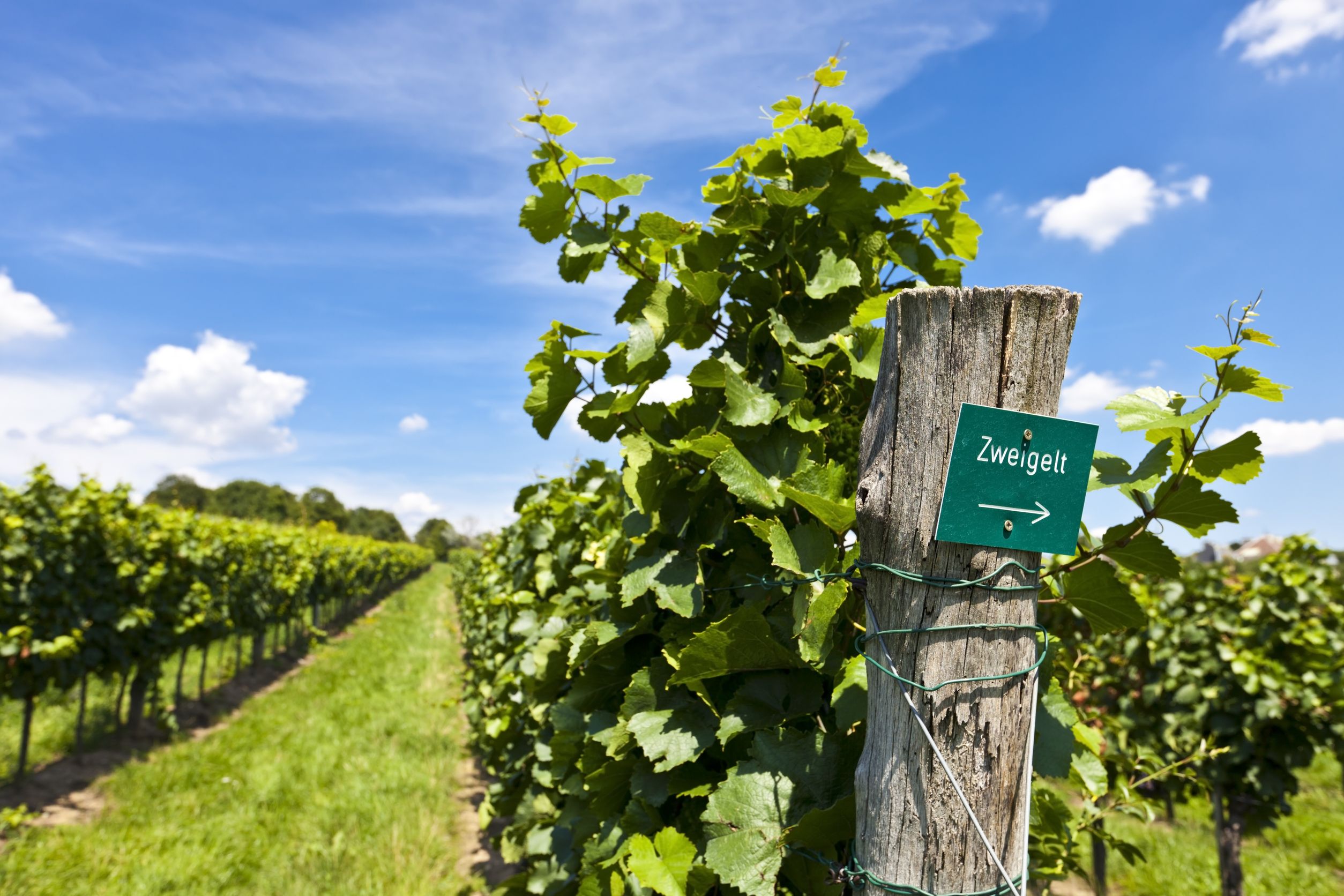
Five Fast Facts about Zweigelt

Zerigelt 1A quick read about Fritz Zweigelt and the grape he created.

#1 – Zweigelt is the leading red grape of Austria. It is also planted in small amounts in Canada, in both Ontario and British Columbia. Zweigelt is the third most-planted grape of the Czech Republic, where is goes by the name Zweigeltrebe. A few wineries – including Wilridge Winery and Perennial Vintners – have some small plantings (a few acres or so) in Washington State.

#2 – Zweigelt is a cross of St. Laurent and Blaufränkisch/Lemberger created by Fritz Zweigelt in 1922. Fritz was working the Federal Institute for Viticulture and Pomology at Klosterneuburg, Austria at the time, which makes the Zweigelt grape a true native Austrian. It was made with the purpose of creating a red grape unique to Austria that could thrive in the cool climate, be disease-resistant, and create a red wine of medium to full body and flavor.

#3 – Dr. Zweigelt did a good job – the grape that bears his name is indeed cold-hardy, drought-resistant, and thrives in a variety of soils. It is fairly disease-resistant, but is susceptible to powdery mildew (that’s Oidium to you CSW students) and berry shrivel/grape wilt.

Zweigelt 2#4 – The name of the grape is pronounced “TSVYE-gelt” – and if you think that’s difficult to say, consider yourself lucky. The original name of the grape was Rotburger (the name of a town close to where the grape was created) but was later changed to honor its creator.  Zweigelt also goes by the name Blauer Zweigelt. By the way, don’t confuse the original name of Zweigelt – Rotburger – with the grape that goes by the name of Rotberger (who would – ha!). For the record – Rotberger (“berger with an e!”) is a white grape cross of Riesling X Trollinger.

5 – As with all wines, the characteristics of a good Zweigelt vary according to vineyard conditions and wine-making techniques. Cool-climate, unoaked versions from Austria’s northern reaches are typically violet-red in color, medium-bodied, and moderate in tannins with fruit-forward flavors favoring red and black cherry. As such, it is the most widely consumed red wine in the pubs, bars, and casual restaurants in and around Vienna. The warmer growing regions in the areas of Lower Austria (Niederösterreich) – particularly  Neusiedlersee – produce full-bodied, richer wines with firm tannins. Such wines are often oak-aged, resulting in flavors of red cherry, red plum, cinnamon, and black pepper.

References:

The Bubbly Professor is “Miss Jane” Nickles of Austin, Texas… missjane@prodigy.net

Five Fascinating Facets of Flor

Bodegas Hidalgo La Gitana (producers of La Gitana Manzanilla) in Sanlúcar de Barrameda – photo by Caleteron via Wikimedia Commons

Bodegas Hidalgo La Gitana (producers of La Gitana Manzanilla) in Sanlúcar de Barrameda – photo by Caleteron via Wikimedia Commons

Ok, I apologize for the gratuitous alliteration, but you have to admit…flor – the indigenous yeast cells that form a “veil” on the surface of certain types of Sherry as it ages – is fascinating. Flor (meaning “flower” in Spanish) is a subject that just seems to get more interesting the closer you look. As a matter of fact, I had a hard time limiting the information I found to just five facets!

#1: Flor is what separates the Finos from the Olorosos. Flor is a film-forming yeast (actually, several related strains of yeast) that is indigenous to the region around the Jerez-Xérès-Sherry DO. Flor is the main factor that causes the myriad types and styles of Sherry to divide roughly into three camps – Fino, Hybrid, and Oloroso – based on the extent of flor influence. Fino Sherries (such as those labeled as Fino or Manzanilla) are aged under the somewhat constant influence of flor. Oloroso Sherries (labeled as Oloroso or sometimes as Cream Sherry) are aged entirely without flor; while hybrids (such as Amontillado and Palo Cortado) are aged partially with flor and partially without.

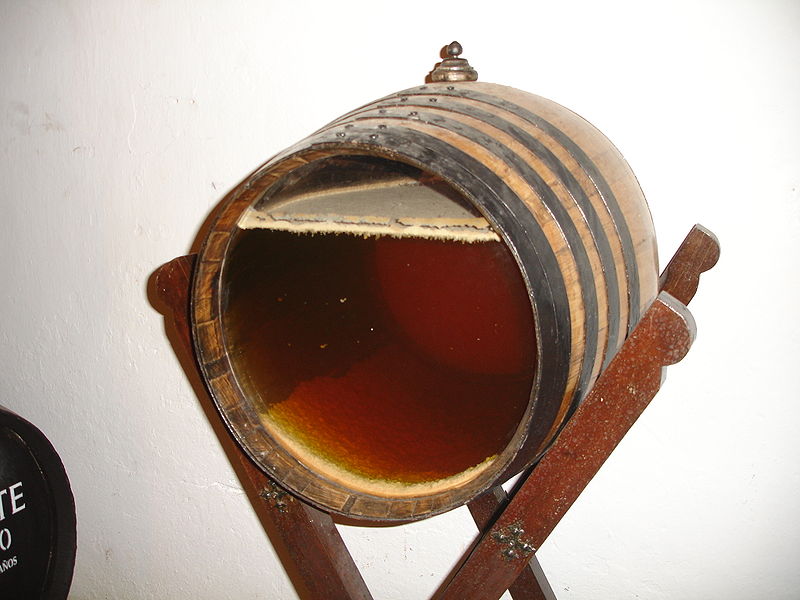
#2: Flor is that “something in the air” in Jerez. Flor imparts its magic by finding its way from the air to the young base wines being prepared each year. The flor starts to develop in the base wines, and, after the wine is fortified – as long as the maximum level of alcohol remains around 15% by volume or less – and placed in a barrel, the yeast will reproduce and start to form a veil (velo in Spanish) that covers the surface of the wine in the barrel like a blanket.  The veil has been described as a waxy foam, about two centimeters thick; or as a light “cottony” film. The “blanket” formed by flor is sturdiest and palest in spring and autumn and turns rather thin and grey in summer and winter. Talia Baiocchi, in her new book “Sherry: The Wine Industry’s Best-Kept Secret” describes a thick film of flor as resembling a “1970s popcorn ceiling.”

Sherry barrel with transparent front to demonstrate the natural development of flor - Photo by El Pantera via Wikimedia Commons

Sherry barrel with transparent front to demonstrate the natural development of flor – Photo by El Pantera via Wikimedia Commons

#3: Flor protects the wine from oxidation in a variety of ways. The veil that is created via the action of flor protects the wine resting beneath it in a myriad of ways. For one, it simply forms a protective barrier between the wine in the barrel and the oxygen above it. In addition, the flor actually consumes some of the oxygen around it, as well as some of the alcohol, glycerol, and (if present) sugar. Thus, Fino Sherries tend to be pale in color, light in body, and bone-dry.

#4 – The collective effects of flor – referred to as “biological aging” – are amazing. The main benchmark for biological aging is considered to be the wine’s aroma. Simply put, contact with flor (both while it is alive, and after it expires and sinks to the bottom of the barrel as lees) may create up to 1,000 milligrams per liter of acetaldehyde in the wine. That is, according to Ruben Luyten of the blog Sherry Notes, more than twenty times the amount of acetaldehyde found in most table wines.  Acetaldehyde’s aromas have been described, variously, as rancid apple, apple cider, almond, hazelnut, and even straw or hay. The presence of flor will also lead to an increase of in other highly aromatic compounds, such as lactones and terpenes, which may add an array of aromas – from dried herbs to green walnuts, mushrooms, and baking spices – to the wine.

#5: Flor has some definitive preferences as to climate and conditions.  Flor can only survive in wine that has an alcohol level of somewhere below 15% abv – but that’s just the beginning of its ways. Flor also needs a good deal of humidity in the air, which explains why Fino Sherries thrive in certain areas, such as the cooler, coastal areas around Sanlúcar de Barrameda and El Puerto de Santa María, while Oloroso Sherries (which are aged without flor) thrive in the hotter, drier, more inland areas around Jerez. It is well-known that solera systems (and the buildings that surround them) are often at ground level (as opposed to an underground cellar) and built with high ceilings or even left partially open to the elements, so as to encourage air flow. It’s also rumored that bungs are left gently in place in Fino Soleras to encourage the movement of the humid air inside the barrels.

Flight of Fino Sherries at London’s Bar Pepito – Photo by Ewan Munro via Wikimedia Commons

Flight of Fino Sherries at London’s Bar Pepito – Photo by Ewan Munro via Wikimedia Commons

While wines produced “under a veil” are somewhat uncommon around the world, there are a few shining examples besides Fino Sherries. These include the Vin Jaune of France’s Côtes du Jura AOC, certain types of Tokaji, a “Vin de Voile” produced by Domaine Plageoles in France’s Gaillac region, and the “Condado Pálido” produced in Spain’s Condado de Huelva DO, among others.  While these wines undergo a similar style of biological aging, it is not certain that they use the same strain(s) of yeast as are found in Jerez-Xérès-Sherry, and, of course, each of these wines is made in its own conditions of climate-atmosphere-terroir. Thus, we can safely say that there’s nothing in the world quite like the flor of Jerez, the protective foam-blanket it creates, and the resulting Fino Sherry.

References: