All I Want for Christmas…is a decent wine pairing!

This time of year, everyone asks me for wine pairing suggestions for the holidays. It’s a great question, but difficult to answer, as Christmas dinner can be quite eclectic! At least with Thanksgiving, we can pretty much count on a turkey. But among my friends and family, Christmas dinner means different things to different folks! Some go for a fancy prime rib, others go traditional with turkey, some folks opt for glazed ham, and one family insists on lasagna! In the spirit of whatever floats your gravy boat, here are a few heartfelt suggestions.

Fancy Christmas—Roast Beef, Prime Rib, or Beef Wellington…of course, red wine with red meat is a mere cliché…certainly, one can pair beefy-beef with a sturdy white wine or a zingy rosé. However, in this case, the wine cliché rocks—and in my mind, prime rib, roast beef, and their ilk deserve to be served alongside a powerful red wine. You’ll want a wine that can survive a few rounds in a cage match with a fatty, roasted, seared, salt-pepper-and-rosemary-rubbed hunk of beef. If you are looking to splurge, grab your favorite Napa Cabernet (hopefully from 2020 or a few years earlier). If you are on a budget, seek out a good, round, twenty-dollar Malbec from Mendoza. Either way, you’ll have a winning match (and a good excuse to take a nap).

Hallmark Christmas—Maple Glazed Ham…here is your chance. Freak everybody out by serving an off-dry German Riesling. Relax and enjoy the show as your wanna-be-a-wine-snob friends turn their noses up at anything with residual sugar and serve them a young-and-gritty Napa Meritage that obliterates 10 percent of their taste buds. (Whoops. So sorry.) For everyone else, demonstrate the sheer pairing perfection of the Riesling…the way the sweetness in the ham’s glaze—as well as those marshmallowy sweet potatoes—makes the wine taste dry and perfectly balanced. It is the best of both worlds…serve a sweet wine, taste a dry wine. It’s like magic.

Traditional Christmas—Roast Turkey and all the trimmings…this is the most schizophrenic meal of the year, combining sweet, savory, salty, and acidic dishes with abandon. I have gone into detail on the possible pairing computations here, but if you want a quick fix…go for Pinot Noir or Beaujolais Cru. Both wines have just enough flavor and power to pair nicely and please just about everyone—while they shouldn’t clash or overpower the bountiful (and eclectic) dishes.

Vegetarian Christmas…I refuse to comment on tofurkey (but if that’s your jam, you do you)! However, being a former Berkeley girl, I always have a few vegetarians in the close-knit friends group. For these folks, I make sure to have plenty of options on the table such as green bean casserole, roasted carrots with whipped feta and walnuts, and/or grilled asparagus. To pair with all these delectable veggies, I reach for Grüner Veltliner. Native to Austria, this grape—redolent with aromas of green fruit, herbs, and white pepper—produces light-to-medium bodied white wines rich in savory flavor. In my humble opinion, it is one of the best wines to pair with veggies of all kinds. It will work with the turkey and ham as well, just in case those so-called vegetarians sneak a chunk or two when they think no one is looking.

Dysfunctional Family Christmas…have no fear, the wine world has the perfect antidote for awkward families: rich, high-octane red Zinfandel from California. Lodi, Dry Creek Valley, and Paso Robles will be happy to serve you up a spicy, fruity, bold Zinfandel that might just reach 15% alcohol by volume. It is perfect…you can take the edge off the “why aren’t you married” talk and just smile…release your best “evil laugh” and do the “crazy eyes.” Hopefully, the wine will have turned your teeth purple, and you will look like a true lunatic. Your relatives will flee, and you will be blessed by a peaceful evening and the truth that red Zinfandel will never let you down.

Of course, when it comes to food, wine, and holidays: eat what you like, drink what you like, celebrate how you like, and share your time with those you love! Happy holidays to all!

The Bubbly Professor is “Miss Jane” Nickles of San Marcos, Texas… missjane@prodigy.net

Five Fast Facts about Barbera

There is a lot to love about Barbera. One of Italy’s most widely-grown red varieties, it’s an easy-going grape in the vineyard and well-behaved in the winery. Compare this to Pinot Noir and Nebbiolo—its uber-finicky friends—and you’ll understand why this grape is so easy to adore. Read on to learn more about beautiful, bountiful Barbera!

#1—Barbera is one of Italy’s native varieties: Barbera is a red-skinned grape variety believed to be native to the Piedmont region of Italy. As of the latest count, there are currently 80,000 acres of Barbera planted worldwide. Of these, about 70,000 acres are found in Italy (mostly in Piedmont, but also in Lombardy, Emilia-Romagna, and a few spots across central and southern Italy where it is appreciated for its refreshing acidity). The grape is grown in many other places across the wine-making world, with significant plantings found in California (courtesy of an influx of Italian immigrants beginning in the 1880s), Argentina, Australia, and South Africa.

#2—Barbera is fruity and floral…Stare deep into a Barbera-based wine and you are likely become mesmerized by its lovely purple hue (with perhaps a glint of blue in the middle). Give the glass a good sniff and soon you’ll sense red and blue fruit (cherries, cranberries, blackberries, blueberries, and plums). Give it another sniff and you’ll likely find flowers (wildflowers, violet), herbs (chamomile, black tea, or mint). If the juice was aged in oak, you’ll find vanilla, toasty, or oaky notes. It’s highly likely that you’ll be sipping a medium-bodied wine with a cool zing of cherry-like acidity and moderate tannins. Serve it up with a giant charcuterie table (fresh mozzarella and sun-dried tomatoes would be good), pepperoni pizza, Grandma’s lasagna, or spaghetti Bolognese. If you just absolutely must, pair it with a grilled burger or a BLT. You can’t go wrong!

#3—Barbera bubbles! WHAT? While a red sparkling wine can be a jolt to the palate (something about the fact that chilling a red wine brings the tannin and bitterness forward), the world nevertheless produces a few. Sparkling Shiraz and Brachetto d’Acqui are the first that come to mind…but now that I think of it, Barbera is (albeit rarely) also used in sparkling wine. (Technically it is frizzante wine, meaning it has about 3 atmospheres [atms] of bubbly pressure as opposed to 5-6 atms of pressure in a fully sparkling/spumante wine. But still.) Piedmont’s San Silvestro winery describes their Barbera Frizzante (Piemonte DOC) in the most appealing way, saying “we decided to tell the most cheerful and lively side of the Barbera variety with a delicate perlage obtained from a second fermentation in a pressurized tank that enhances its fruity and harmonic taste.” Several appellations (located in Italy’s Piedmont region) allow for the production of Barbera Frizzante. These include the Piemonte DOC, Colli Tortonesi DOC, and Barbera del Monferrato DOC.

Photo credit: Petar Milošević

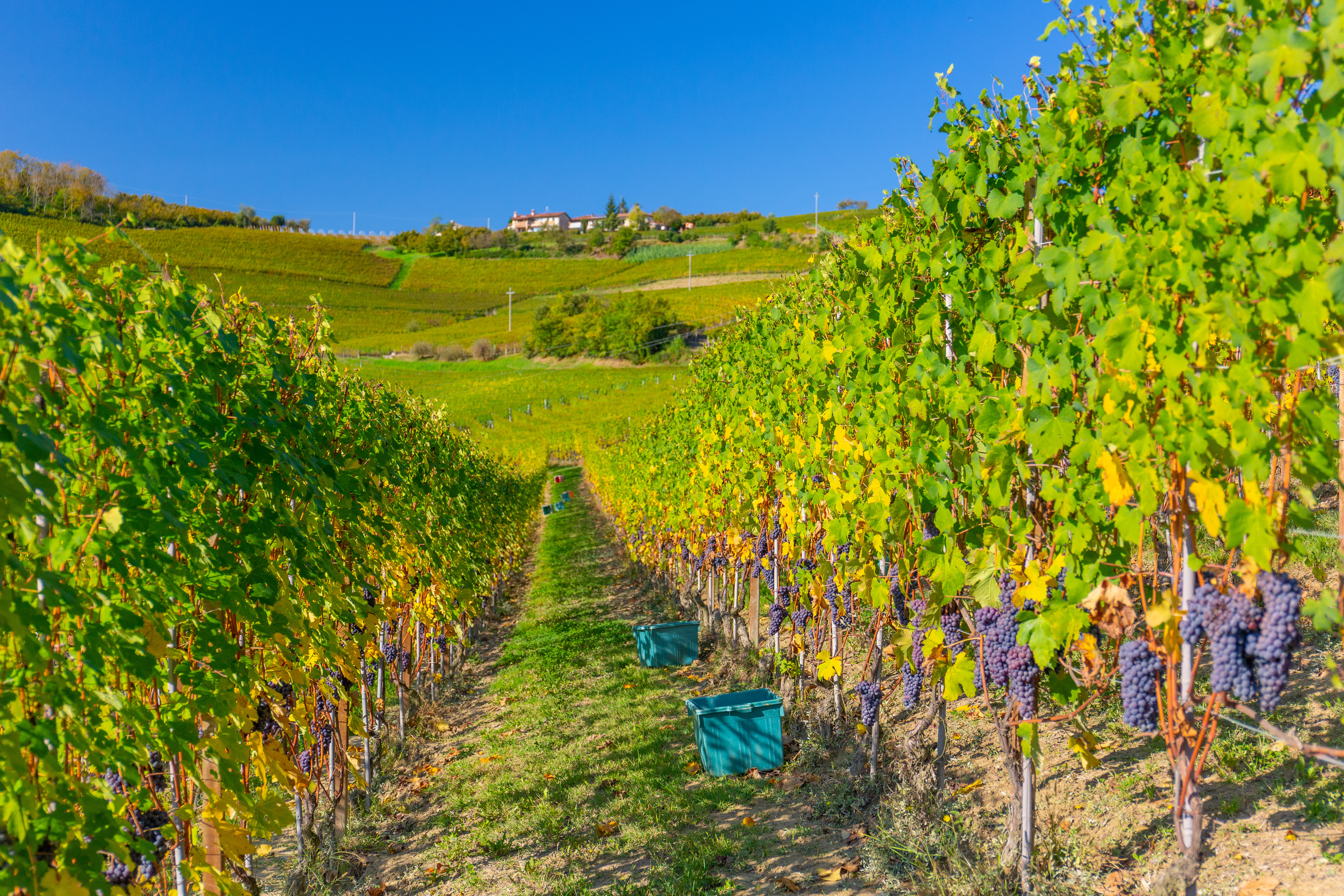
#4—Barbera is easy-going in the vineyard: This productive workhorse can offer up a high yield while still retaining its flavor and quality. Barbera—a great source of crisp, zingy acidity in a varietal wine or blend—is known for being able to retain its acidity even in warm-to-hot climates and while super-ripe. The grape is easily recognizable due to the compact shape of its clusters and the fact that its leaves turn a lovely reddish color in the fall.

#5—Barbera is a big deal: Barbera is Italy’s the third-most-widely grown red grape (behind Sangiovese and Montepulciano). While Nebbiolo steals the spotlight in its native home of Piedmont, Barbera is the most widely planted grape variety in the region. Several of Piedmont’s 60 AOCs (count ‘em, 60!) produce Barbera-based wines (mostly red, some rosato [rosé], and even some bubbles). These include the Barbera d’Alba DOC, Barbera del Monferrato DOC, Barbera d’Asti DOCG, Barbera del Monferrato Superiore DOCG, and the new-kid-on-the-block, the Nizza DOCG.

Long live Barbera!

References/for more information:

The Bubbly Professor is “Miss Jane” Nickles of San Marcos, Texas… missjane@prodigy.net

Five Fast Facts about the Calatayud DO

Unless you are a true wine geek (and I certainly consider myself one), you may have never heard of the Calatayud Denominación de Origen (DO)—fair enough. However, I have been seeing more of these wines on the shelf at my local liquor hangout, so I thought that it was a good time to introduce…Five Fast Facts about Spain’s Calatayud DO!

#1: It’s in Aragón—a region that is not really well-known for fine wine. Tucked just beneath the Pyrenees and inland of Catalonia, the area has a great history (in Medieval times, it was its own kingdom), amazing topography (it is home to the highest mountain in the Pyrenees and crisscrossed by the Ebro River), and incredible cities (visit Zaragoza and tour the Cathedral-Basilica of Our Lady of the Pillar). While the area does produce wine, none of the appellations are that well-known. Trust me on this one (or read fast fact #2, below).

#2: Calatayud is one of just four DOs located within Aragón. The Somontano DO—home to some delicious, Garnacha-based rosés and well as some nice varietal reds—is located in the north of the area. Two smaller areas, Campo de Borja and Cariñena, are—along with Calatayud—located and south of the Ebro River Valley. All of these appellations are approved for a long list of wine types and styles—from solid reds to light rosé and white…even sparkling and dessert wines.

#3: The Calatayud DO specializes in big red wines…mainly Garnacha and Garnacha-based blends. This hot, dry, hilly region is a challenging place for agriculture…but Garnacha thrives in areas such as these. Garnacha accounts for just over 75% of the area’s nearly 9,000 acres of vines. Other red grapes—such as Tempranillo and Mazuelo—also thrive in the region and are often part of the Calatayud Tinto blend. (Note: Garnacha is the Spanish name for the grape otherwise known as Grenache.)

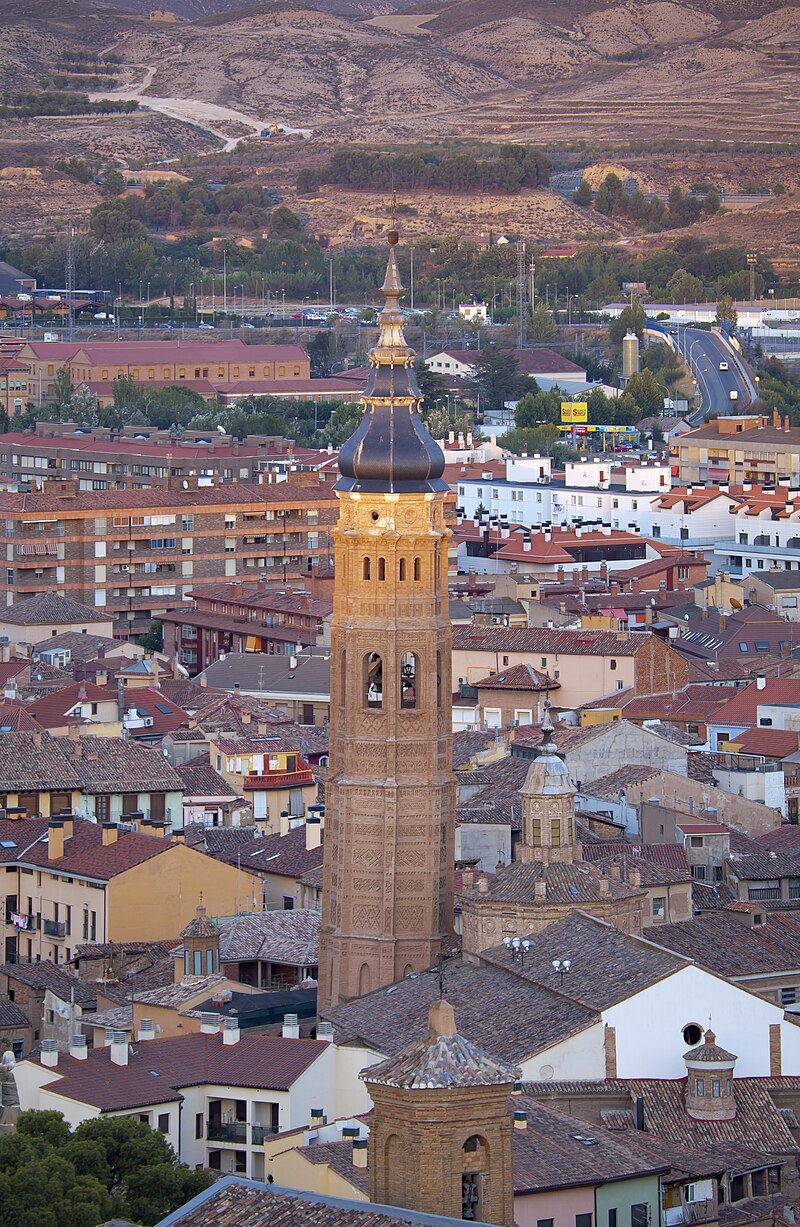
Photo of the bell tower at the Colegiata de Santa Maria la Mayor by Diego Delso, via Wikimedia Commons

#4: Like the other DOs of Aragón, the Calatayud DO is approved for the production of a long list of wine styles. Tinto (red), rosado (rosé) and blanco (white) may be produced in a range of sweetness levels ranging from bone-dry to super sweet; the terms used for these range from seco (dry) to semiseco, semidulce, and dulce (sweet). Fortified wines—known as vino de licor—may be produced using Garnacha, Macabeo or Moscatel (Muscat). Sparkling wines—vino espumoso—and Spain’s unique, slightly fizzy vino de aguja are also produced in Calatayud.

#5: The Calatayud DO is situated somewhat between the far-more-famous appellations of Priorat (about 150 miles to the east) and Rioja (about 150 miles to the east). The appellation is named after the tiny city of Calatayud, known for its 15th century Mudéjar bell tower on the grounds of the Colegiata de Santa Maria la Mayor (Collegiate Church of Santa Maria)—the tallest in the region.

References/for more information:

The Bubbly Professor is “Miss Jane” Nickles of San Marcos, Texas… missjane@prodigy.net

Five Fast Facts about the Margaret River Region

Vineyards in the Margaret River Region

The Margaret River is many things. It’s a town! It’s a river! It’s a wine region!

Here at the Bubbly Professor, we are mostly interested in the wine region, but the region (of course) is shaped by the river. It’s a fascinating spot, so let’s explore five fast facts about Australia’s Margaret River wine region.

#1: Look to the far west of Western Australia. The Margaret River Region is located in the far west of Western Australia. It consists of a long, narrow stretch of land (about 60 miles/96 km from north to south) jutting out from the Australian landmass, surrounded on three sides by the waters of the Indian Ocean. Its namesake—the town of Margaret River—is pretty much a surfing town (it was featured in the 60s surfing flick Endless Summer) and is home to just over 6,000 permanent residents. To reach the town (and the wine region) you will need to drive about 170 miles/275 km south from Perth—the nearest city—and as such, many people describe Margaret River as “the most geographically isolated wine region on earth.”

Wine map of Western Australia via WineAustralia

#2: The Margaret River runs through it. The Margaret River—just 37 miles/60 km long—flows from its source in the Whicher Range across the Margaret River Plateau until it meets the Indian Ocean. The Whicher Range is not too tall (the average height of the hills is just 558 feet/170 m above sea level), and the typically calm river changes its character with the seasons as the volume of water varies and causes the banks to expand and contract. The point where the river meets the sea—River Mouth Beach—is an interesting spot, as the calm river waters meet the wild, surf-worthy waves of the West Australia Coast.

#3: It’s young—at least for a wine region. Commercial viticulture did not arrive in the area until the 1960s, when several people—notably Dr. Tom Cullity, a Perth cardiologist influenced by a paper written by Dr. John Gladstones of the University of Western Australia—took note. Dr. Cullity planted vines that would become the Vasse Felix Winery—often called Margaret River’s founding winery—in 1967. Other endeavors soon followed, including Moss Wood (1969), Cape Mentelle (1970), Cullen Wines (1971), and Leeuwin Estate Winery (in 1973).

Cape Leeuwin

#4: Its more maritime than most. The area is greatly influenced by the surrounding ocean—and has what n described as “the most marked maritime climate of any region in Australia in terms of rainfall.” The area enjoys an average of 1,000 mm (almost 40 inches, about the same as Seattle, Washington) of rain a year. Other aspects of the climate are, however, a tad more Mediterranean—with most of the rain falling during the winter, followed by a warm, dry summer and little chance of frost or freezing temperatures.

Other aspects that contribute to the local terroir include the latitude—the area is situated comfortably within the temperate zone of the Southern Hemisphere at 33.5°S—and the region’s relatively low elevations (the average is just 131—744 feet/ 40–227 m above sea level). Soils include well-drained red loam topsoil dotted with gravel atop gneiss, schist, and granite-based sub-soils.

#5: In terms of grapes, it’s more Bordeaux than Barossa. The top three grape varieties in the Margaret River—Sauvignon Blanc, Cabernet Sauvignon, and Semillon—hail from Bordeaux. As is typical of Bordeaux, many of these grapes make their way into blends, including Sauvignon Blanc/Semillon and Cabernet Sauvignon/Merlot. Also noteworthy is that Margaret River is one of the few regions in Australia (in addition to the far more famous Hunter Valley) with a focus on Semillon. As for those grape varieties considered more typical of Australia: Chardonnay makes a good show in the Margaret River Region (by most accounts, it is the fourth-most-widely grown grape). Shiraz, however, only takes up just 13% of the total acreage (compared to 27% country-wide).

The area of Western Australia has been inhabited for over 50,000 years. Its first inhabitants—the Wadandi people—are considered the traditional owners of the land, collectively known as Wadandi Boodja, meaning Saltwater People’s Country.

References/for more information:

The Bubbly Professor is “Miss Jane” Nickles of Austin, Texas… missjane@prodigy.net

Pertaining to Petrichor

.

Wine and spirits aficionados have a unique vocabulary. Consider these terms, and admit to yourself how often you have used them: foxy, malo, stemmy, corked, brett. Dig a bit deeper and we find hogo, rancio, lanolin, graphite, and iodine.

And then there is petrichor, often used to describe an earthy, sometimes mineral-like aroma defined as “the scent that arises from the earth after it rains.” To be specific, it refers to the scent of the air after a light rain falls on dry earth—the breaking of a dry spell, as it were. Scientists will tell us that we humans find the aroma pleasant due to the fact that in an evolutionary sense, humans relied on the rain for survival and the aroma represents life-sustaining rainfall (a fact which remains true today).

The term itself was invented in 1964 by two Australian scientists—Isabel Joy Bear and Richard G. Thomas—who were working for Australia’s Commonwealth Scientific and Industrial Research Organisation (CSIRO). Their work was published in the March 1964 edition of Nature magazine, under the title The Nature of Argillaceous Odour (the word “argillaceous” referring to rocks or sediment containing clay).  Bear and Thomas explained the source of the petrichor aroma as remnants of the oils emitted by plants and bacteria trapped in the soil.

The word itself is derived from the Greek petra (stone) and ichor (the blood that flowed in the veins of the gods, according to Greek mythology). In terms of etymology, it is the stuff of legends: blood from a stone. 

.

In 2015, scientists at MIT figured out—and captured using high-speed cameras—the mechanism of petrichor. Put simply, as a raindrop hits the ground (a porous surface), tiny air bubbles are trapped just below the surface. The bubbles then shoot upward, creating a tiny explosion of aromatic compounds as they escape the surly bonds of earth.

Pop culture alert: the word petrichor had its moment of fame in the Doctor Who TV series. In the episode titled “The Doctor’s Wife,” characters played by Karen Gillna, Matt Smith, and Suranne Jones used the word as part of a password (Crimson…Eleven…Delight…Petrichor). They defined petrichor as “the smell of dust after rain.” It’s an impressively accurate definition. Check out a video here.

There is also a winery known as Petrichor Vineyards, located in Sonoma’s Fountaingrove District AVA. According to the winery website, the term “petrichor” represents a passion for terroir—and a good choice it is.

References/for more information:

The Bubbly Professor is “Miss Jane” Nickles of San Marcos, Texas… missjane@prodigy.net

(Under the) Tuscan Syrah

.

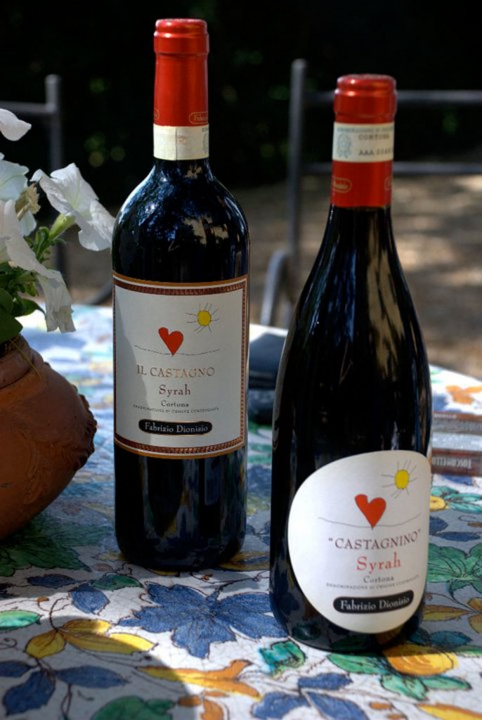
Tuscany is truly the land of Sangiovese; most of its famous wines—all variations of Chianti, beloved Brunello, and Vino Nobile di Montepulciano to name but a few—are based around Sangiovese in all its glory. However, in the Cortona DOC—tucked into one tiny southeastern corner of the province—Syrah rules the roost.

The cultivation of Syrah has a long history in Cortona. Fanciful legends abound about its introduction to the area from the post-Crusades Middle East; others tell of its introduction along with the political upheaval following the fall of House of the Medici (1737).

Recorded history is not quite so colorful but (according to the website of the Consorzio of the Cortona DOC) can trace Tuscan Syrah back to the early twentieth century, when the Count of Montecarlo di Lucca brought some vines back to his property in Arezzo following a trip to France. A few generations later—by the 1960s—several estates in the area discovered Syrah vines tucked in and around their established vineyards and encouraged and expanded its use.

In the 1970s, science—by way of Professor Attilio Scienza at the University of Milan—began to study the efficacy of several different cultivars in and around Cortona and discovered that Syrah performed exceptionally well.

The study also revealed significant similarities between the terroir of Cortona—an area tucked into the foothills of the Apennines and blessed with an abundance of sun-drenched, south-facing hill sides—and the Syrah-dominant Northern Rhône Valley of France. These days, Syrah—accounting for as much as 80% of the area’s vines—is well established in and around Cortona.

Photo via: fabriziodionisio.it

By the late 1990s, the Cortona DOC had been established, requiring Cortona Rosso DOC to contain a minimum of 50% Syrah.

As far as I can tell, Cortona Rosso is the one of only two DOC/DOCG wines of Italy (aside from varietally-labeled wines) that require the use of Syrah. (The other is the Lazio’s Atina DOC that requires the use of a minimum 10% Syrah in addition to at least 50% Cabernet Sauvignon.)

  • The details of Cortona Rosso DOC include:
    • Grape varieties: 50% to 60% Syrah, 10% to 20% Merlot, maximum 30% other red grapes allowed for use in Tuscany
    • May not be released for sale before March 31 of the year following the harvest
    • Riserva versions must be aged in oak barrels for a minimum of one year and may not be released for sale before November 1 of the second year following the harvest

In addition to its Syrah-focused red blends (rosso), the Cortona DOC allows for the production of several other styles of wine. Many of these are varietal—including Chardonnay, Sauvignon Blanc, Grechetto, Cabernet Sauvignon, Merlot, and Sangiovese as well as Syrah. By EU standards, the varietal wines must be produced using a minimum of 85% of the named grape variety. The Cortona DOC also allows for the production of Vin Santo (based on red and/or white grapes).

.

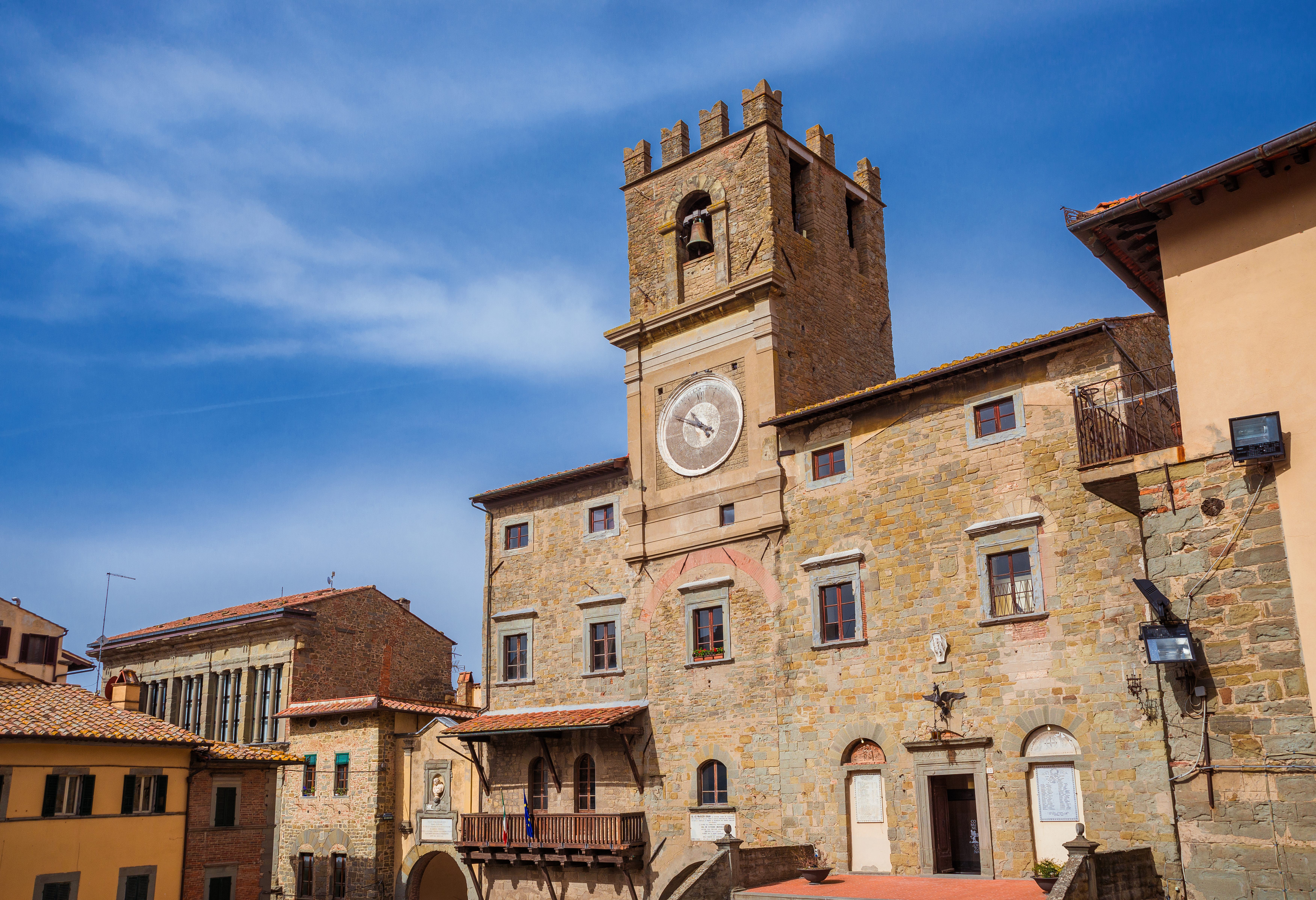
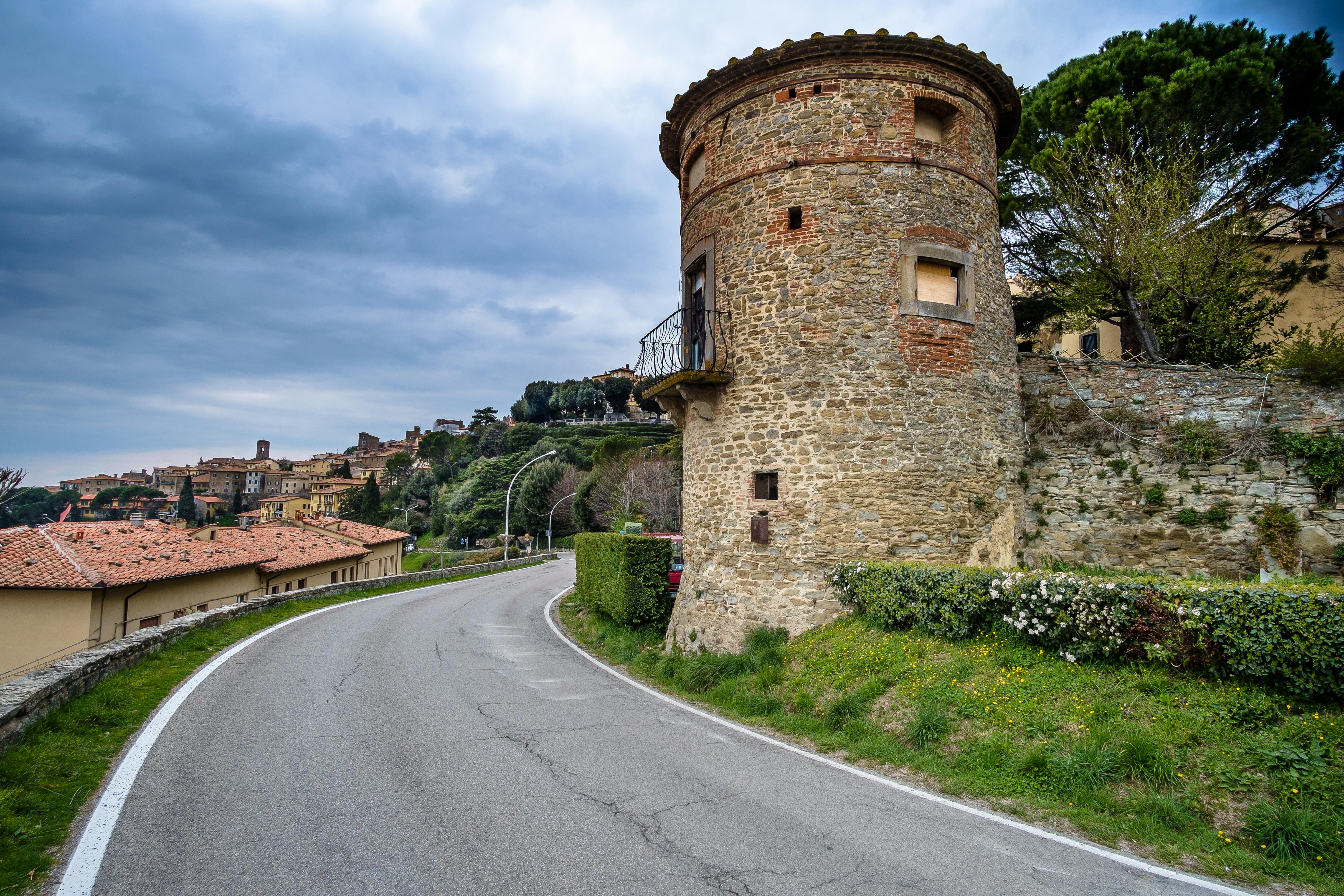
Many Americans became familiar with Cortona via the best-selling book Under the Tuscan Sun by Frances Mayes. The book—and later, the movie—made the town look idyllic, which happens to be true. Cortona is a dream-come-true for travelers who prefer to venture off-the-beaten-track. You will find plenty of delicious opportunities to wine and dine in Cortona, and the community is rightfully proud of the local wine. Main sights to see include the main town squares (Palazzo del Capitano del Popolo and the Palazzo Comunale), the ancient walls of the city, an impressive museum of Etruscan antiquities (Museo dell’Accademia Etrusca e della città di Cortona), the Basilica di Santa Margherita, and (of course) Bramasole.

References/for more information:

The Bubbly Professor is “Miss Jane” Nickles of San Marocs, Texas… missjane@prodigy.net

Confusion Corner: Cadillac

It’s a place! It’s a person! It’s a car! It’s two separate AOCs! Cadillac—a word with many meanings—is long overdue for an untangle here in the Confusion Corner.

Since this is a wine blog, we’ll start with the town and the wines of Cadillac. But hang on for a great story about a character who crowned himself the Sire of Cadillac, and how this relates to the automotive legend known as the Cadillac Sedan.

The town—Cadillac, France: Cadillac—population: 2,800— is a small town (commune) in Nouvelle-Aquitaine, France. The town has history: it was established in 1280 by Jean I de Grailly—a senior official of the Duchy of Gascony—in order to provide river access for the Château de Benauge. These days, the small town serves as an excellent home base or stop-over for a wine tour of Entre-Deux-Mers, the Médoc, and Graves; and you can visit the imposing Castle of the Dukes of Eperson (Château des ducs d’Épernon/Château de Cadillac) built in the 1500s. Along the way, you can visit the Château de Benauge (about 6 km/4 miles to the northeast).

Map of the Cadillac AOC via the INAO

The wines—the Cadillac AOC: The Cadillac AOC is located just to the east of some of Bordeaux’s most famous sweet wine-producing regions, including Sauternes, Barsac, and Cérons. The Cadillac AOC hugs the east bank of the Garonne River and is home to dozens of lakes, rivers, and streams—including the Estey de Rouquey, the Lac de Baurech, and the Ruisseau de l’Euille. All this flowing water creates a recurring layer of mists and fog— which settles into the nooks and crannies of the lowest-lying vineyards—and allows for the formation of botrytis cinerea on the vines. This in turn allows for the production of luscious, flavorful, sweet white wines—and, like many appellations that surround it, the Cadillac AOC is approved for sweet white wines only. The main grape variety of the Cadillac AOC is Sémillon; Sauvignon Blanc, Muscadelle, and Sauvignon Gris are allowed as well. The wines of the Cadillac AOC must contain a minimum of 51 g/L residual sugar; grapes may be affected by botrytis and/or air-dried after harvest (a process known as passerillage).

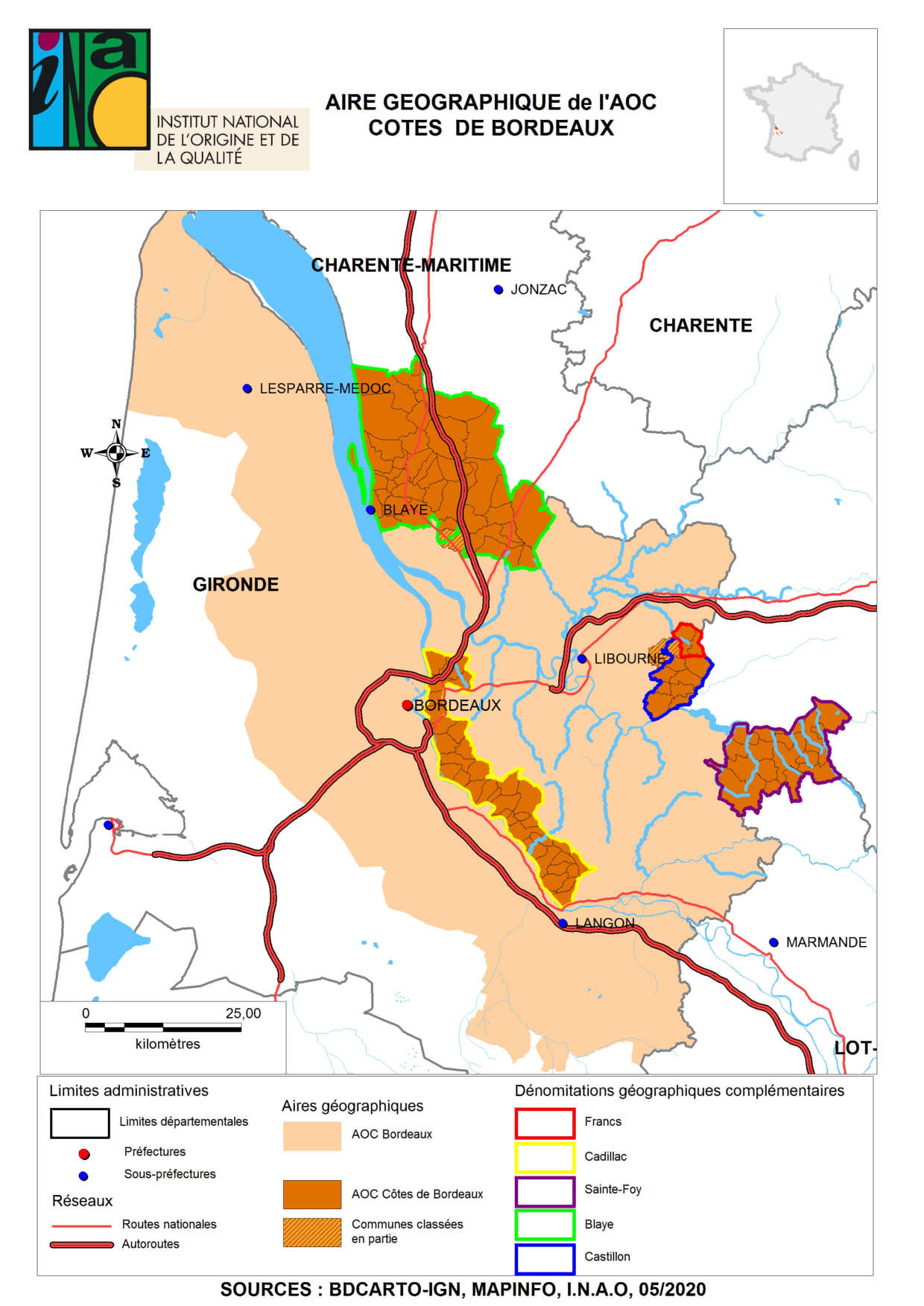
Map of the Côtes de Bordeaux AOC via the INAO

The wines—the Cadillac-Côtes de Bordeaux AOC: The entire area of the Cadillac AOC (as well as a small parcel extending from its northern edge) is included in another appellation, the Côtes de Bordeaux AOC. Cadillac is a sub-appellation of the larger Côtes de Bordeaux AOC, which encompasses four discontiguous plots of land (and five named sub-appellations) located to the east of the Garonne River and the Gironde Estuary. As if that weren’t confusing enough, the Cadillac-Côtes de Bordeaux AOC—is approved only for red wine. The allowed grape varieties mirror those used throughout most of Bordeaux and include Cabernet Sauvignon, Merlot, Malbec, Carmenère, and Petit Verdot. (For serious wine students: the five sub-appellations of the Côtes de Bordeaux AOC are: Cadillac, Castillon, Sainte Foy, Francs, and Blaye.)

The man and the car: In 1683, a fascinating character named Antoine Laumet left his home in France and arrived at Port Royal—the then-capital of Acadia/New France (and modern-day Nova Scotia, Canada). Upon his arrival in North America, he declared himself Antoine de la Mothe, écuyer, sieur de Cadillac and embarked upon several decades worth of escapades, serving at various times as an explorer, cartographer, merchant, and officer of the French Navy. In 1701, he helped to establish Fort Pontchartrain du Détroit on the north bank of the Detroit River. The fort became part of the modern city of Detroit, Michigan.

For many generations, Laumet—under his assumed nickname, Cadillac— was hailed as a hero (or at least, a founding father of sorts). A French High School in Ontario was named after him, the Cadillac Line on the Montreal Metro bears his name, as does Cadillac Mountain in Maine. Cadillac—the famous American Car Brand, headquartered in Detroit—was indeed named after him, and the original crest of the Cadillac Brand was modeled after his self-created amorial bearings (“family” coat of arms).

Postscript—and now we know: It has come to light that Antoine Laumet/Mssr. Cadillac was not quite the hero he was once believed to be. It has been revealed that he frequently abused his power; was abrasive (to say the least); traded heavily in fur, alcohol, and other products to the detriment of the First Nations; and was most likely involved in some of the earliest instances of the slave trade in North America. Le sigh.

Photo of the Château de Cadillac by Fabien Lotte via Wikimedia Commons

References/for more information:

The Bubbly Professor is “Miss Jane” Nickles of Austin, Texas… missjane@prodigy.net

Five Fast Facts about the Bay of Biscay

Biarritz (France)

If you are a wine student who has studied Bordeaux, you’ve heard of the Bay of Biscay. If you have dreamed of traveling to the resort town of Biarritz, you’ve heard of the Bay of Biscay.  If you are a sailor who likes a challenge, you’ve heard of the Bay of Biscay. If you are interested in learning more, read on for five fast facts about the Bay of Biscay!

#1: The name and the place: The Bay of Biscay is a portion of the Atlantic Ocean located off the west coast of France and the northern coast of Spain. It stretches from Point Penmarch (a small peninsula in Brittany’s Finistère department) in the north to Cape Ortegal (a headland on the shores of A Coruña, Galicia) in the south. It is named for the province of Biscay—a sub-region of Basque Autonomous Community of Spain (Comunidad Autónoma del País Vasco).

If you sailed from Point Penmarch to Cape Ortegal (you might want to consult item #5 before doing so), you would cover 360 miles/580km; if you drove the coast, you would cover 914 miles/1,475 km and pass through the cities of Nantes, Bordeaux, Bayonne, San Sebastian, and Bilbao.

#2: It’s a bay…it’s a gulf…it’s a sea: The term Bay of Biscay is used mostly by English Speakers. In France, this area is known as the Golfe de Gascogne (Gulf of Gascony), and many Spanish speakers know it as the Golfo de Vizcaya (Gulf of Biscay/Vizcaya). In Spain, the waters just off the coast of Northern Spain (stretching east to the French city of Bayonne) are known as the Mar Cantábrico (Cantabrian Sea).

  • For the geo-curious: Terms such as bay, gulf, and sea are loosely defined. However, according to the National Geographic Education Resource Library:
    • A bay is any body of water partially surrounded by land.
    • A gulf is a portion of the ocean that penetrates land. (As such, the terms bay and gulf are largely interchangeable.) While there are some exceptions (such as the Bay of Bengal), in common use a gulf is larger than a bay.
    • Sea is a broad term that may be applied to more than 50 different types of water formations; this term is typically reserved for bodies of salt water.

#3: The Rennell Current: Several ocean currents flow through the Bay of Biscay, all of which are considered branches of the Gulf Stream. The Gulf Stream—named for its source (the Gulf of Mexico, at 20°N)—carries warm water northward and eventually reaches the northern coast of Europe. The portion of the current flowing closest to the coast in the Bay of Biscay is known as the Rennell Current, named for James Rennell (1742–18300, a British geographer and oceanographer who studied and mapped many ocean currents. It is estimated that the Rennell Current can have a warming effect of up to 4°(F) on the areas along the coast of France.

#4: The triangle of fog: Fog can show up at any time and just about any place on the Bay of Biscay, but it is an almost daily occurrence during late spring and all through summer, particularly in the southwest portion of the bay.  This “triangle of fog” typically forms over the deepest water in the bay and can extend inland along the northern coast of Spain (Galicia–Asturias–Cantabria—Basque Country) for several miles.On th

On the coast in Deba (Basque Country, Spain)

#5: The shelf and the shallow: The Bay of Biscay has a long history of shipwrecks, rough water, and tumultuous storms. During the winter months, areas of low pressure (unstable air masses/depressions) track into the bay via the Gulf Stream and are easily energized into fierce thunderstorms, much to the dismay of anyone caught on the open water.  At times, these thunderstorms are met with winds from the east and this clash of wind and rain can cause the water to churn “like a washing machine.” In addition, the continental shelf extends over a large portion of the bay, resulting in shallow water and rough seas that can occur during all types of weather.  Click here to see a detailed map of the continental shelf in the Bay of Biscay. 

Here’s to the Bay of Biscay! The next time you raise a glass of Muscadet, Cognac, Txakolina, Sidra de Asturias, or Bordeaux…remember to pay homage to the influence of the Bay of Biscay…whether it be storms or fog or ships that made it through.

References/for more information:

The Bubbly Professor is “Miss Jane” Nickles of Austin, Texas… missjane@prodigy.net

It’s Baffling…Bonarda (and Friends)

Bonarda is baffling. One grape—Bonarda Piemontese—may be considered the Original Bonarda or the True Bonarda…and yet there are quite a few other distinctly different grapes that (at least sometimes) go by the same name. These include Croatina, Douce Noir, and Uva Rara. Let’s take a closer look and try to unravel the mystery of Bonarda.

Bonarda Piemontese: Native to Italy’s Piedmont region, Bonarda Piemontese has been linked with the area around Turin since the 1790s. This heritage suggests that Bonarda Piemontese is the Original Bonarda and most likely the first grape to use the moniker.

Bonarda Piemontese is very sparsely planted—the latest statistics count just 540 acres/218 ha planted in Piedmont. The grape—typically used in red blends—is specifically mentioned and allowed for use in a few of the appellations of northwest Piedmont, including Colli Tortonesi DOC and Pinerolese DOC. (Several other Piedmont appellations allow for the use of Bonarda; but the regulations are unclear as to which specific version of Bonarda is intended.)

According to the Vitis International Variety Catalogue (VIVC), Bonarda Piemontese has up to 14 synonyms; of these, the ones that make the most sense include Bonarda di Asti, Bonarda di Chieri, and Bonarda Nero. In red blends, it is appreciated for its color, freshness, and ability to add a bit of softness to a wine otherwise full of edgy (often Nebbiolo-derived) tannin. If you ever happen to stumble across a varietal Bonarda Piemontese, you could expect to find a smooth, soft-tasting wine with floral aromas and fresh, fruity flavors.

Croatina (Bonarda Rovescala): Croatina is a dark-skinned red grape believed to be native to the Oltrepò Pavese area of Lombardy. It is here—in this area named after the town of Pavia across the Po—that the Croatina grape is often referred to as Bonarda Rovescala (after the tiny town of Rovescala), or simply Bonarda.

The name Croatina means Croatian Girl, and for many years it was assumed that the grape was native to the Primorska Hrvatska (Coastal Region) of Croatia. While it would have been a short trip indeed from Croatia to Northern Italy, it is now considered doubtful that the grape originated in Croatia.

What is known is that there are currently close to 8,100 acres/3,300 ha of Croatina grown throughout Northern Italy, where it is known to produce richly hued (purple/blue), mildly tannic wines with aromas of red cherry, blackberry, raspberry, and sweet spices.

Croatina is allowed for use in more than a dozen AOCs across Piedmont, Lombardy, Emilia-Romagna, and Veneto. These include Oltrepò Pavese DOC, Colli Tortonesi DOC, and Colline Novaresi DOC (among others). It is also used in the Bonarda dell’Oltrepò Pavese DOC, which is required to contain a minimum of 85% Croatina.

Douce Noire (Bonarda Argentina): Douce Noire is a minor French grape, believed to be native to the Savoie Region and still planted in small amounts in this mountainous area of eastern France. In other parts of France, it is more commonly referred to as Corbeau (meaning crow, and likely referring to its dark black color).

Douce Noire is also planted—under the name Charbono—in some parts of California, particularly in Napa where it was once a specialty of the Inglenook Winery. It is believed that the grape was originally brought to California by Italian immigrants who may have introduced it as Charbonneau (a name once used in eastern France).

It is, however, Argentina where Douce Noire really shines; at last count there were over 46,000 acres/19,000 ha of Douce Noire planted in Argentina—mainly in Mendoza and San Juan. In Argentina— where it is known as (you guessed it) Bonarda—Douce Noire is used to produce red blends and fruity, easy-to-drink reds and rosés typically available at a good (value) price. It is unclear how the name Bonarda came to be used in Argentina, but it is likely that when it first arrived, the grape was thought to be of Italian origin. It has been suggested that the grape be referred to as Bonarda Argentina to avoid (further) confusion.

Uva Rara (Bonarda Novarese): Uva Rara is thought to be native to northern Italy (Piedmont and Lombardy), where it currently accounts for 1,500 acres/600 ha of vines. The name translates to rare grape and is believed to refer to the small number of grapes in each bunch rather than rarity in use.

Uva Rara is typically used in red wine blends; it can soften the tannic edge of Nebbiolo and add color and depth to wines based on Barbera or Croatina. You may find a splash of Uva Rara in the wines of the Ghemme DOCG, Gattinara DOCG, Lessona DOC, or Oltrepò Pavese DOC (among others). In addition, it is allowed for use as a varietal wine in the Colline Novaresi DOC

While you are on the lookout of these wines, be alert…you may experience a sighting of Bonarda. If you’ve read this far, you should be not at all surprised to learn that in these parts, Uva Rara is sometimes referred to as Bonarda; specifically, Bonarda Novarese.

TL/DR: Croatina, Douce Noir, and Uva Rara are sometimes referred to as Bonarda; however, they are all distinct grape varieties and not identical to nor related to Bonarda Piemontese.

References/for more information:

The Bubbly Professor is “Miss Jane” Nickles of Austin, Texas… missjane@prodigy.net

Can She Pair a Pumpkin Pie?

It is that time of year once again and everyone is talking about wine and Thanksgiving. For those of you who follow along, you know that the wine world has gone a bit crazy lately on the subject of food and wine. Some folks say there is just no such thing as food and wine pairing, and you should just serve what people like. Who can argue with that?

And then there is the crowd that insists that certain wines pair with certain foods and other pairings are just a disaster. Well, there’s something to be said for that as well.

So here is my latest take on the matter. I recently had the pleasure of presenting this information to several classes full of bright-eyed and interested wine students. As such, what follows is basically my outline for my 2024 Thanksgiving Wine and Food Pairing Class, that I call “Can She Pair a Pumpkin Pie”?

For starters, here are some basic concepts concerning food and wine pairing, and how they relate to our very American, very complex Thanksgiving Day feast.

#1: Never forget: Turkey is like Switzerland! What I mean by this is that turkey is about as neutral in taste and flavor as it gets, so in theory…. turkey should pair well with just about any wine.

#2: If you have bubbles, you’ll have no troubles. In other words, if you’d rather just not deal with any of these concepts or (what we used to call) rules, just serve bubbly and you’ll be fine. Bubbles just do not hit the palate as hard as other wines and simplify the entire match-up/meet-up between food and wine.

#3: You don’t pair to protein—you pair to preparation. This is where we start to get serious. Remember how we said turkey is neutral? Well, most proteins are…. before you cook them. So, the turkey (or chicken or cod) is not so important in the food and wine dance, but the way you cook them might make a huge difference. Think of the difference between grilled chicken, poached chicken, barbequed chicken, chicken piccata, and chicken with apricot sauce. In all of these instances, it is the preparation (particularly the sauce) that matters more than the protein.

#4: Consider weight, intensity, and complexity. I am going to be a bit contradictory here and say that the overall weight of the meal (basically based on the protein) should be taken into account when pairing your wine. Fish is typically light, so it pairs well with lighter wines. Red meat is typically heavy, so it pairs well with full-bodied wines. Turkey is typically considered medium weight, so most meals wrapped around turkey will pair well with medium-bodied wines (but can do just fine with lighter wines as well). And then there’s complexity…Thanksgiving meals with sauces and gravies and cranberries and marshmallows and green bean casseroles have a lot going on. They are the very definition of complex. This will be explained soon. Just hold on.

 #5: You don’t pair to flavor—you pair to taste. Here’s the deal. Taste components in food (salt, sweet, bitter, acid, etc.) will change the way you perceive the wine. This is consistent and predictable. Whether or not it is “good” (if you like it or not) is up to you. Flavors—such as cherry, berry, veggie, cocoa, and herbal—are pretty forgiving. You can mix and match flavors to your heart’s content. Tastes are where it’s at, so let’s dive into the taste components that are likely to show up at our table on Thanksgiving and see just how they will impact our perception of the wine we serve.

What tastes do we have here?

  • Salty foods at Thanksgiving:
    • Gravy, Stuffing, Green Bean Casserole
    • Potatoes au Gratin, Mashed Potatoes
    • Why this matters?
      • Saltiness is food is very forgiving…it will change wine, but it is almost always for the best.
      • The Food and Wine Truth: Salty food goes with just about any type of wine. Yeah! No worries.
  •  Sweet foods at Thanksgiving:
    • Cranberry Sauce, Sweet Potatoes, Glazed Carrots
    • Creamed Corn, Roasted Butternut Squash with Maple Syrup
    • Dessert! Pumpkin Pie, Pecan Pie
    • Why this matters?
      • Sweetness in food makes wine taste less sweet.
      • The Food and Wine Truth: Sweet food requires sweetness or fruitiness in wine; it will make the wine taste less sweet, less fruity, and more acidic. This is why earthy, dry, and tannic wines are (shall we say) challenging in the Thanksgiving line-up.
  • Acidic foods at Thanksgiving:
    • Cranberry Sauce, Salad/Salad Dressing
    • Relish tray (pickles, olives, tomatoes)
    • Why this matters?
      • Acidity in food makes wine taste less acidic.
      • The Food and Wine Truth: Acidic food requires acidic wine; acidity in food will make the wine taste less acidic. This can make the wine seem “flat” or “dull” if the wine is not super-zingy to begin with.

My ideal Thanksgiving wines? What does all this mean? Well….what we are looking for is a wine that is high in acid with lots of fruity flavors, dry (if red), dry-to-off-dry if white or pink, moderate in tannin (if red), with little or no oak influence. Or just serve bubbles. Need some examples? Of course you do! As such, here is my no-nonsense guide to Thanksgiving Day wine.

  • Bubbles or Rosé:
    • Just about anything goes!
  • White Wine:
    • Off-dry or fruit forward
    • Lively acidity, little or no oak
    • Any weight will work—from light-to medium- and full-bodied
    • Examples:
      • Riesling (dry to off-dry; Washington State, Germany, Austria)
      • Chenin Blanc (dry to off-dry; Vouvray is great!)
      • Gewurztraminer (dry to off-dry)
      • Unoaked Chardonnay
      • Viognier
      • White Rhône-style blends
      • Muscat (dry to off-dry or even sweet!)
  •  Red Wine:
    • (Light to) medium or medium-plus in body
    • Fruit forward, good acidity
    • (Light to) moderate in tannin and bitterness
    • Restrained oak
    • Examples:
      • Beaujolais (or other Gamay-based wine)
      • New World Pinot Noir (Oregon, Sonoma)
      • Old World Pinot Noir (Burgundy, Loire Valley, Germany)
      • Fruit-forward Zinfandel, Malbec, or Merlot
      • Grenache-based Rhône (or Rhône-style) blends
      • Barbera (unoaked)
      • Bonarda (from Argentina)
  • For dessert: something sweet!

 Whatever you choose, make sure it is something you enjoy and have a Happy Thanksgiving!

The Bubbly Professor is “Miss Jane” Nickles of San Marcos, Texas… missjane@prodigy.net