The (Lucky) French Thirteen

Administrative map of the 13 (new as of 2016) regions of France

Administrative map of the 13 (new as of 2016) regions of France

It’s called territorial reform.

As a citizen of the world, you have no doubt heard by now that in January of this year (2016), after years of debate, the French government reduced the number of the administrative regions in Metropolitan France from 22 to 13. This “simplification” has been dubbed le big bang des régions by the French media.

Despite their original intent (and hopefully, eventual success) such changes tend to complicate things in the short term. In this regard, we wish the French well.

On a more selfish note, as a lifelong student of wine this means I need to re-do some of my flashcards. I’m in the process of doing just that, but for now I felt the need to make a quick survey of how these new administrative regions affect the study of French wines!

First, some quick good news: A lot of wine study deals in departments, and these have not changed. There are still 101 departments in France, which include: 94 on the mainland, 2 in Corsica, and 5 overseas territories (Guadeloupe, Martinique, French Guiana, Réunion, and Mayotte). Your studies of the Haut-Rhin, Gironde, and Lot-et-Garonne have not been in vain.

And for some more good news, the following administrative regions of France have not changed:

  • Bretagne (Brittany)
  • Centre (although the name has changed to Centre-Val de Loire)
  • Île-de-France
  • Pays de la Loire
  • Provence-Alpes-Côte d’Azur
The departments - thankfully, there have been no recent changes

The departments – thankfully, there have been no recent changes

That leaves seven newly-defined regions. Here goes:

Grand Est: The newly-formed Grand Est region comprises the former regions of Alsace, Champagne-Ardenne, and Lorraine. The capital city is Strasbourg. That’s right—the Alsace region (technically) is no more. However, the wine region is still referred to as Alsace, and if you look Alsace up in a (non-wine centric) dictionary or encyclopedia, it will define it along the lines of something like “a historic and cultural area of France.” Main wine areas in the Grand Est region include Champagne (parts of which cross over into the new Hauts-de-France region to the northwest), Alsace, Moselle AOC, and Côtes de Toul AOC.

Bourgogne-Franche Comté: This new region encompasses the former regions of Bourgogne (Burgundy) and Franche Comté. The capital city is Dijon. There is nothing too complicated about this region, it is merely the coupling of two former administrative areas into one, with a hyphenated name. Wine regions affected include Burgundy (even Chablis, Irancy, and Saint-Bris made the cut) and Jura. The vineyards of Beaujolais and the Savoie AOC are now partially in the region of Bourgogne-French Comté and partially in the new region to the south (Auvergne-Rhône-Alpes). The good news: the ideal pairing of white Burgundy and Comté cheese now consists of two sister products from the same region.

Auvergne-Rhône-Alpes: Like Bourgogne-Franche Comté, this newly-formed administrative region seems to be merely a late marriage (complete with hyphenated name) between two longtime neighbors. The capital city is Lyon. The main wine regions within the new region include all of the Northern Rhône Valley (from Côte Rotie in the north to Saint-Péray at the southern tip) and Grignan-les-Adhémar (of the Southern Rhône), parts of Beaujolais, and parts of the Savoie AOC.

Occitanie: This new region is made up of the former regions of Languedoc-Roussillon and Midi-Pyrénées.  The capital city is Toulouse. Just like long, lost Alsace, we will read things like “Languedoc is a former province of France. Its territory is now contained in the modern-day region of Occitanie in the south of France.” (Thank you, Wikipedia.) The Occitanie region contains all of the vineyards areas of Languedoc and Roussillon as well as some of the AOCs of Southwest France, including Cahors, Floc de Gasconge, and Fronton. Note: the terms “Languedoc” and “Roussillon” will still be used to refer to wine regions/appellations.

...

Nouvelle Aquitaine: This new region is comprised of the former regions of Aquitaine, Limousin, and Poitou-Charentes. The capital city is Bordeaux. This new area includes all of the vineyards and AOCs of Bordeaux (thank goodness), all of the Cognac-producing region and most of the Armagnac-producing areas (a portion of which stretches into Occitanie). Nouvelle Aquitaine also includes some AOCs of Southwest France, including Bergerac, Buzet, Côtes de Duras, and Monbazillac.

Normandie (Normandy): This area hasn’t changed too much; it just combines the former regions of Upper Normandy and Lower Normandy. This totally makes sense to me and seems like an actual simplification. The new capital city is Rouen. Wine production is not really a thing here, but the apple brandy (with its three Calvados AOCs) and the Camembert cheese is quite good.

Hauts-de-France: Named for this area’s location at the “top” (haut) of France, this new area comprises the two former regions of Nord-Pas-de-Calais and Picardy. The capital city is Lille. Not much wine production goes on in this northerly spot, aside from the fact that the official boundaries of the Champagne region extend ever-so-slightly into the Hauts-de-France’s Aisne department.

Click here for a pdf of the maps-of-france-used-in-this-post, including a blank map of the “New France.”

References/for more information:

The Bubbly Professor is “Miss Jane” Nickles of Austin, Texas… missjane@prodigy.net

A Little bit about the Lot

The town of Estaing on the Lot River

The town of Estaing on the Lot River

The Lot River has its source in south-central France, in a small mountain range known as the Cévennes. The Cévennes Range is part of, and sits alongside, the eastern edge of the much-larger Massif Central.

The highest mountain in the Cévennes is Mont Lozère, rising to 5,575 feet (1,700 m) above sea level.  It is here, on the side of Mont Lozère, that the Lot River begins its 300-mile (482 km) journey as a “winding blue ribbon” through the departments of Lozère, Aveyron, Cantal, Lot, and Lot-et-Garonne. Along this path, the Lot River flows through the AOC wine regions of Estaing, Entraygues-Le Fel, and Cahors before joining the Garonne for the final trip to the sea.

From its beginning in the Cévennes, the Lot River flows for about 60 miles alongside a plain known as L’Aubrac—named for the small town of Aubrac located on its western side. This high plateau extends almost 1,000 square miles, and was created by a series of volcanic eruptions that occurred over 6 million years ago. The plateau of L’Aubrac is somewhat defined by the Lot River; the Lot River itself forms the southern boundary, while the Truyère River defines the northern border.

On its journey across the Aubrac Plateau, the Lot River flows through the town of Estaing. Estaing is considered to be one of the most picturesque towns in all of France. Estaing is also the recipient of a rather new AOC, awarded in 2011. The wines of the Estaing AOC are red, white, or rosé, and typically dry (although off-dry styles are permitted).

The Valentre Bridge over the Lot River (Cahors)

The Valentre Bridge over the Lot River (Cahors)

The white wines of the Estaing AOC are based on a minimum of 50% Chenin Blanc and a minimum of 10% Mauzac; the remainder may include up to 25% Saint-Côme (a local grape also known as Rousselou). The red and rosé wines are based on Gamay, with Fer (Fer Servadou) required in the reds, and two accessory varieties (chosen from a long list of allowed, obscure varieties) required in the rosés.

The western boundary of the Aubrac Plateau is about ten miles upriver from Estaing, at the town of Entraygues-sur-Truyère.  Entraygues-sur-Truyère was founded where the Truyère River (a right tributary of the Lot) flows into the Lot River as it continues its journey down the eastern foothills of the Massif Central.

From Entraygues-sur-Truyère, the Lot River twists and turns for about 4 more miles before it reaches the town of Le Fel. Between these two towns you will find the terraced vineyards of the obscure yet delightful Entraygues-Le Fel AOC. This is a tiny AOC, consisting of about 50 acres in total.

Red, white, and rosé wines are produced here; they are mostly dry but off-dry styles are allowed as well. The white wines of the Entraygues-Le Fel AOC are based on a minimum of 90% Chenin Blanc; the remaining 10% may comprise either Mauzac or Saint-Côme. The red and rosé wines are blends, based on Fer, Cabernet Franc, and Cabernet Sauvignon, plus small allowed amounts of Mouyssaguès and Négret de Banhars. No single grape may be more than 60% of the blend.

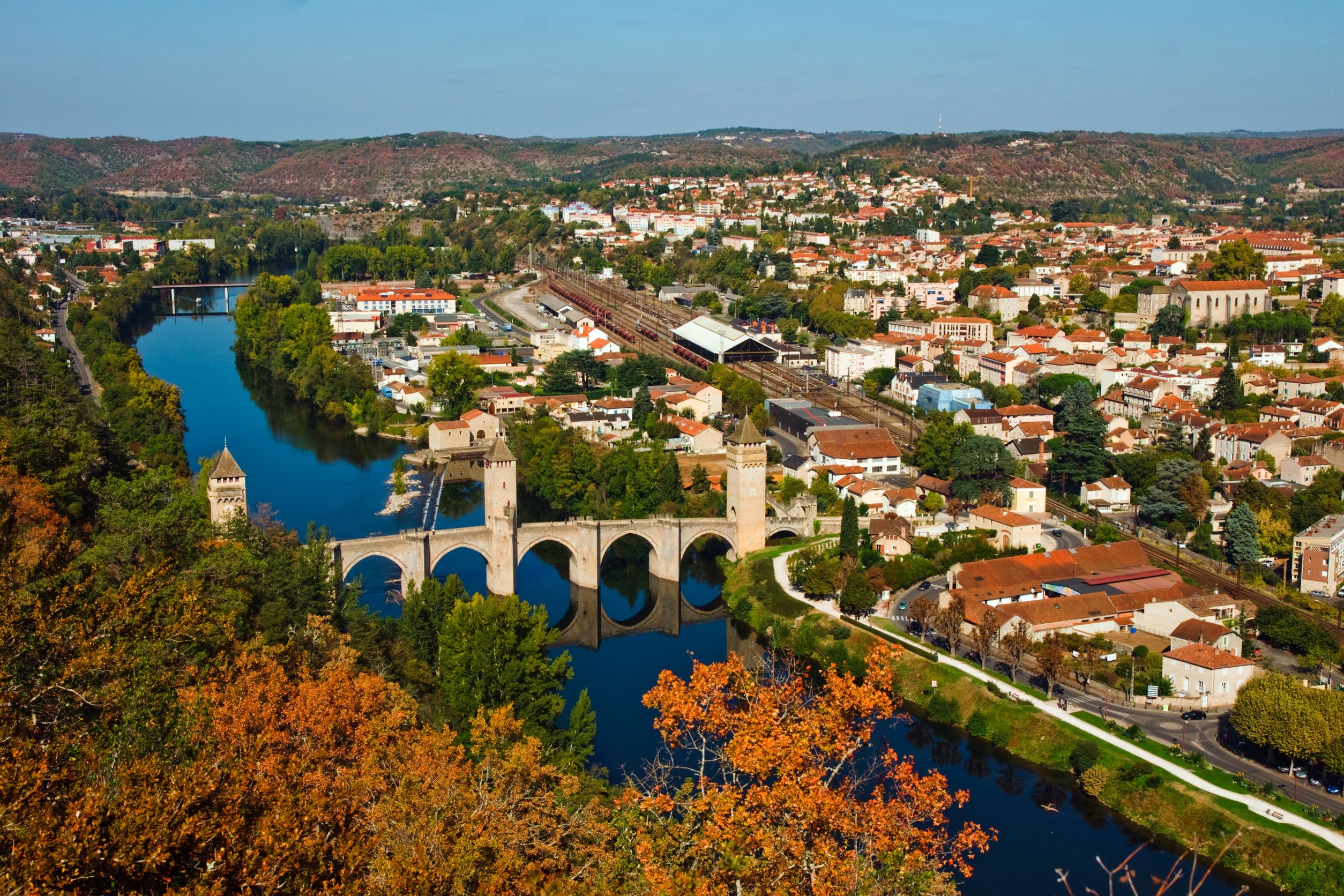
Panoramic view of Cahors, surrounded by the Lot River

Panoramic view of Cahors, surrounded by the Lot River

After leaving the town of Le Fel, the Lot River twists and turns through the hills, limestone plateaus, and valleys for about 70 more miles until it reaches the town of Cahors. Here, the Malbec-dominated vineyards of the Cahors AOC follow the twists and turns of the Lot River for over 25 miles. Cahors is a red wine-only AOC, producing the deep, dark, spicy wines known as the “Black Wine of Cahors.” Cahors AOC is produced using a minimum of 70% Malbec, with Tannat and Merlot allowed for the remainder.

The vineyards of Cahors are planted on two distinct soils; those closest to the river are planted on gravelly slopes, while those farther from the river are planted on the area’s limestone plateaus (known as the Causses). Wines produced using grapes planted on the limestone plateaus are known to be more tannic and austere, while grapes planted closer to the river produce wines that are fruitier and more approachable while young.

After the Lot River leaves the vineyards of Cahors behind, it continues to wind its way for another 60 miles before it reaches the town of Aiguillon. At Aiguillon (a commune of the aptly-named Lot-et-Garonne Department), the Lot River joins the Garonne River for its final journey through the vineyards of Bordeaux, into the Gironde Estuary, and finally out to sea.

Map of the Lot River by Lemen, via Wikimedia Commons

Map of the Lot River by Lemen, via Wikimedia Commons

References/for more information:

The Bubbly Professor is “Miss Jane” Nickles of Austin, Texas… missjane@prodigy.net
 

The Spirits of Galicia

...

If you visit Galicia (and you really should), you’ll probably want to stay in Santiago de Compostela. While you are there, you can backtrack along the final kilometers of the Camino de Santiago, and feel the amazement as the Cathedral—the final spot for so many who have traveled so far—comes into view.

You’ll definitely want to attend the mid-day Pilgrim’s Mass (where hopefully they will swing the botafumeiro—a gigantic incense burner, from the ceiling). After Mass, you might want to visit the Museum of the Galician People and the Galicia Contemporary Art Centre.

For dinner, wander around the old town and take your pick of the tapas bars. Be sure and sample the Caldo Galego, a traditional soup of potatoes, cabbage, and ham; and the Empanadas Galegas, which are typically baked into a large pie and cut into wedges. Treats for seafood lovers abound, but a plate of Pulpo Galego a la Ferira (octopus cooked whole and cut into bite-sized pieces) is the local favorite.

The next day, try to wake up early and take the train to Pontevedra. Once there, you’ll be in the heart of the Rías Baixas wine region and can easily visit several wineries with just a short drive, including my favorites Bodegas Martín Códax, Mar de Frades, and Bodegas Paco & Lola (where they make the famous “Polka Dot” Albariño).

...

One more thing: don’t miss out on the unique spirits of Galicia, most of which are based on the left-overs (pomace) of the outstanding wine production in the area. The pomace brandy of the area is known Orujo. Orujo (named after the Spanish word for pomace) is actually produced all over Spain, but has a special significance in the north of Spain.

Orujo de Galicia PGI: A regional version of orujo—Orujo de Galicia, produced in almost all of the wine areas of Galicia—has been awarded PGI status. Production methods for Orujo de Galicia vary, but the use of copper pot stills is traditional. Orujo, similar to Italy’s famous and popular grappa, may be produced in households, but there are over 85 commercial producers of the spirit.

Like most pomace brandies, Orujo is typically made as a somewhat fiery, raw, and unaged spirit. However, an aged version, known  as Orujo envejecido (aged Orujo), is oak-aged for at least one year in barrels of 500-liter capacity or smaller (or two years in larger barrels).

Three other PGI spirits—Aguardiente de Hierbas de Galicia, Licor Café de Galicia, and Licor de Hierbas de Galicia—are also produced in the area.

...

Aguardiente de Hierbas de Galicia PGI:  de Hierbas de Galicia PGI is a flavored spirit produced using Orujo de Galicia as the base spirit. It is created by soaking (macerating) a variety of herbs in the Orujo, by the re-distillation of the Orujo in the presence of herbs, or a combination of these procedures. According to the PGI regulations, Aguardiente de Hierbas de Galicia PGI must be produced using at least three different herbs or botanicals. Any herbs that are suitable for food may be used, but peppermint, chamomile, lemon verbena, rosemary, oregano, thyme, coriander, saffron, orange blossom, fennel, licorice, walnut, nutmeg and cinnamon are among the most widely used. Aguardiente de Hierbas de Galicia PGI usually has a clear, light-green color and must have no more than 100 g/L of sugar.

Licor de Hierbas de Galicia PGI: Licor de hierbas de Galicia is produced using a base of Orujo de Galicia, although neutral spirits are allowed as well. It must be bottled at a minimum of 20% abv and contain at least 100 g/L of sugar (making it technically a liqueur). The color ranges from straw yellow to light yellow-green. Licor de hierbas de Galicia must be flavored using at least three types of herbs, although many versions contain a dozen or more more.

Licor Café de Galicia PGI: Café de Galicia PGI is produced using Orujo de Galicia as its spirit base, but neutral spirits are also allowed. This is a sweetened spirit (liqueur) flavored with roasted coffee beans. Licor Café de Galicia may be produced via maceration, re-distillation, or a combination of methods, and must contain a minimum of 100 g/L of sugar.

...

When in Galicia: In addition to being served straight, on the rocks, or in a variety of cocktails, Orujo de Galicia is used in a regional beverage known as queimada.  Queimada is made with orujo, sugar, lemon peel, cinnamon, and coffee beans. The ingredients are poured into a clay pot, set aflame, stirred until the blue flames die out, then ladled into ceramic cups. The sharing of queimada is accompanied by the recitation of an incantation (which is often described as a “spell” of protection against witches and things that go bump in the night). The sharing of the queimada is based on Celtic lore and considered a part of Galician tradition.

References/for more information:

The Bubbly Professor is “Miss Jane” Nickles of Austin, Texas… missjane@prodigy.net


WineGeo: The Massif Central

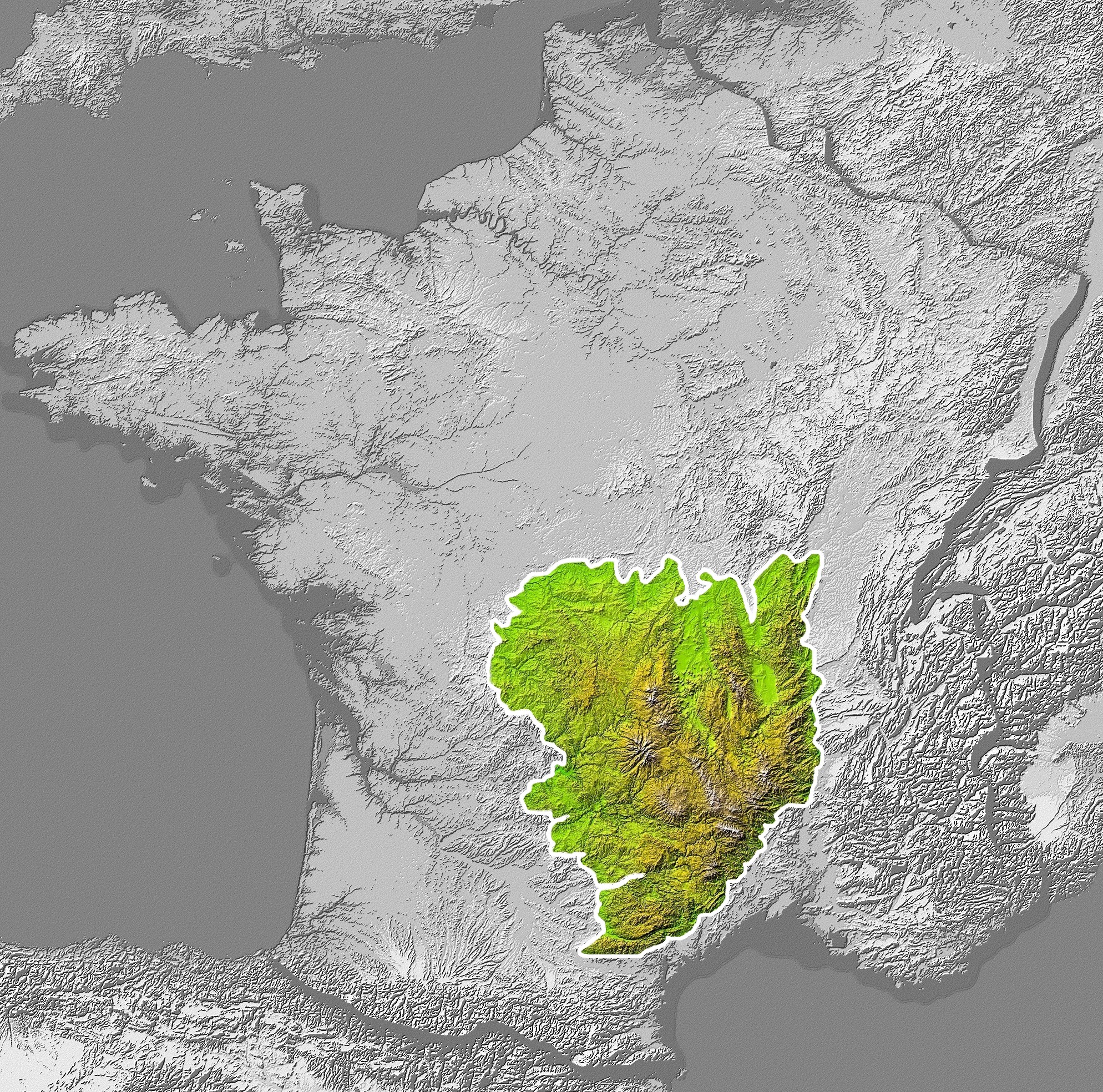
Map of the Massif Central by Technob105, via Wikimedia Commons

Map of the Massif Central by Technob105, via Wikimedia Commons

As a wine lover, surely you have heard of the Massif Central. It’s that big uplift in the middle of France. Except that’s not exactly true…

The Massif Central is actually located in the south of France; but fairly well centered on the east-west axis—just take a look at the cool map. Its boundaries sound familiar to wine lovers: it fills the area between the Loire River Basin to its north, the Mediterranean coastal plains of Languedoc to its south, the lowlands of Aquitaine to the west, and the Rhône-Saône River valley to the east.

Most of the area within the Massif Central consists of rugged mountains, fertile valleys, and forests—about 35% of the area is forests. The rest of the land is open countryside and farmland, much of which supports three brands of cattle (Limousins, Aubracs, and Salers) as well as Lacaune Sheep—famous for producing the milk that will become Roquefort Cheese. A few small towns dot the middle of the area, and three cities—Saint Etienne, Clermont Ferrand, and Limoges—are located near the edges.

The outline of the area, which does not conform to any political or regional boundaries, is considered to be demarcated by the contour line of 1,000 feet (300 m) above sea level. Most of the land sits at an altitude of about 1,640 feet (500 m). The Massif Central stretches over 200 miles from north to south, and about 175 miles (at its widest point) from east to west. This is a large area—all told; it covers about 15% of France. It is also the third highest mountain range in France, thanks to the 6,190-foot (1,885-m) summit of Puy de Sancy.

The town of Navacelles, in the Massif Central

The town of Navacelles, in the Massif Central

Many famous wine-related rivers have their source in the Massif Central. These include the Lot and the Tarn—both tributaries of the Garonne; as well as the Dordogne, the Cher, and the Loire.

Some vineyards are tucked around into the valleys and the outskirts of the uplift. One of these, the Côtes de Millau AOC, is the easternmost of the South West France AOCs. It is located in the south of the Massif Central in and around an area known as Causse du Larzac—a limestone karst plateau situated between the towns of Millau and Lodève. Karst is a landscape formed from the dissolution of soluble rocks, such as limestone, and the deep valleys and gorges here were created over the millennia as the Tarn River cut a series of paths through the limestone. Most of the Côtes de Millau vineyards are planted on steep, terraced slopes in the deep valleys of the Tarn.

The Côtes de Millau AOC produces red wines (dry), white wines (dry and off-dry), and rosé (dry and off-dry). The reds are blends, based on a minimum of 30% Syrah and 30% Gamay, 10% to 30% Cabernet Sauvignon and an allowed splash (max 20% each) of Fer and Duras. Rosés are based on a minimum of 50% Gamay; Cabernet Sauvignon, Duras, Fer, and Syrah are also allowed. White wines are made with a minimum of 50% Chenin Blanc and a minimum of 10% Mauzac.

The Millau Viaduct

The Millau Viaduct

If you’d like to visit the wineries of the Côtes de Millau, you’ll need to transverse the Tran River Gorge. Have no fear, you can drive across via the A75 highway on the cable-stayed Millau Viaduct bridge, and when you do, you’ll be on the tallest bridge in the world. The height of the tallest mast is 1,125 feet (343 m) and the bridge deck is 890 feet (270 m) high. If you are bothered by heights, it might be best not to look down.

References/for more information:

 The Bubbly Professor is “Miss Jane” Nickles of Austin, Texas… missjane@prodigy.net