The Valentine’s Day “Secret Weapon” Wine


The Valentine’s Day “Secret Weapon” Wine


My favorite wine for romance is Brachetto d’Acqui DOCG. Use any brand you like but the absolute romantic-est is Rosa Regale by Banfi Vintners.  Just look at it…the bottle is elegantly shaped, the clear glass means you can see the beautiful clear garnet-red color of the wine, and as if that weren’t enough to make it just sing “Valentine!” the black and gold label has a picture of a red rose!


This is the everybody loves it wine of your dreams.  From Piedmont, Italy and grown in the company of some mighty heavy hitters, Brachetto is the wine to bring on a date.  Trust me on this one.


This wine has all the ingredients you need in a romantic wine …it’s pinkish-red, bubbly, lightly sweet, a perfect match for chocolate and low in alcohol.  Wink, wink, that low in alcohol bit will come in handy in case the date is a success.  As if that weren’t enough, the slight sweetness in this wine and the raspberry-strawberry flavors make it a perfect match for milk-chocolate dipped strawberries…imagine the possibilities.


The aromas of this wine are easily recognizable and always consistent—the first to hit are fruity scents of raspberry and strawberry, followed immediately (sniff above the rim of the glass) by a strong scent of rose perfume.  I have been known to describe this aroma as a haunting memory of roses, rose-honey potpourri, or wedding bouquet.


I tell my students that this wine can be the center of a picture-perfect seduction—the Valentine’s Day Secret Weapon—if they will just do this: First, make some hand-dipped milk-chocolate strawberries. Put them in a pretty box and show up for your date with the strawberries and a bottle of Brachetto. After your sweetheart opens the door, say, “Hey baby, I’ve got the bubbly and the chocolate strawberries … everything you wanted for Valentine’s Day.” If your gal (or guy) is anything like me, they’ll say “Oh yeah? Where are my roses???” to which you reply, “In the bottle, baby … in the bottle.”


After you demonstrate the roses in the wine aromas, the rest is up to you!


Happy Valentine’s Day to All – and if you happen to find yourself on your own this year, buy yourself a bottle of Brachetto d’Acqui, and repeat after me, “who cares!”

The Bubbly Professor is “Miss Jane” Nickles of San Marcos, Texas… missjane@prodigy.net

Spotlight: Re-write (Tips for Transforming your Mangled, Messy Notes into an Awesome Study Tool)

In all my years of teaching, I have found that the students who claim to have “studied really hard” and yet fail to reach their goals have one thing in common: they did not take notes. They may have re-read the text a thousand times, dried up a hundred highlighters, and listened to a year’s worth of podcasts—but they did not take notes.

Here at the Bubbly Professor, we believe strongly in the power of notes. It starts with a proper reading of the textbook (ideally before you attend a class or webinar on the subject matter)—and taking written notes.

In this article, we’d like to offer up a few ideas on another best practice: the re-write. Used properly, a re-write (or three) can transform your notes—even if they started out as a mangled mess of scribbles—into a streamlined study tool.

For starters, here are a few basic pointers:

  • Read over your notes two or three times before you attempt your first re-write. This will certainly give you a head start with memorization, but the real goal here is to ensure that you understand the context and see the “big picture” surrounding the information.
  • Use a fresh, designated notebook or file for your re-writes. You should expect this notebook or file to be highly useful during your revision.
  • Rewriting is not the same thing as re-copying. Your notes should be transformed in the re-writing process, and this will take some effort. This is especially important if you have made the mistake of taking liner notes—meaning you’ve copied something from the book or something that your instructor said basically word-for-word.

Idea #1: Create a Shrinking Outline: The first step in creating a shrinking outline is to re-write your notes into outline form—your first outline. Start by identifying the key concept in a section of your notes and—using the key concept as your section header—add the supporting details. Make sure that you paraphrase the pertinent information in clear, simple terms and in your own words.

Study this outline for a few days (or weeks, or whatever your timeline allows), and then create your second outline. Shrink this outline so that it includes just the key concepts and eliminates the supporting details. When studying from this outline, use active recall to fill in the supporting details. Refer back to the first outline to judge your progress.

Your third (and perhaps final) shrinking outline should contain just a list of prompts or key words. This final outline might remind you of the process of creating a deck of flash cards (and once completed, it may be used in the same way). Use this outline for self-testing, once again referring back to your first outline to make sure you’re capturing all the information that you want to learn.

Idea #2: Create Cloze Exercises: Don’t be frightened off by the obscure terminology: a cloze exercise is just a fill-in-the-blank exercise. (The terminology is believed to have been derived from the law of closure, as used in Gestalt Theory.)

Despite the weird-sounding name, cloze exercises can easily be created via a re-write—and they are an excellent study tool.

To create cloze exercises, follow the steps outlined above to create your first set of outlined notes (alternatively, you could start with your messy, mangled notes if they are clear enough). Re-write your notes or your outline leaving out the key words or phrases that you’d like to commit to memory. Put the answers on a separate page. If you are typing your notes, create a new file and blank out the key words; your original file can serve as the answer key.

Here are a few examples:

  • The main grape of the Chianti DOCG is _______________________; which must comprise a minimum ________________ of the finished wine.
  • The only EU country to have an AOC-designated rum is _______________; the name of this product is __________________.

One of the reasons that fill-in-blank notes are so effective is that they allow you to use the awesome power of the active recall study technique.

TL/DR: Please take notes. Re-write them effectively. Use them for revision. They can—and should—be one of your best study tools!

The Bubbly Professor is “Miss Jane” Nickles of Austin, Texas… missjane@prodigy.net

Confusion Corner: Saint-Macaire

.

Saint-Macaire: It’s a grape, it’s a place, it’s an appellation…but despite the name of that appellation—Côtes de Bordeaux-Saint-Macaire AOC—it is NOT one of the sub-zones of the Côtes de Bordeaux AOC. As such, Saint-Macaire is a perfect subject for Confusion Corner!

Let’s take a look at the many faces of Saint-Macaire:

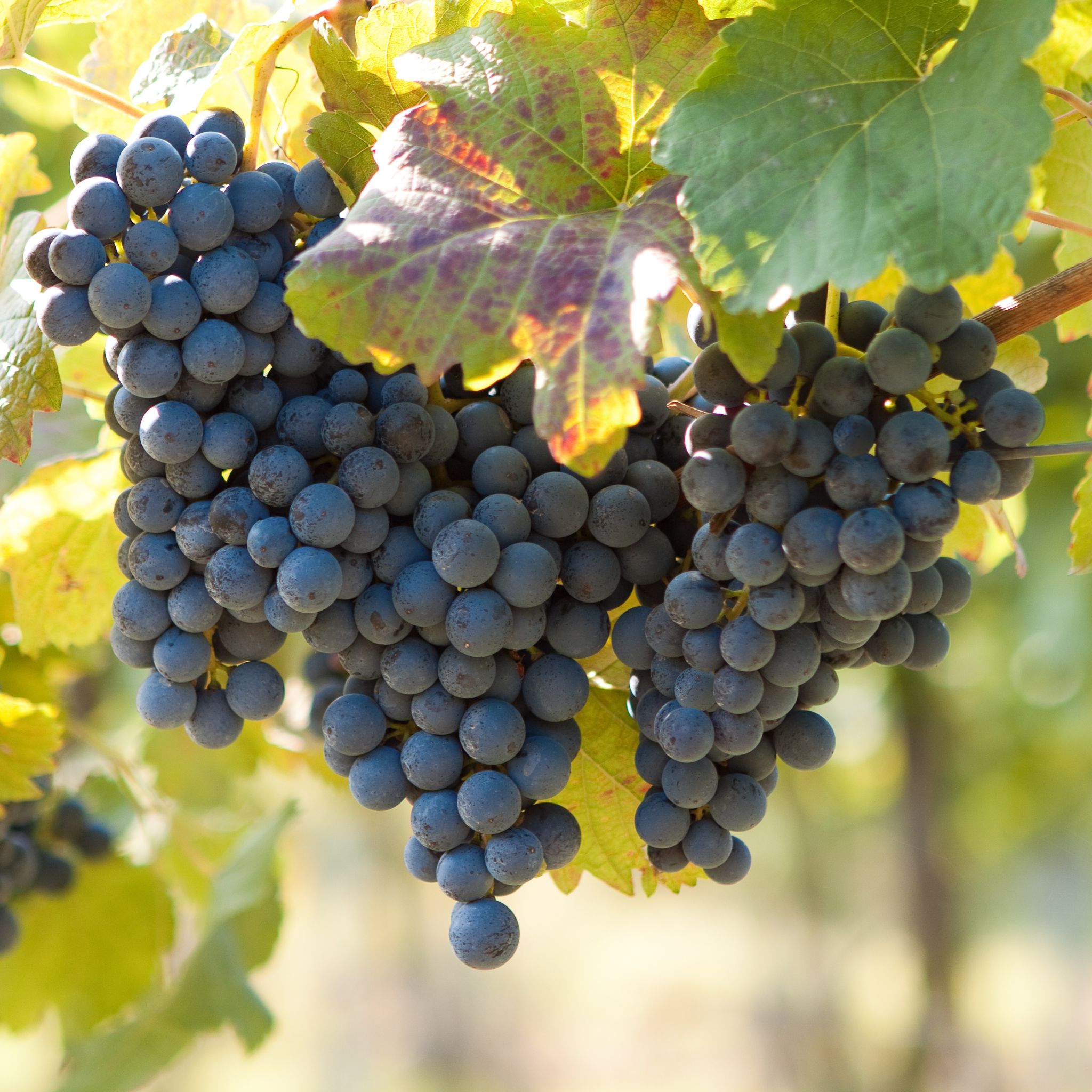
It’s a grape: Saint-Macaire is a super-obscure red grape, believed to have originated somewhere in the area around Bordeaux. It was once-upon-a-time grown in small amounts on Bordeaux’s Right Bank and known for producing soft, fruity wines with a good snap of acidity and a deep red color. However, the grape was not widely re-planted in Bordeaux in the years following phylloxera and eventually, it was nearly forgotten.

Official statistics tell us that these days, only about 1 hectare of Saint-Macaire remains planted in all of France. It is not approved for use in any of the modern AOCs of Bordeaux—including its namesake, the Côtes de Bordeaux-Saint-Macaire AOC—but it may end up in the wines of the Atlantique IGP or a Vin de France.

.

Outside of France, there are a few estates in California that grow Saint-Macaire—these include O’Shaunessy Estate Winery in Napa’s Howell Mountain AVA and Sonoma’s Hanna Winery. Due to its historic stature as a lost grape of Bordeaux, Saint-Macaire is included in the list of grapes approved to be used in Meritage—as defined by the Meritage Alliance—and once in a great while, I’ll find it listed on a Meritage label.

Australia’s Calabria Family Winery (formerly known Westend Estate) grows a few acres of Saint-Macaire in Victoria—and is believed to be the only estate in Australia growing the grape.

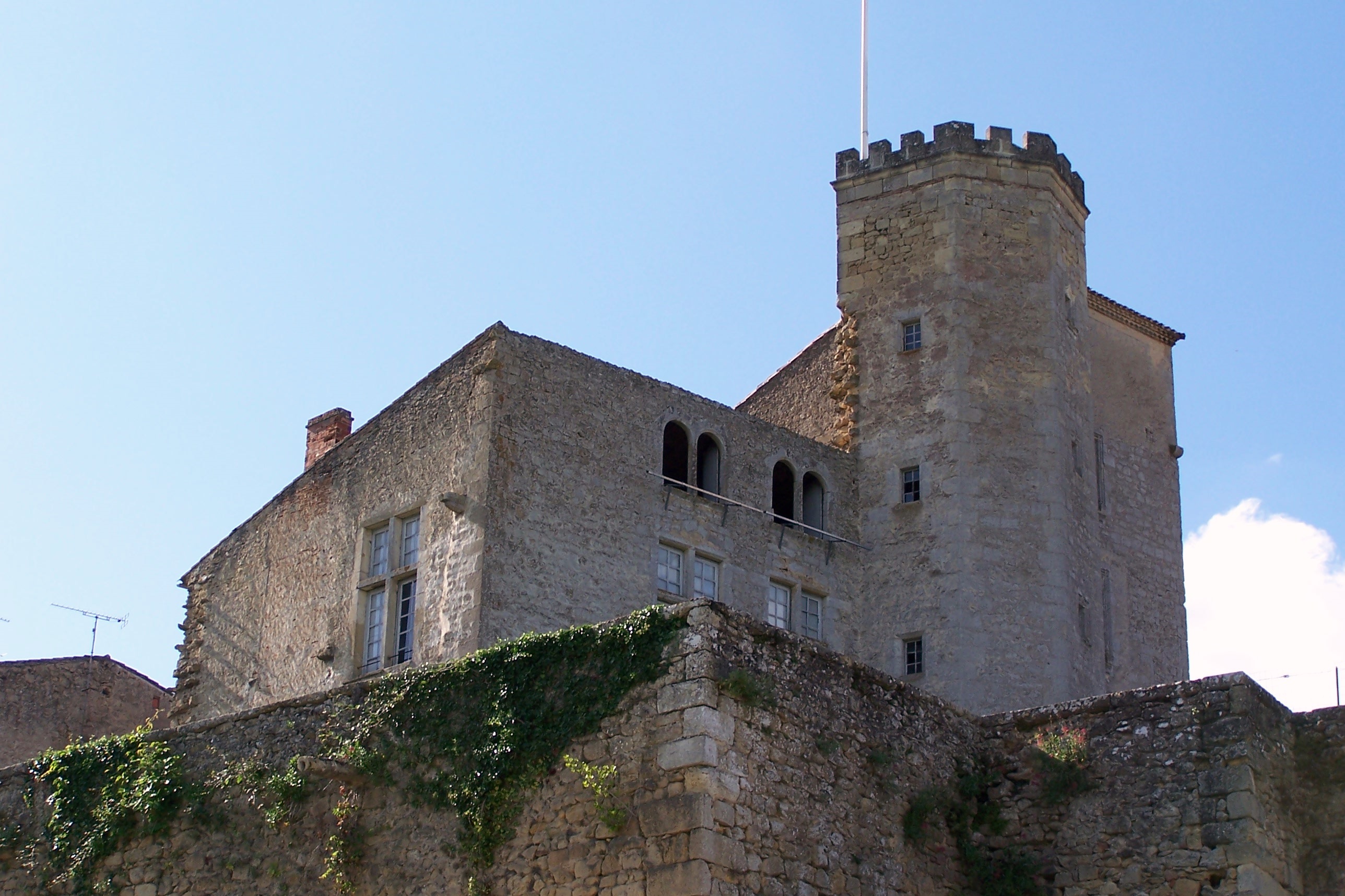
It’s a place: Occupying a 2-mile (3-km) stretch of the northern bank of the Garonne River in France’s Gironde Department, Saint-Macaire is a tiny commune (population: 1,196).  In addition to its vineyards (planted mainly to Muscadelle, Sauvignon Blanc, and Sémillon), the area’s claim to fame is the Château de Tardes, a Monument Historique (national heritage site) and castle dating from 13th century. The building was rebuilt—complete with a hexagon-shaped tower and spiral staircase—into a Renaissance-style mansion in the centuries that followed.

Photo of Château de Tardes by Henry Salomé via Wikimedia Commons

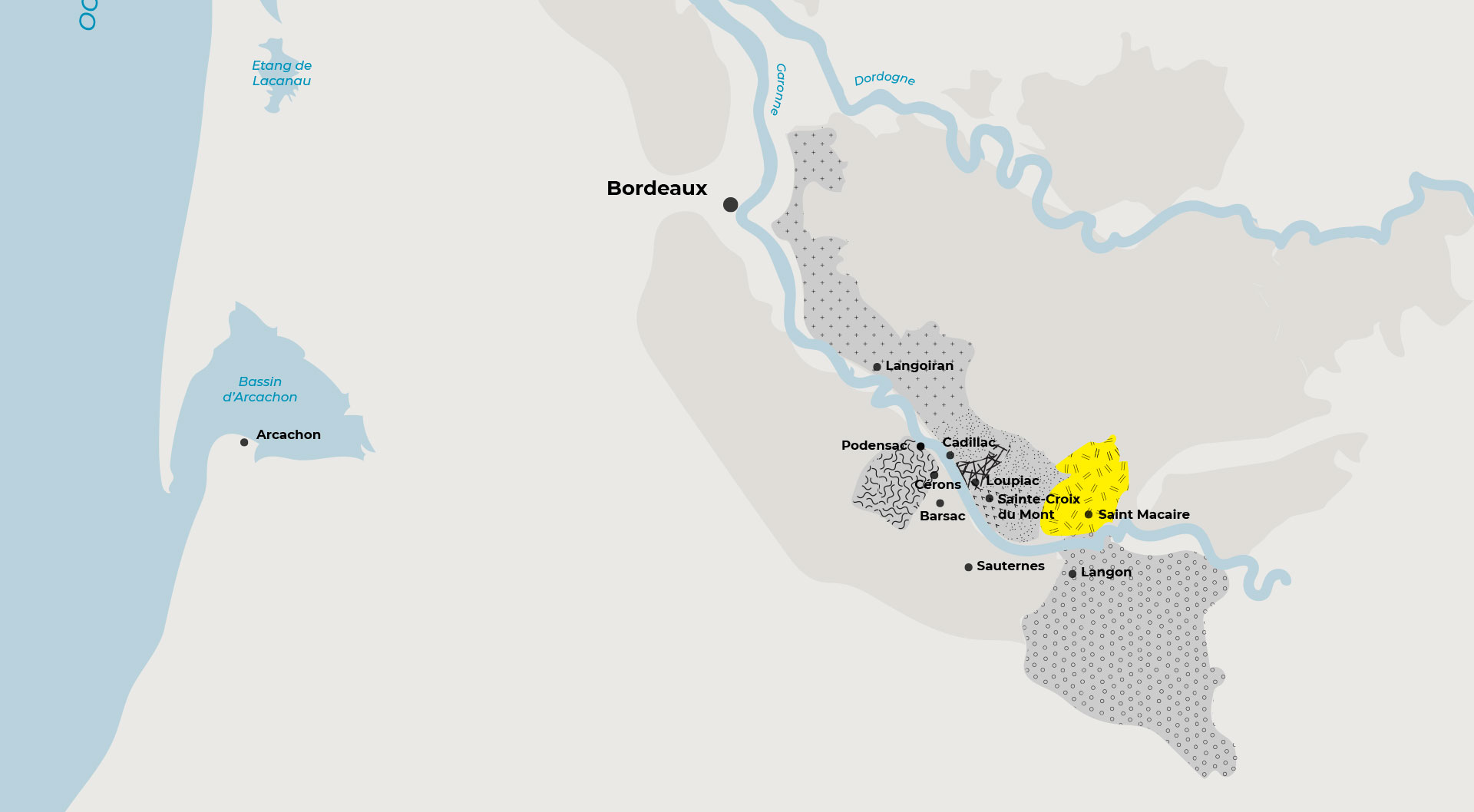
It’s an appellation: Nestled between the Garonne River and the surrounding Entre-Deux-Mers AOC, the Côtes de Bordeaux-Saint-Macaire AOC is located on the softly rolling (south-facing) hills found along the eastern edge of Bordeaux. The Côtes de Bordeaux-Saint-Macaire AOC is approved for the production of white wines only. Dry wines are allowed and are defined as having less than 4 g/L (0.04%) of residual sugar. However, the area is best-known for its sweet (moelleux) and even sweeter (liquoreux) versions of white wines. Produced using ultra-ripe grapes (often affected by botrytis or allowed to dry after harvest), the sweet wines of the area known for notes of ripe pear, toasted almonds, bees wax, tropical fruit, dried apricot, honey, and fig.

It is NOT one of the sub-zones of the Côtes de Bordeaux AOC: Despite the similarity in their names, the Côtes de Bordeaux-Saint-Macaire AOC is not a sub-zone of the Côtes de Bordeaux AOC. The Côtes de Bordeaux AOC, established in 2009, has five sub-zones—Francs, Cadillac, Castillon, Blaye, and Sainte Foy—all of which are located quite close to Saint-Macaire. Each of these subzones may append their name to the “Côtes de Bordeaux AOC” title; this means that the name of wine bottled under the Francs subzone (as an example), could be listed as “Francs—Côtes de Bordeaux AOC.” And thus, the confusion reigns.

However, Saint-Macaire has not joined the the club of the Côtes de Bordeaux AOC. One clear definition between the appellations is that the Côtes de Bordeaux AOC (and its five sub-zones) are all approved for the production of red wines, while the Côtes de Bordeaux-Saint-Macaire AOC is only approved for white wines. (Note: Three of the Côtes de Bordeaux subzones—Francs, Blaye, and Sainte Foy—may produce white wines in addition to reds.)

Map of the Côtes de Bordeaux-Saint-Macaire AOC via http://www.sweetbordeaux.com

Hopefully, this post cleared up some of the confusion regarding Saint-Macaire. It’s really quite simple: Saint-Macaire is a grape, a place, and an appellation—but it is not one of the sub-zones of the Côtes de Bordeaux AOC, despite sharing the good portion of a name and being located in a similar spot.

Any questions?

References/for more information:

The Bubbly Professor is “Miss Jane” Nickles of Austin, Texas… missjane@prodigy.net

Zonda, Diablo, Nor’wester, Chinook: The Foehn Winds of Wine

Advanced students of wine can name them: the Zonda winds of Argentina, New Zealand’s Nor’westers, California’s Diablo, and the wild Chinook winds of Oregon. These are foehn winds—warm and dry, sometimes fierce and hot—that periodically rush down the leeward side of a mountain range after the air has dropped its rain on the windward side and climbed up and over the peaks.

Other areas in the wine-producing world that are affected by foehn winds include Alsace, the Jurançon (Southwest France), Switzerland, Washington State, northwest Italy, Catalonia, Lisboa (Portugal), Cotnari (Romania), Valencia, and Málaga. To simplify the concept, think of it this way: any place that benefits from a rain shadow provided by a large mountain (or mountain range) can also be in the line of fire for the foehn.

The well-known Zonda wind of Argentina, experienced most acutely in Mendoza, La Rioja, and San Juan—where the Andes reach their highest peaks—is the perfect, illustrative example. It all begins with the cool, humid breezes off the Pacific Ocean that head towards Chile, coming in from the west. As they reach the shore, they drift inland along Chile’s numerous river valleys, allowing the fog and cool air to penetrate inland. Eventually, the air mass bumps up against the Andes and begins to drift higher and higher.

As the air lifts, it expands and cools. Clouds begin to form as the air becomes laden with water vapor. As the clouds become saturated, the moisture condenses, and it begins to rain or snow. This activity allows for the release of latent heat, and by the time the air mass reaches the peak of the mountain it is cool and dry.

Above the mountains, the wind can be bounced about by mountain air waves—changes in the air flow sometimes referred to by the frankly terrifying name the turbulent vortex—and flung downward, assisted by variations in air pressure.

As the air rolls downhill, it quickly warms up, assisted by the warmth on the ground and the sunshine on the leeward side of the mountains.  Further downslope, the increase in air pressure coaxes even more heat into the air and by the time it reaches the foot of the mountains, it is warm, dry, and ready to roll.

Foehn winds can be beneficial to vineyards; a nice, warm breeze can reduce the risk of mold- or fungi-related vine diseases, and otherwise help keep a vineyard healthy and dry. However, In the extreme, a foehn wind can shake, rattle, and roll a vine enough to cause physical damage. If the wind lasts for more than a few days (which is not unusual), the vineyard’s human inhabitants often complain of nervousness, headache, difficulty sleeping, and irritability.

Another good reason to keep your eye on the weather!

Note: Foehn winds were first studied in the European Alps, and are often referred term as föhn winds, after the original German.

References/for more information:

The Bubbly Professor is “Miss Jane” Nickles of Austin, Texas… missjane@prodigy.net

Make it Meaningful to Make it Memorable (ft. The Chianti Seven)

.

As a wine student, you have most likely memorized the seven subzones of the Chianti DOCG—and somewhere along the way, you got it through your head that Chianti Classico does its own thing and is NOT one of the seven. For your next trick, you probably learned where to find each subzone on the map.

Or…at least that is the way my studies progressed. I was well-armed with flashcards, wine maps, and a power point slide with seven distinct bullets—one for each of the not-so-famous subzones of the Chianti DOCG.

Despite endless repetition, I had a hard time memorizing the seven subzones of Chianti (much less locating them all on a map). My mistake, of course, was trying to memorize a list of terms without any meaning or familiarity behind them. However, once I learned each area’s “back story,” memorizing the terms—and locating them on the map—was a breeze!

The moral of my story is: make it meaningful to make it memorable. Your brain loves (and finds it easy to remember) information that is ripe with narrative and meaning. Your brain hates (and tends to forget) lists of words, terms, or sounds that lack context.

Here is some of what I learned about the subzones of Chianti, many years ago. I still remember it to this day.  

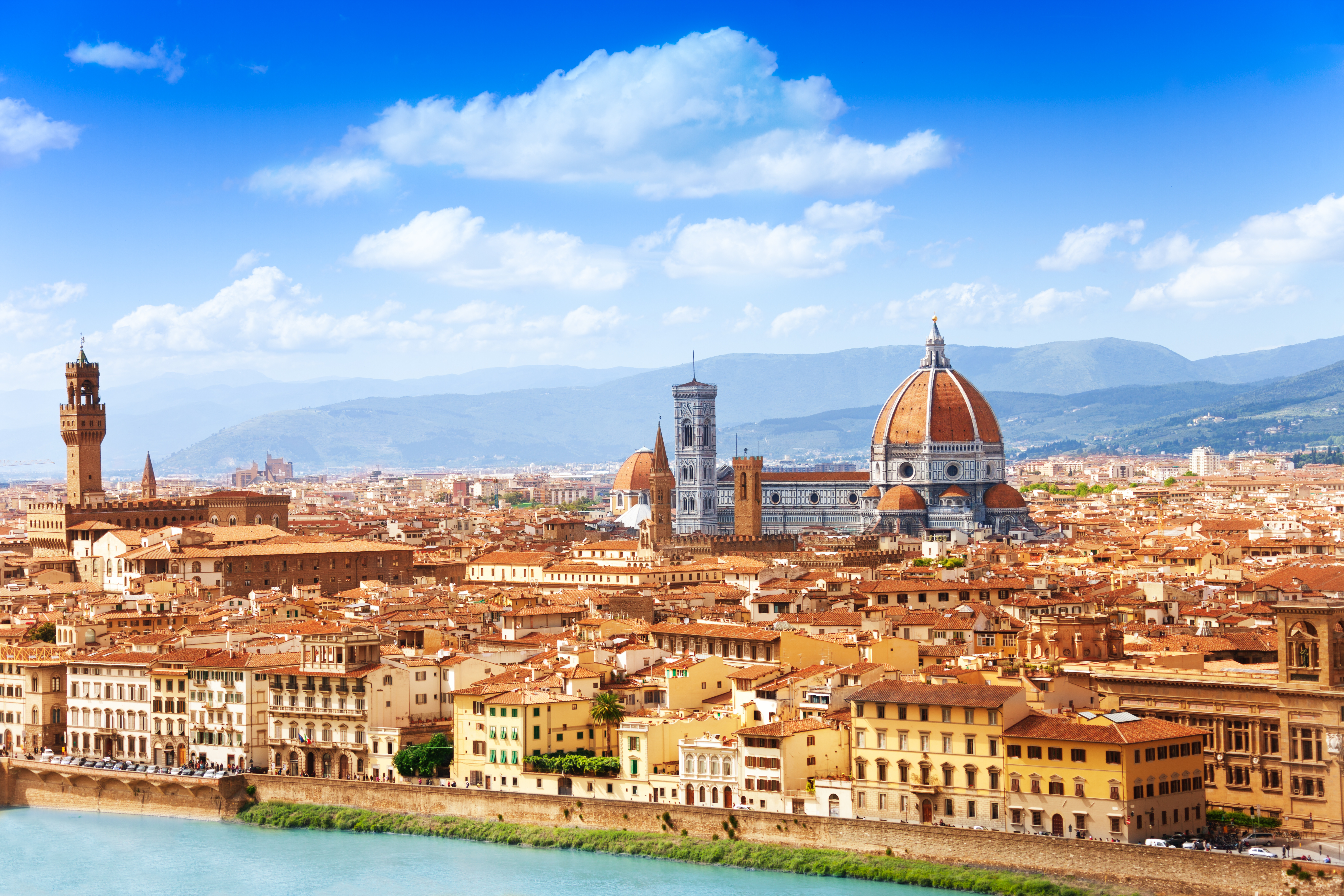
Cityscape of Florence with the Arno River in the foreground

Four of the seven subzones are grouped around the city of Florence, so we will start there:

Colli Fiorentini:  This area—translated as and encompassing the hills around Florence—surrounds the southern edge of the city of Florence. This is one of the northernmost areas of the Chianti DOCG. The vineyards of Colli Fiorentini are generally planted on the south-facing slopes of the rolling hills of the area; and may reach as high as 1,000 m (300 ft). The zone also includes some low-lying land in the valleys of the Pesa and Arno Rivers. This is one of the lesser known of the Chianti sub-regions, and much of the wine produced from the Colli Fiorentini vineyards ends up being served—by the glass or carafe—in the cafes and restaurants of Florence.

Montalbano: This subzone is named for the Montalbano Hills—a low chain of hills located to the north/northwest of the city of Florence. The Montalbano zone—located towards the northern end of the Chianti DOCG—overlaps the Carmignano DOCG. Vines used for Chianti Montalbano tend to be planted on the western side of the hills (where the soil is more sandstone), while the Carmignano DOCG is located on the eastern side of the zone—where the soil is richer in limestone. As such, wines labeled under the Chianti-Montalbano DOCG tend to be lighter and fruitier in style than those produced in some of the more inland areas. This region famously includes the town of Vinci—where Leonardo di Vinci once lived.

.

Montespertoli:  Montespertoli is the newest of Chianti’s official subzones, having been designated as such in 1997. Before that, it was part of the Colli Fiorentini region. Named for the town of Montespertoli—located about 12 miles/20 km southwest of the historic center of Florence—this is the smallest of the chianti subzones in terms of acreage. The area is known for its rolling hills, well-drained limestone soils, and abundant sunshine—all of which help to produce well-ripened grapes and lush, balanced wines.

Rufina:  Rufina—undoubtedly the most famous of the Chianti subzones—is located in the foothills of the Apennines, east of the city of Florence. Rufina overlaps the Pomino DOC and is differentiated from most of the rest of the Chianti DOCG by its inland location. Likewise, Rufina experiences more continental influences on its climate and can claim some of the region’s highest elevations: vineyards here are planted as high as 1,600 ft /500 meters (higher than the average of the rest of the region, including Chianti Classico at 1,000 ft/300 meters). The high elevation of the area’s vineyards lend an excellent diurnal temperature fluctuation, and the area’s limestone-and-clay soils strike the ideal balance between excellent drainage and just enough water retention (making this area particularly drought-resistant).

  • The dueling republics of Florence and Siena famously solved their border dispute via a race between two knights on horseback, who each set off from their respective towns at the first crow of the rooster. The hungry black rooster of Republic of Florence famously arose before dawn, allowing most of the disputed land to be awarded before Florence. In honor of this event, the black rooster has been the symbol of the Consorzio of Chianti Classico since 1924. The rooster on our graphic map thus serves to remind us of Florence to the north, and Siena to the south.

Three of the seven subzones of the Chianti DOCG are located further afield from Florence:

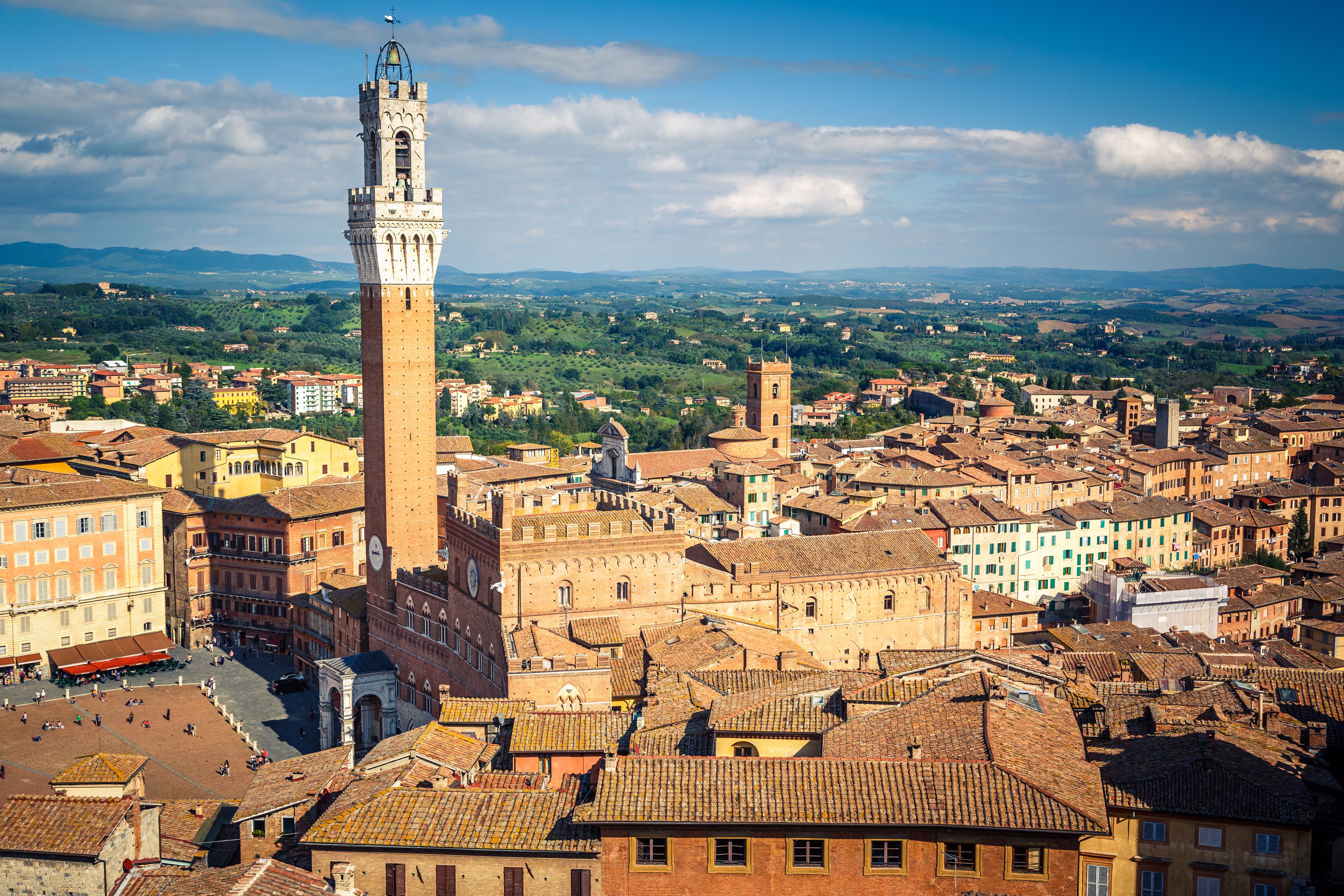
View over the city of Siena

Colli Senesi: The Colli Senesi subzone—located in the southern reaches of the Chianti region and spread out over three noncontiguous areas—is tucked into the hills surrounding the city of Siena. The area is considered one of the most prestigious of the seven subzones, which makes a lot of sense considering that it overlaps Montalcino, Montepulciano, and San Gimignano. It even has stricter standards than some of its kin, in a sense. For instance, wines of the Chianti DOCG require a minimum of 70% Sangiovese in the mix; in Colli Senesi, the minimum is raised to 75%. It also requires a higher level of alcohol (13% minimum abv) for its Riserva wines; Chianti DOCG and the other six subzones require just 12% or 12.5%.

Colli Aretini: The Colli Aretini zone is named for the hills of Arezzo. Arezzo—one of the 9 provinces of Tuscany—is located in the eastern part of Tuscany. The Colli Aretini encompasses the valley of the River Arno at the point where the river moves from its southerly course and takes a loop-de-loop turn to head north and west on its way to the city of Florence. This river valley keeps the region cool, as it allows the moderating influence of the Mediterranean Sea to penetrate inland. The zone does include some elevation—as high as 1,000 ft/300 meters in spots—on the hills that rise out of the Arno valley floor. The Chianti Aretini subzone is not particularly well-known; much of the vineyards of the area produce fruit destined to be included in wines labeled as Chianti DOCG.

.

Colline Pisane:  The Colline Pisane—the hills around Pisa—zone is located just south of the city of Pisa. This region is unique in that it is closer to the Mediterranean Se—and on a lower set of hillsides—than the rest of the Chianti region. It is also somewhat of an outlier—literally—in that there some distance between Colline Pisane and the rest of the Chianti subzones, all of which are connected. The area’s unique location (and terroir) helps to make the wines of the Colline Pisane quite distinctive. They are often described as lighter and softer than most, with a ruby-red color, floral (violet) aromas, and a distinctively fruity (as opposed to earthy) character— especially when young.

Note: In addition to the concept that making information meaningful makes it memorable, this post demonstrates chunking—a key principle of education and learning that I find particularly applicable to the study of maps and geography. More on that later!

References/for more information:

The Bubbly Professor is “Miss Jane” Nickles of Austin, Texas… missjane@prodigy.net