Confusion Corner: Côte des Bar, Côtes de Barr, Clos de la Barre
February 11, 2023 Leave a comment
 In the world of French wine, there are several different places that go by the name Bar (or Barr or Barre). They sound similar, they look alike (almost) on a wine label, but they are not at all the same. At least two are officially-designated appellations of origin; some are descriptive terms—well-accepted and widely used, but not granted any type of protected status under the law. Let’s take a look at three of these, spread out over Champagne, Burgundy, and Alsace—and collectively representing the three of the iconic styles of wine: red, white, and sparkling. Let’s dig a bit deeper in the Côte des Bar in Champagne, the Côtes de Barr in Alsace, and the Clos de la Barre in Volnay. Do you know which is which?
Alsace–Côtes de Barr AOC: The Côtes de Barr is one of the 13 official sub-appellations—dénominations géographiques complémentaires—of the Alsace AOC. Some of the Alsace sub-appellations are fairly well known—serious students of wine will no doubt recognize Klevener de Heiligenstein, Ottrott, and Saint-Hippolyte—however, the Côtes de Barr remains somewhat obscure.
 Located just south of the town of Heiligenstein and covering the entirety of the commune of Barr in the Bas-Rhin, the Côtes de Barr is sub-appellation is approved for white wines based on the Sylvaner grape variety only. Domaine Leipp-Leininger is a leading producer. Barr—despite its small population of 7,000—is considered one of the leading wine towns of the Bas-Rhin and is worth a tourist stop for its centuries-old half-timber houses, the Place de l’Hôtel de Ville (town square), Musée de la Folie Marco (museum housed in a 17th-century Alsatian villa), and the Chapel of Saint Martin.
In an eternal nod to the confusion of Confusion Corner, the commune of Barr is also home to the Alsace Grand Cru Kirchberg de Barr AOC. Named for the steep-sided slopes leading up to the Chapel of Saint Martin (the name Kirchberg is derived from hill of the church), the vineyards are largely planted to Gewurztraminer; although Riesling, Muscat, Pinot Gris, and Pinot Noir are represented as well. True wine nerds will recognize Kirchberg de Barr as one of the two Alsace Grands Crus recently approved for the production of Pinot Noir (red wine) under the Grand Cru label.
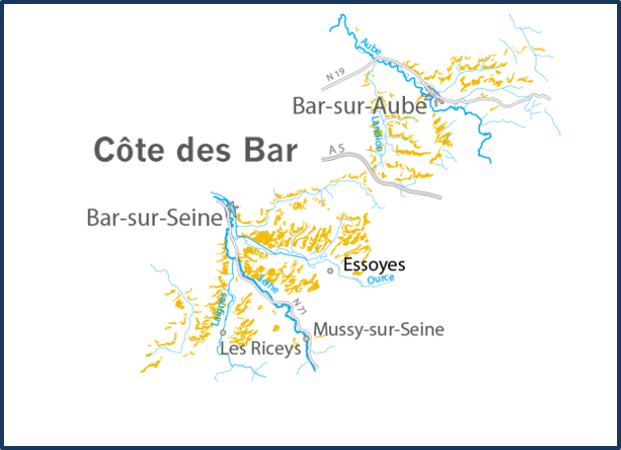
Map of the Côte des Bar via the Union des Maisons de Champagne
The Côte des Bar: While not an official sub-region, the Côte des Bar is one of the five informally grouped districts of Champagne and it is described on the appellation’s cahier des charges. This area—often referred to as the Aube, based on the area’s political department—is located well to the south of the other, more centralized vineyard areas of Champagne.
The Côte des Bar is named for two towns which are, in turn, named after the two main rivers—the Aube and the Seine—that run through the area. Bar-sur-Aube is located on the eastern side of the area, while Bar-sur-Seine is situated on the west. In the case of both of these towns, the name Bar is derived from an old Gallic term meaning summit or height.
The area is known for its band of Kimmeridgian soil (also seen in Chablis) as well as some outcroppings of Portlandian limestone. While all seven of the grapes of Champagne are grown in the Côte des Bar, a great majority—as much as 86% of the total vineyard acreage—is planted to Pinot Noir.
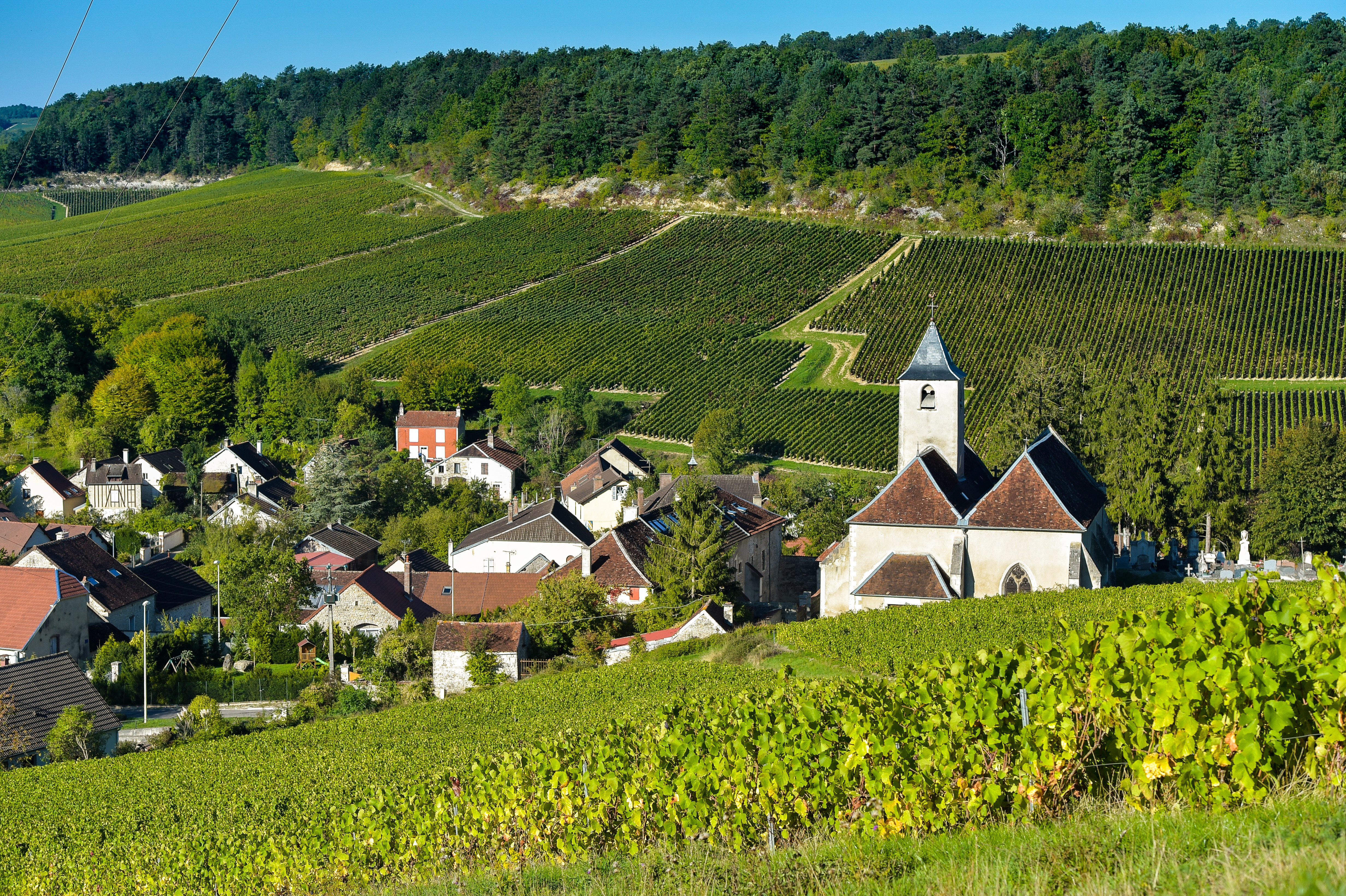 Volnay Clos de la Barre Premier Cru AOC: Clos de la Barre—barre being an Old French term meaning fence—is one of 29 designated Premier Cru vineyards located within the Volnay AOC. The Volnay AOC—including all 29 Premiers Crus—is only approved for red wine. The Clos de la Barre Premier Cru is a tiny appellation—totaling about 1.3 hectares/3.5 acres—situated just to the east of the village of Volnay. The vineyard is owned by one family and planted exclusively to Pinot Noir. These days, all the grapes are sold to Maison Louis Jadot, making them the sole producer of Volnay Clos de la Barre Premier Cru wines.
Note: for this article, I’ve only included mentions of the place-name Bar (or Barr or Barre) that are listed on an appellation’s Cahier des Charges. If there are more to be found, let us know!
References/for more information:
- Alsace AOC-Cahier des Charges
- Map of the Alsace AOC subregions via the INAO
- Map of the Alsace Grands Crus of the Bas-Rhin, via the INAO
- Champagne AOC – Cahier des Charges
- Volnay AOC – Cahier des Charges
- https://www.leipp-leininger.com/
- https://www.paysdebarr.fr/visiter/fr/barr-cite-viticole
The Bubbly Professor is “Miss Jane” Nickles of San Marcos, Texas… missjane@prodigy.net


 The Bubbly Professor