Can She Pair a Pumpkin Pie?

It is that time of year once again and everyone is talking about wine and Thanksgiving. For those of you who follow along, you know that the wine world has gone a bit crazy lately on the subject of food and wine. Some folks say there is just no such thing as food and wine pairing, and you should just serve what people like. Who can argue with that?

And then there is the crowd that insists that certain wines pair with certain foods and other pairings are just a disaster. Well, there’s something to be said for that as well.

So here is my latest take on the matter. I recently had the pleasure of presenting this information to several classes full of bright-eyed and interested wine students. As such, what follows is basically my outline for my 2024 Thanksgiving Wine and Food Pairing Class, that I call “Can She Pair a Pumpkin Pie”?

For starters, here are some basic concepts concerning food and wine pairing, and how they relate to our very American, very complex Thanksgiving Day feast.

#1: Never forget: Turkey is like Switzerland! What I mean by this is that turkey is about as neutral in taste and flavor as it gets, so in theory…. turkey should pair well with just about any wine.

#2: If you have bubbles, you’ll have no troubles. In other words, if you’d rather just not deal with any of these concepts or (what we used to call) rules, just serve bubbly and you’ll be fine. Bubbles just do not hit the palate as hard as other wines and simplify the entire match-up/meet-up between food and wine.

#3: You don’t pair to protein—you pair to preparation. This is where we start to get serious. Remember how we said turkey is neutral? Well, most proteins are…. before you cook them. So, the turkey (or chicken or cod) is not so important in the food and wine dance, but the way you cook them might make a huge difference. Think of the difference between grilled chicken, poached chicken, barbequed chicken, chicken piccata, and chicken with apricot sauce. In all of these instances, it is the preparation (particularly the sauce) that matters more than the protein.

#4: Consider weight, intensity, and complexity. I am going to be a bit contradictory here and say that the overall weight of the meal (basically based on the protein) should be taken into account when pairing your wine. Fish is typically light, so it pairs well with lighter wines. Red meat is typically heavy, so it pairs well with full-bodied wines. Turkey is typically considered medium weight, so most meals wrapped around turkey will pair well with medium-bodied wines (but can do just fine with lighter wines as well). And then there’s complexity…Thanksgiving meals with sauces and gravies and cranberries and marshmallows and green bean casseroles have a lot going on. They are the very definition of complex. This will be explained soon. Just hold on.

 #5: You don’t pair to flavor—you pair to taste. Here’s the deal. Taste components in food (salt, sweet, bitter, acid, etc.) will change the way you perceive the wine. This is consistent and predictable. Whether or not it is “good” (if you like it or not) is up to you. Flavors—such as cherry, berry, veggie, cocoa, and herbal—are pretty forgiving. You can mix and match flavors to your heart’s content. Tastes are where it’s at, so let’s dive into the taste components that are likely to show up at our table on Thanksgiving and see just how they will impact our perception of the wine we serve.

What tastes do we have here?

  • Salty foods at Thanksgiving:
    • Gravy, Stuffing, Green Bean Casserole
    • Potatoes au Gratin, Mashed Potatoes
    • Why this matters?
      • Saltiness is food is very forgiving…it will change wine, but it is almost always for the best.
      • The Food and Wine Truth: Salty food goes with just about any type of wine. Yeah! No worries.
  •  Sweet foods at Thanksgiving:
    • Cranberry Sauce, Sweet Potatoes, Glazed Carrots
    • Creamed Corn, Roasted Butternut Squash with Maple Syrup
    • Dessert! Pumpkin Pie, Pecan Pie
    • Why this matters?
      • Sweetness in food makes wine taste less sweet.
      • The Food and Wine Truth: Sweet food requires sweetness or fruitiness in wine; it will make the wine taste less sweet, less fruity, and more acidic. This is why earthy, dry, and tannic wines are (shall we say) challenging in the Thanksgiving line-up.
  • Acidic foods at Thanksgiving:
    • Cranberry Sauce, Salad/Salad Dressing
    • Relish tray (pickles, olives, tomatoes)
    • Why this matters?
      • Acidity in food makes wine taste less acidic.
      • The Food and Wine Truth: Acidic food requires acidic wine; acidity in food will make the wine taste less acidic. This can make the wine seem “flat” or “dull” if the wine is not super-zingy to begin with.

My ideal Thanksgiving wines? What does all this mean? Well….what we are looking for is a wine that is high in acid with lots of fruity flavors, dry (if red), dry-to-off-dry if white or pink, moderate in tannin (if red), with little or no oak influence. Or just serve bubbles. Need some examples? Of course you do! As such, here is my no-nonsense guide to Thanksgiving Day wine.

  • Bubbles or Rosé:
    • Just about anything goes!
  • White Wine:
    • Off-dry or fruit forward
    • Lively acidity, little or no oak
    • Any weight will work—from light-to medium- and full-bodied
    • Examples:
      • Riesling (dry to off-dry; Washington State, Germany, Austria)
      • Chenin Blanc (dry to off-dry; Vouvray is great!)
      • Gewurztraminer (dry to off-dry)
      • Unoaked Chardonnay
      • Viognier
      • White Rhône-style blends
      • Muscat (dry to off-dry or even sweet!)
  •  Red Wine:
    • (Light to) medium or medium-plus in body
    • Fruit forward, good acidity
    • (Light to) moderate in tannin and bitterness
    • Restrained oak
    • Examples:
      • Beaujolais (or other Gamay-based wine)
      • New World Pinot Noir (Oregon, Sonoma)
      • Old World Pinot Noir (Burgundy, Loire Valley, Germany)
      • Fruit-forward Zinfandel, Malbec, or Merlot
      • Grenache-based Rhône (or Rhône-style) blends
      • Barbera (unoaked)
      • Bonarda (from Argentina)
  • For dessert: something sweet!

 Whatever you choose, make sure it is something you enjoy and have a Happy Thanksgiving!

The Bubbly Professor is “Miss Jane” Nickles of San Marcos, Texas… missjane@prodigy.net

Five Fast Facts about Jumilla

The Jumilla (pronounced who-ME-ah) Denominación de Origen (DO)—a wine region tucked between Murcia and Castille-La Mancha inland from the Mediterranean Coast of Spain—is sometimes called Spain’s best-kept secret. While secrets are fun, it might be high time to give this ancient and hard-working wine region its turn in the spotlight.

Read on to learn five fast facts about the Jumilla DO!

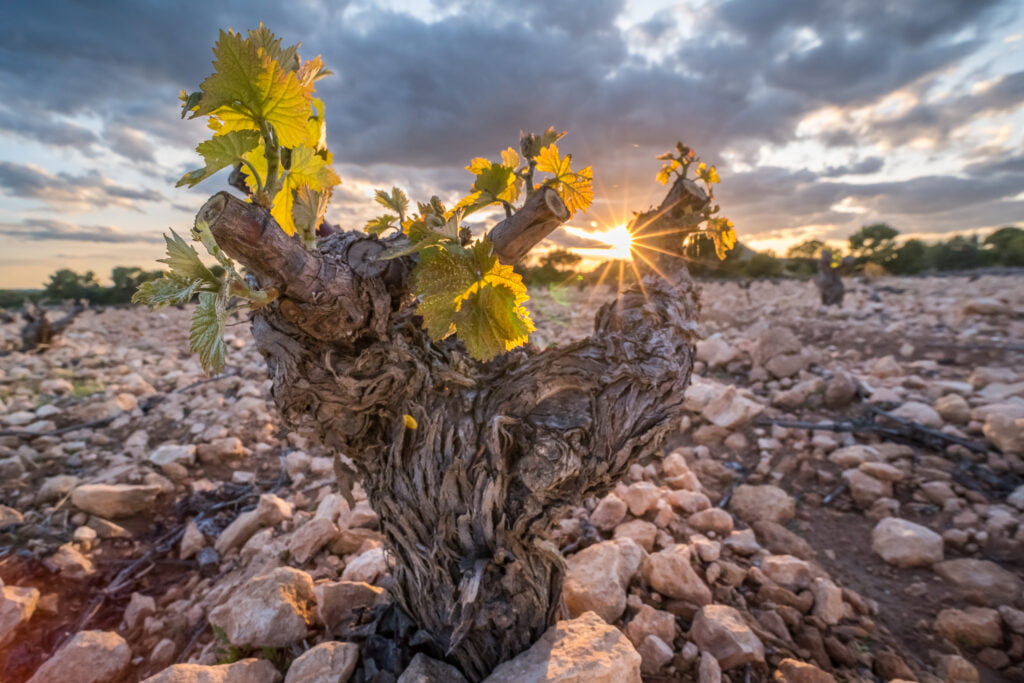
photo via: jumilla.wine/en/our-vines

#1: Gnarly Old Vines: Like its neighbors, the Jumilla DO is heavily focused on Monastrell. Monastrell—as the sturdy red Mourvèdre grape variety is known in Spain—accounts for over 80% of the vineyard plantings in the region.

Vines were established in the area over 2,500 years ago and due to the unique combination of soil and climate, the region is home to Europe’s largest collection of old-vine Monastrell…many vines are over 90 years old.

#2: Altitude High and Limestone Deep: The Jumilla DO has an arid but beautiful climate. It can be described as a rugged-and-hot Continental climate with some sunny Mediterranean influence closer to the coast. The area typically receives less than 12 inches of rainfall while enjoying over 3,000 hours of sunshine a year. Elevation also plays a role, with the majority of Jumilla’s vineyards planted at relatively high altitudes ranging from 1,150 feet to 2,625 feet asl. The mountainsides provide excellent drainage, fantastic capture of the sunlight (in the southern exposures), and a great diurnal temperature fluctuation. Underneath its high sky, the area’s soils are diverse but dominated by cool limestone bedrock topped with volcanic soils, gravel, sand and clay. These well-drained soils require the vines to dig deep in a search for water and help the vines to develop thick, structural roots—a key component in the long lifespan of many of these vines.

photo via: jumilla.wine/en/our-vines

#3: Rare Rootstock (Un-grafted Vines): Jumilla avoided Phylloxera (the dreaded pest that decimated the vineyards of Europe—and later the world—beginning in the late 19th century) for a long time. While the pest was (eventually) discovered in the area in 1989, by this time the world had learned a lot about how to handle it. As such, many of Jumilla’s ancient vines are un-grafted and remain planted on their original vinifera rootstock. This contributes to the unique character and authenticity of these wines and their rich, varietally-specific flavors. 

#4: Focused on Red (but that’s not all): While the area is heavily focused on red wines and Monastrell, it produces small amounts of white wine (based on a range of grape varieties including Chardonnay, Sauvignon Blanc, Airén, Macabeo, and Malvasía) as well as some crisp rosé and late harvest/dessert wines. Rosé and red blends may contain Tempranillo, Garnacha, Cabernet Sauvignon, and Syrah in addition to Monastrell.  In addition, a variety of aging regimes—from no aging at all to a quick nap in stainless steel to extended stays in oak—are used throughout the region. It’s a bountiful buffet of vinous goodness. 

Map of the Jumilla DO by Té y Kriptonita via Wikimedia Commons

#5: Jumilla Monastrell—Rich, Rustic, Rambunctious Red: Jumilla Monastrell is the big, bold red wine of your dreams. Look for high aromatic intensity (the aromas jump out of the glass), lots of red and black fruit flavors (blackberry, cherry, strawberry, red currant, and black plum) supported by some florality (think dried wild flowers), minerality (sniff the air after a good soaking rain), and dried herbs. Flavors of coffee and cocoa/chocolate often show up on the mid-palate. Oak-aged wines may also have some underlying sweet spice aromatics (licorice, nutmeg, cinnamon, and clove). No matter what the aging regime, this should be a rich, complex, and tannic wine with a loooooooong finish.

Leading producers of Jumilla DO include Ramón Izquierdo, Egobodegas, and Bodegas Juan Gil.

References/for more information:

The Bubbly Professor is “Miss Jane” Nickles of San Marocs, Texas… missjane@prodigy.net

Five Fast Facts about the Edna Valley AVA

Base map via the TTB AVA Explorer

I am teaching a wine and food pairing class this afternoon, which just happens to feature a lovely Pinot Noir from the Edna Valley. As such, today is a great day to look at five fast facts about the Edna Valley AVA!

#1: It’s named after a town: The Edna Valley AVA—located in California’s San Luis Obispo County—is named after the rural town of Edna (population: 193). Edna was founded in the 1880s by a dairyman Edgar Steele.

#2: Time and place: The Edna Valley AVA was established in 1982 as a sub-appellation of California’s larger Central Coast AVA. At this time, it was the first sub-appellation to be established in San Luis Obispo County. Other AVAs in San Luis Obispo later followed, including several which are much better-known than the Edna Valley; these include the Paso Robles AVA (and her 12 sub-appellations), the Arroyo Grande AVA , York Mountain, and the Templeton Gap. The Edna AVA became a sub-appellation of the San Luis Obispo Coast (SLO Coast) AVA once it was established in 2022. If you are hanging out in the Edna Valley AVA, you can practically wave “hello” to your friends at Cal Poly and drive the 5 miles to Pismo Beach in about 10 minutes. The Edna Valley AVA is often discussed in tandem with its neighbor-to-the-immediate south, the Arroyo Grande Valley AVA.

#3: It’s a cool-climate paradise: The Edna Valley AVA extends along a low-lying northwest-southeast canyon tucked into Santa Lucia Mountains.  The western edge of the Edna Valley AVA is located just about 7 miles from the coast and is situated at the southeast end of the Los Osos Valley. The Los Osos Valley extends all the way to Morro Bay and helps to keep the area cool—and only moderately sunny—by siphoning an influx of ocean breezes and maritime fog down into Edna Valley. Combined, these influences provide the Edna Valley AVA with an overall cool climate and a super-long growing season (some say it has the longest growing season of all of California).

#4: Agriculture is well-established: Many successful agricultural endeavors were established in the Edna Valley in the 19th century. These included some viticulture (Mission grapes) as well as dairy farms, orchards (apple, pear, and citrus) and oat and barley farms. These businesses thrived well into the 1970s, when vinifera-based viticulture and winemaking caught on.

#5: Come for the Pinot, stay for the Chardonnay: Accounting for just over 30% of total vineyard plantings, Pinot Noir is the most widely planted grape variety in the Edna Valley AVA. Chardonnay—planted in about 28% of the vineyards—comes in second place. Other notable varieties include Syrah, Sauvignon Blanc, Albariño, Pinot Gris, and Viognier. This is a gorgeous area for wine tourism and tasting (and don’t forget a quick detour to the beach). Welcoming wineries located in the Edna Valley AVA include Tolosa Winery, Saucelito Canyon, and Wolff Vineyards.

References/for more information:

The Bubbly Professor is “Miss Jane” Nickles of San Marcos, Texas… missjane@prodigy.net