Confusion Corner: Cadillac
January 21, 2025 Leave a comment
 It’s a place! It’s a person! It’s a car! It’s two separate AOCs! Cadillac—a word with many meanings—is long overdue for an untangle here in the Confusion Corner.
Since this is a wine blog, we’ll start with the town and the wines of Cadillac. But hang on for a great story about a character who crowned himself the Sire of Cadillac, and how this relates to the automotive legend known as the Cadillac Sedan.
The town—Cadillac, France: Cadillac—population: 2,800— is a small town (commune) in Nouvelle-Aquitaine, France. The town has history: it was established in 1280 by Jean I de Grailly—a senior official of the Duchy of Gascony—in order to provide river access for the Château de Benauge. These days, the small town serves as an excellent home base or stop-over for a wine tour of Entre-Deux-Mers, the Médoc, and Graves; and you can visit the imposing Castle of the Dukes of Eperson (Château des ducs d’Épernon/Château de Cadillac) built in the 1500s. Along the way, you can visit the Château de Benauge (about 6 km/4 miles to the northeast).

Map of the Cadillac AOC via the INAO
The wines—the Cadillac AOC: The Cadillac AOC is located just to the east of some of Bordeaux’s most famous sweet wine-producing regions, including Sauternes, Barsac, and Cérons. The Cadillac AOC hugs the east bank of the Garonne River and is home to dozens of lakes, rivers, and streams—including the Estey de Rouquey, the Lac de Baurech, and the Ruisseau de l’Euille. All this flowing water creates a recurring layer of mists and fog— which settles into the nooks and crannies of the lowest-lying vineyards—and allows for the formation of botrytis cinerea on the vines. This in turn allows for the production of luscious, flavorful, sweet white wines—and, like many appellations that surround it, the Cadillac AOC is approved for sweet white wines only. The main grape variety of the Cadillac AOC is Sémillon; Sauvignon Blanc, Muscadelle, and Sauvignon Gris are allowed as well. The wines of the Cadillac AOC must contain a minimum of 51 g/L residual sugar; grapes may be affected by botrytis and/or air-dried after harvest (a process known as passerillage).
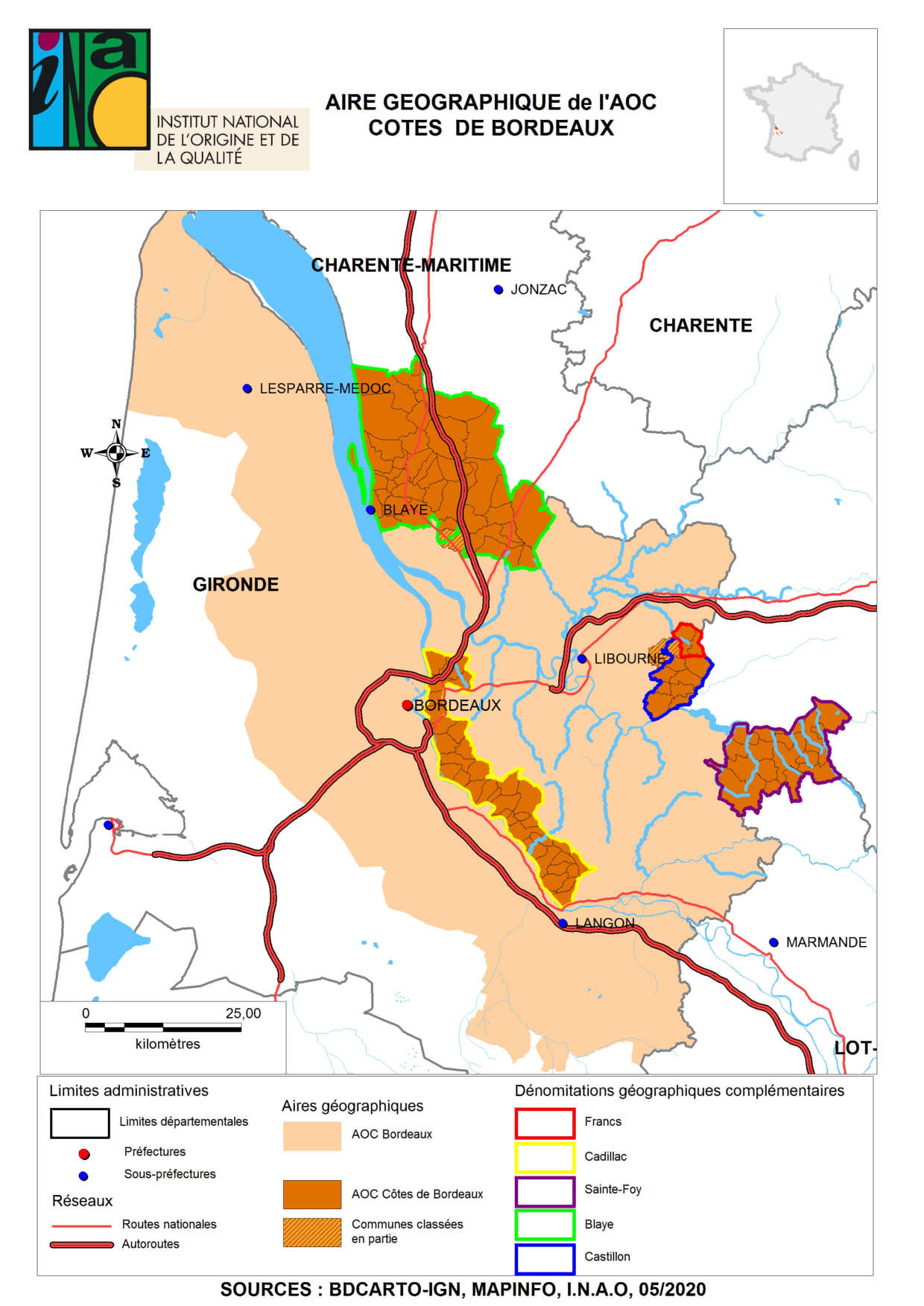
Map of the Côtes de Bordeaux AOC via the INAO
The wines—the Cadillac-Côtes de Bordeaux AOC: The entire area of the Cadillac AOC (as well as a small parcel extending from its northern edge) is included in another appellation, the Côtes de Bordeaux AOC. Cadillac is a sub-appellation of the larger Côtes de Bordeaux AOC, which encompasses four discontiguous plots of land (and five named sub-appellations) located to the east of the Garonne River and the Gironde Estuary. As if that weren’t confusing enough, the Cadillac-Côtes de Bordeaux AOC—is approved only for red wine. The allowed grape varieties mirror those used throughout most of Bordeaux and include Cabernet Sauvignon, Merlot, Malbec, Carmenère, and Petit Verdot. (For serious wine students: the five sub-appellations of the Côtes de Bordeaux AOC are: Cadillac, Castillon, Sainte Foy, Francs, and Blaye.)
The man and the car: In 1683, a fascinating character named Antoine Laumet left his home in France and arrived at Port Royal—the then-capital of Acadia/New France (and modern-day Nova Scotia, Canada). Upon his arrival in North America, he declared himself Antoine de la Mothe, écuyer, sieur de Cadillac and embarked upon several decades worth of escapades, serving at various times as an explorer, cartographer, merchant, and officer of the French Navy. In 1701, he helped to establish Fort Pontchartrain du Détroit on the north bank of the Detroit River. The fort became part of the modern city of Detroit, Michigan.
 For many generations, Laumet—under his assumed nickname, Cadillac— was hailed as a hero (or at least, a founding father of sorts). A French High School in Ontario was named after him, the Cadillac Line on the Montreal Metro bears his name, as does Cadillac Mountain in Maine. Cadillac—the famous American Car Brand, headquartered in Detroit—was indeed named after him, and the original crest of the Cadillac Brand was modeled after his self-created amorial bearings (“family” coat of arms).
Postscript—and now we know: It has come to light that Antoine Laumet/Mssr. Cadillac was not quite the hero he was once believed to be. It has been revealed that he frequently abused his power; was abrasive (to say the least); traded heavily in fur, alcohol, and other products to the detriment of the First Nations; and was most likely involved in some of the earliest instances of the slave trade in North America. Le sigh.

Photo of the Château de Cadillac by Fabien Lotte via Wikimedia Commons
References/for more information:
- Cahier des Charges – Cadillac AOC
- Cahier des Charges – Côtes de Bordeaux AOC
- Map of the Cadillac AOC via the website of the INAO
- https://www.bordeaux.com/us/
- The website of the Château de Benauge
- https://www.cestenfrance.fr/chateau-des-duc-depernon-chateau-de-cadillac/
- Antoine de la Mothe Cadillac – Wikipedia
The Bubbly Professor is “Miss Jane” Nickles of Austin, Texas… missjane@prodigy.net


 The Bubbly Professor