March of the Hybrids

Hybrid grape varieties—they are loved in Canada (Vidal) for icewine, in New York State (Cayuga) for sparkling wine, and in Texas (Blanc de Bois) for deflecting Pierce’s Disease.

In the European Union? Not so much. The EU has very little love for hybrid grapes, and only a handful of them are approved for use in quality wines—meaning they have made it onto the all-important Register of Approved Varieties. Ouch.

However….hybrid grapes are not entirely shunned in the vineyards of the EU. Here are three examples of hybrid grapes that marched right into the European Union where they were greeted with (somewhat) open arms.

.

Baco Blanc: Baco Blanc is a hybrid of Folle Blanche (vinifera) X Noah (a seedling of Tyler—a natural riparia X labrusca hybrid discovered in Henry County, Kentucky—that for some spooky reason has a DNA profile identical to the Basque grape Hondarribi  Zuri). Baco Blanc was created in 1898 by François Baco, working in the Landes in southwest France, in response to the fact that Folle Blanche was not taking well to grafted rootstock.  The inventor actually named the grape Maurice Baco in honor of his late son, but the name Piquepoul du Gers was widely used in and around southwest France, leading to some confusion about the progeny of the grape. Baco Blanc is a light-skinned white grape with fairly neutral flavors and just a hint of the “foxy” shining through.

Baco Blanc’s claim to fame: Baco Blanc is one of the ten grapes authorized in the production of Armagnac, and is listed as an approved variety on all four of the decrets concerning the great brandy: Armagnac AOC, Armagnac-Ténarèze AOC, Bas Armagnac AOC, and Blanche Armagnac AOC. This makes Baco Blanc the only hybrid grape used in a French appellation d’origine controlee (AOC/PDO) product. Not bad.

.

Regent: Regent (a red grape) was created in 1967 in Pfalz, Germany by a scientist named Gerhardt Alleweldt. Bred to be resistant to diseases of the fungus/rot/mildew variety, it is a hybrid of Diana (vinifera—Silvaner X Müller-Thurgau) X Chambourcin (itself already a complex French-American hybrid).  The grape was named after a famous diamond that once embellished the Crown of Louis XV (and now resides in the Louvre).

Regent’s claim to fame: Regent makes darn good wine. It ripens to high sugar levels, and can produce full-bodied wines with velvety tannins and aromas of red fruit (cherry, red currant, red plum). It’s so good that it often is described—in complimentary terms—as “vinifera-like” and “you can’t even tell it’s a hybrid.” Germany even managed to get it listed in the Register of Approved Varieties as a vinifera variety. There are currently over 5,000 acres (2,020 ha) planted in Germany, with additional plantings in Switzerland and England. In Belgium, it is an approved variety in the Côtes de Sambre et Meuse, Hageland, Haspengouw, and Heuvelland AOCs.

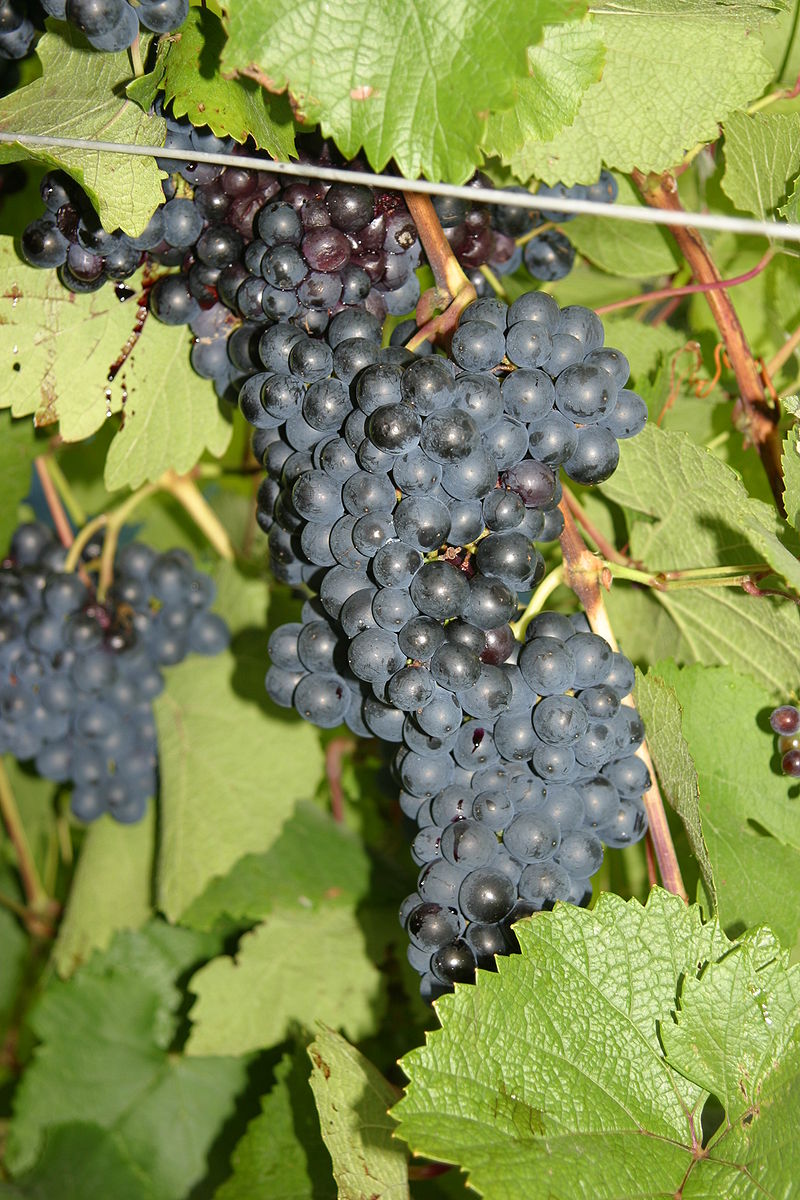
Rondo grapes photo credit: Dr. Joachim Schmid (Geisenheim University) via Wikimedia Commons

Rondo: Rondo, a red grape, is a hybrid of St. Laurent (vinifera) X Zarya Sevra (a Seyants Malengra X Vitis amurensis hybrid). Rumor has it that it was originally created in 1964 by Czech Professor Vilém Kraus, who later offered the grape to Dr. Helmut Becker of the Geisenheim Grape Breeding Institute—which explains why the grape is known as a German hybrid.

Rondo’s claim to fame: Rondo has been listed in the EU’s Register of Approved Varieties since 1997—interestingly enough, with the entry for “species” left blank (cue the theme to The Twilight Zone…) But all conspiracy theories aside, it seems that Rondo is a vigorous vine with excellent disease resistant, and as a bonus the grapes have red-colored flesh—making it a good blending partner for many cold-weather red grapes. It seems that despite its amurensis-linked heritage, the wines it produces are vinifera-enough in style to give it a spot on the roster.  Rondo is currently the number 4 red grape (by vineyard plantings) in England, and is planted in Germany (particularly in Baden and other areas near the southern portion of the country).

References/for more information

The Bubbly Professor is “Miss Jane” Nickles of Austin, Texas… missjane@prodigy.net
Whole Lotta Ancellotta

...

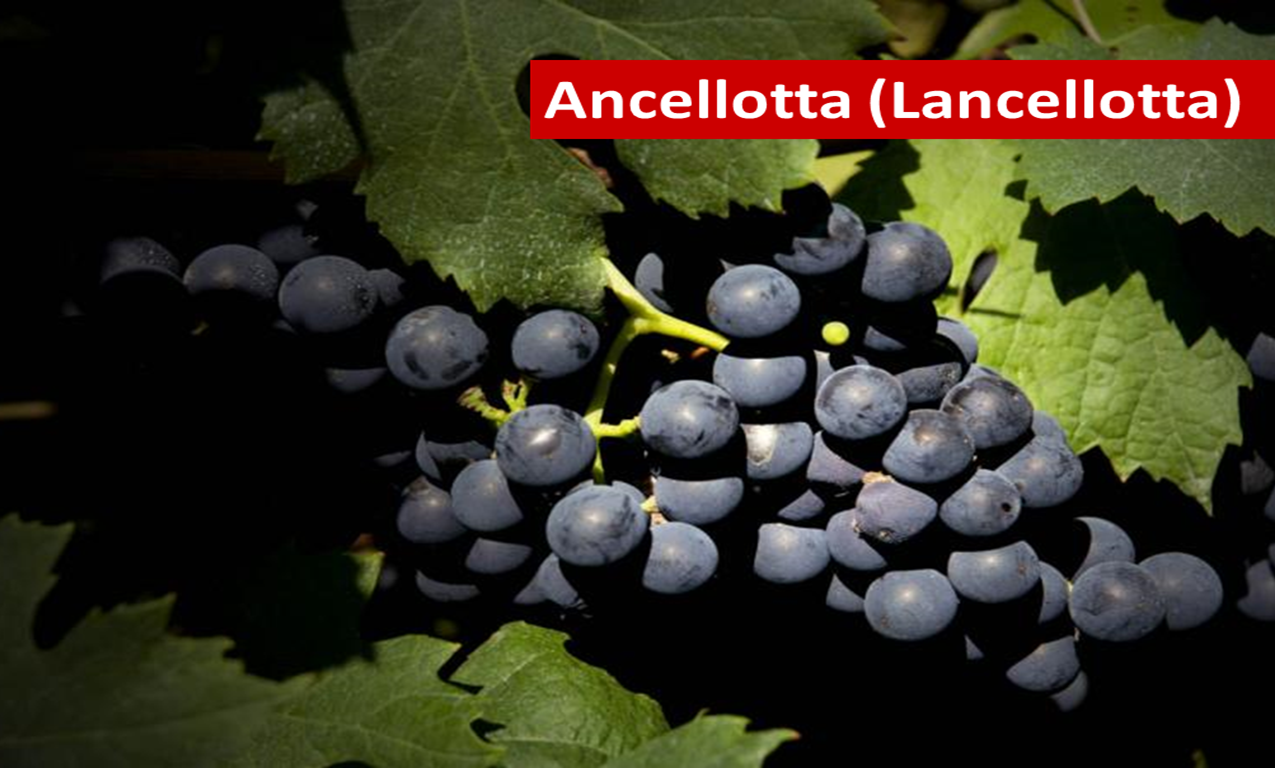
The Ancellotta grape is native to Italy’s Emilia-Romagna area and used in small amounts in some styles of Lambrusco. When I read that, I thought to myself, “Now there’s an obscure grape variety”!

As first impressions often are, I was wrong! Italy has over 11,000 acres of Ancellotta, and while that can’t compare to Sangiovese’s 200,000 acres, it certainly doesn’t place it at the bottom of the very long list of grapes grown in Italy.

The Ancellota grape is a vigorous red grape known for small, very dark berries. The high level of anthocyanins in the skins mean that this grape is often used, in small amounts, to add a punch of color to otherwise lightly hued red wines. This feature also means that the grape is sometimes used in concentrated musts used for coloration. Besides its color and structure, Ancellotta grapes are known for ripe red fruit flavors and aromas, such as plum, blackberry, and blueberry; as well as a spiciness characterized as “sweet spice” or “baking spices.”

...

Ancellotta is perhaps best known as a minor allowed component of several styles of Lambrusco. It is allowed to be used up to 15% in the blend of Lambrusco Salamino di Santa Croce DOC and Lambrusco Mantovano DOC. It’s also allowed, up to 15% in Lambrusco di Modena DOC and Lambrusco di Reggiano DOC. In Colli di Scandiano e di Canossa DOC, it may be used in Lambrusco—but only those produced with a minimum of 85% of either the Lambrusco Montericco or Lambrusco Grasparossa variety.

But here’s where it gets interesting: did you know that Ancellotta is required to be at least 30% of the blend of Reggiano Rosso DOC? True fact! Plus, it is allowed to be up to 60% of the blend. So that’s where the 11,000 acres of Ancellotta are headed! The rest (40—70%) of the Reggiano Rosso DOC blend may be Cabernet Sauvignon, Fogarina, Malbo Gentile, Marzemino, Merlot, Sangiovese, or various members of the Lambrusco grape variety.

...

The Ancellotta grape variety is also planted in Brazil where it is believed to cover at least 1,000 acres, mainly in the Serra Gaúcha area.  At the Don Guerino Winery in Alto Feliz, it is used in “Top Blend,” a gran reserva blended red wine, alongside Merlot, Teroldego, Tannat, and Cabernet Sauvignon. Don Guerino also produces a 100% varietal Ancellotta that has been described as having a deep intense color, aromas and flavors of plum, blackberry and spice; great structure, and ripe tannins.

Ancellotta is also grown in Switzerland. It is often used, in small amounts, for its color-enhancing quality in the Pinot Noir of the Valais region. It is also used in the blended wine known as Dôle. Dôle, which must contain a combined minimum of 85% Pinot Noir and/or Gamay, is considered to be among the finest wines of Switzerland. Other grapes used in Dôle may include Carminoir (a recent Cabernet Sauvignon X Pinot Noir cross), Merlot, Syrah, and—you guessed it—Ancellotta.

References:

The Bubbly Professor is “Miss Jane” Nickles of Austin, Texas… missjane@prodigy.net
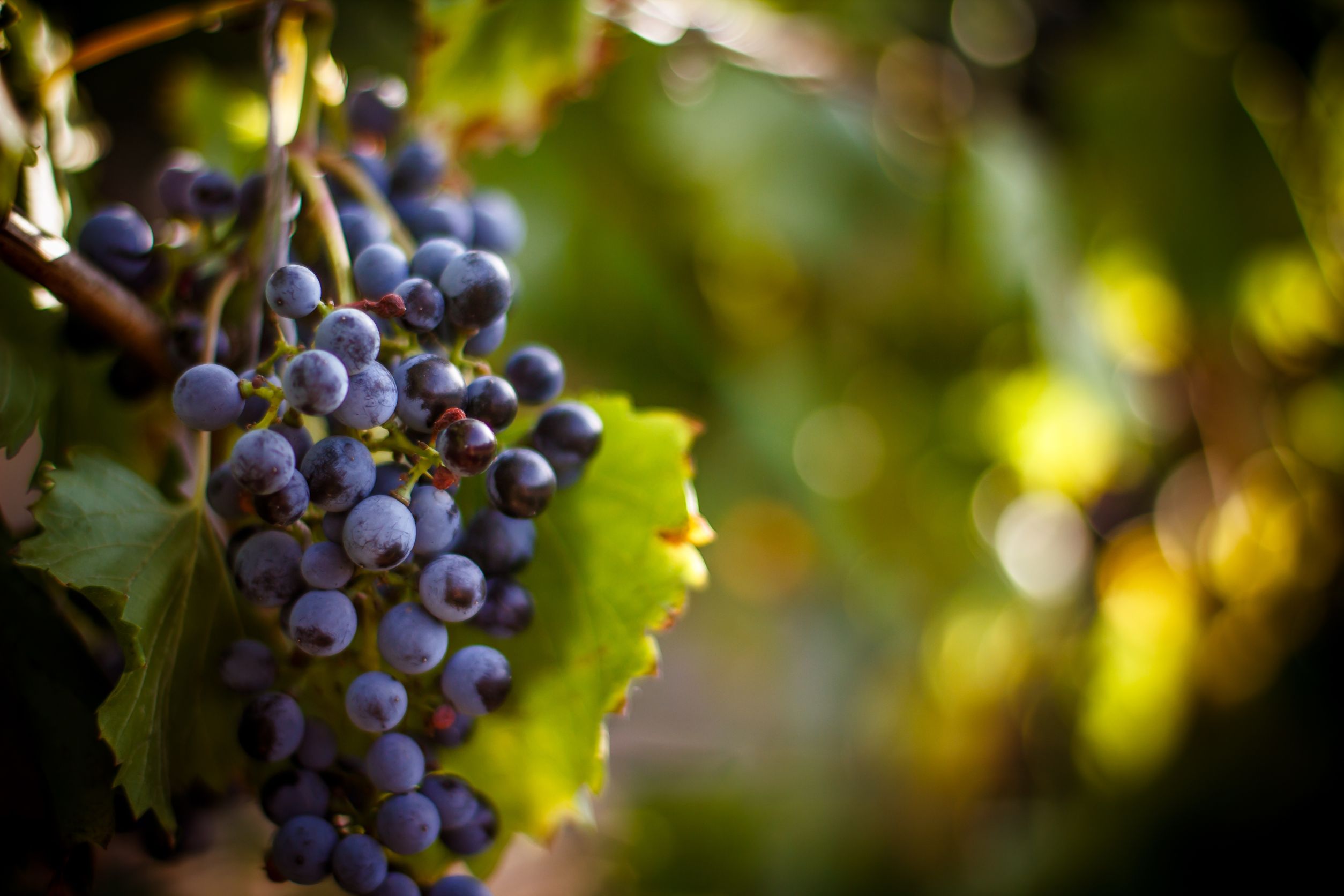
Marselan from Marseillan

Photo of Marselan Grapes by Vbecart Photography, via Wikimedia Commons

Photo of Marselan Grapes by Vbecart Photography, via Wikimedia Commons

I first heard of the grape variety Marselan while studying – for the first time – the wines of China. China, as you may have heard, recently became the world’s second-place country in terms of vineyard holdings – coming in on the list right after Spain, and before France. While many of China’s vineyards are dedicated to table grapes, wine grapes, including vinifera varieties, now account for at least 10% of the vines. Of the vinifera varieties grown, Cabernet Sauvignon dominates, followed by Carmenère, Merlot, Chardonnay, Cabernet Franc, Shiraz, Gamay, Grenache, and Marselan.

There it was: Marselan – a grape variety I had never heard of before – so of course I had to investigate…

Marselan is a vinifera cross (Cabernet Sauvignon X Grenache) created in 1961 by French ampelographer Paul Truel. Truel was working in Montpellier, France at the Institut National de la Recherché Agronomique (INRA). His goal was to create a high yielding grape with large berries of at least moderate quality. Marselan produces grape berries of small-to-medium size, so the variety was shelved and not expected to have a future in commercial wine production.

However…by the 1990’s viticultural priorities had shifted, and disease resistance, particularly to threats such as powdery mildew and coulure, brought Marselan out of cold storage. The grape was approved by the French as a commercial variety in 1990 and in 2007 was approved by the TTB (United States) as a varietal wine name.

At its best, Marselan is said to combine the finesse and quality of Cabernet Sauvignon with the heat tolerance and high yield of Grenache. According to Jancis Robinson’s book “Wine Grapes,” varietal Marselan “tends to produce deeply colored and highly aromatic wines that have supple tannins and the potential to age.”

In addition to its plantings in China, Marselan is planted – albeit in small amounts – throughout the south of France. It is allowed to be up to 10% of the blend in the wines of the Côtes du Rhône AOC, and is produced as a varietal wine in the Languedoc. Small plantings may also be found in California, Argentina, Arizona, Spain, Uruguay, and Brazil.

The grape was named “Marselan” by its creator, in homage to the town of Marseillan, France. Marseillan is the home of the phylloxera-free vine collection of Domaine de Vassal, operated by the INRA. Domaine de Vassal provided the parent Cabernet Sauvignon and Grenache vines from which the original Marselan was bred.

References:

  • Robinson, Jancis (et al): Wine Grapes. New York, 2012: Harper Collins Publishers
  • Robinson, Jancis and Harding, Julia: The Oxford Companion to Wine, 4rd Edition. Oxford, 2015: The Oxford University Press
  •  http://www.winechina.com/en/

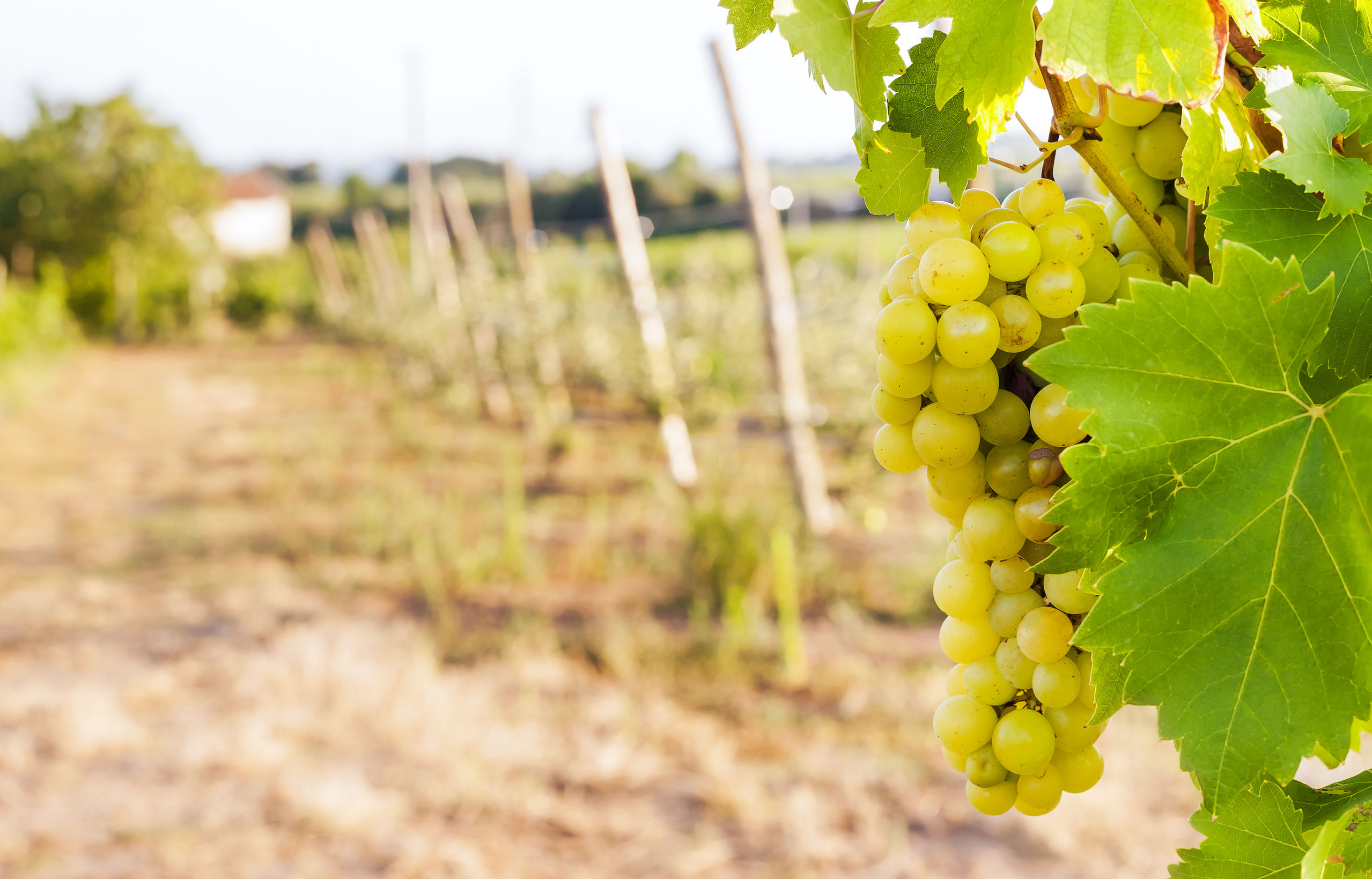
White–ish: Albariza Soil

....

….

Albariza, the word: According to Miriam-Webster.com, the word “albariza” is “borrowed from Spanish, a noun derivative from the feminine form of albarizo meaning “white-ish, or off-white.” Derived from the word albar (“white”) plus the attenuating (limiting) suffix –izo.

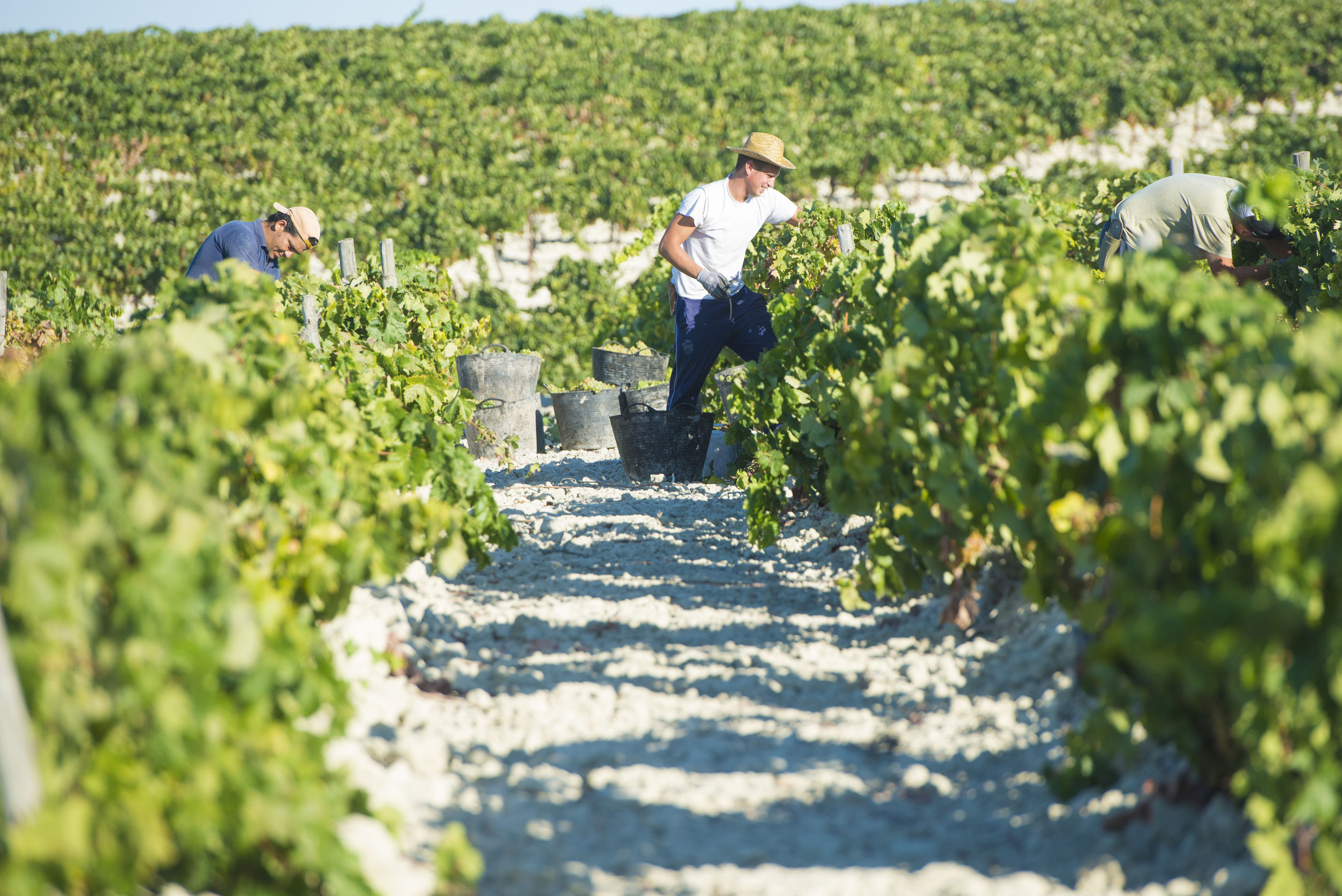
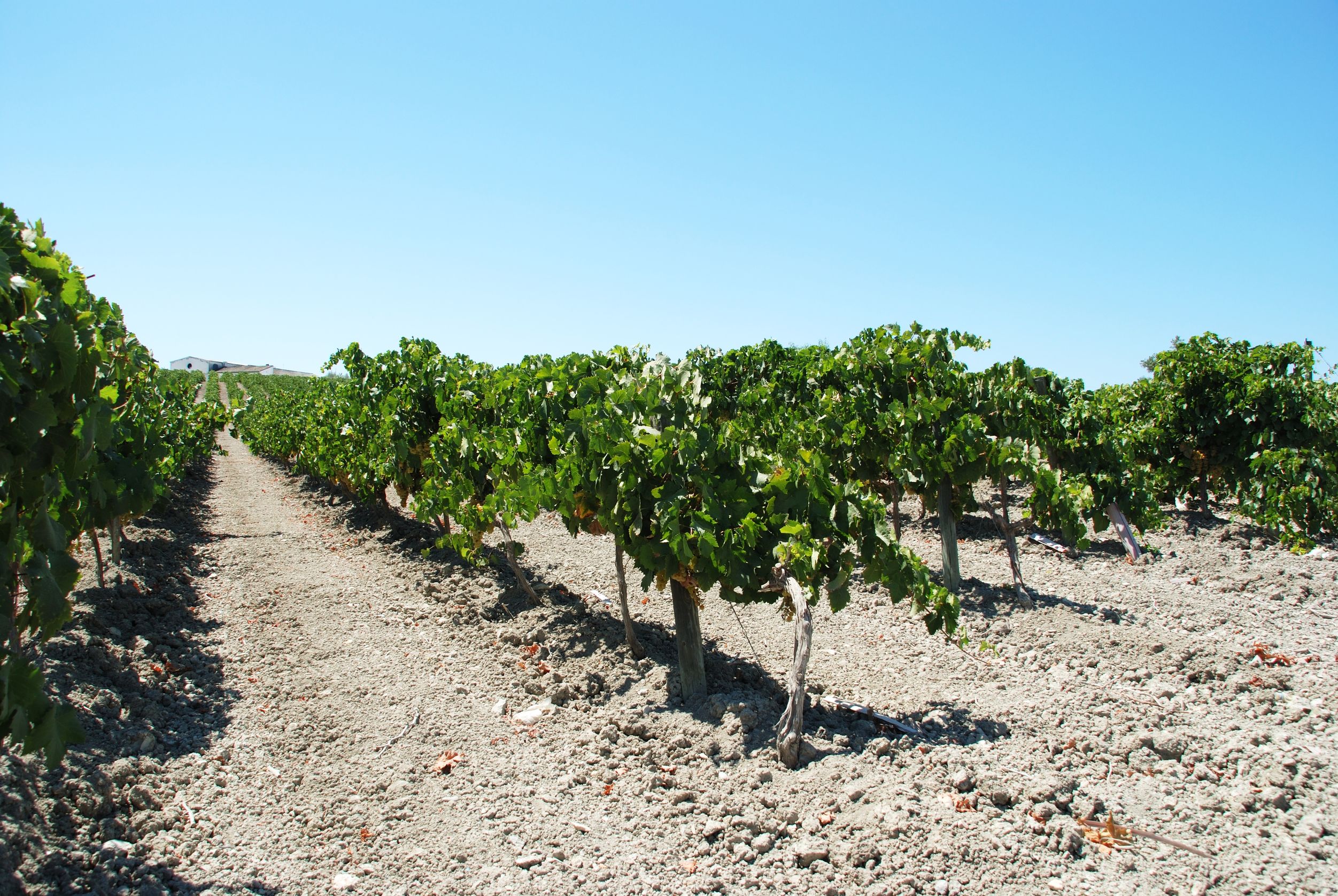
Albariza, the soil: According the Oxford Companion to Wine, albariza is “A local, Andalusian term for the white, chalky-looking soil typical of parts of the Jerez region of southern Spain. It appears dazzling white in summer, and has the characteristic of drying without caking, slowly releasing moisture to the vines during the growing season.”

Albariza, for wine lovers: If you are a wine lover, you probably already know a few things about albariza soil. Such as, it is a particularly fine conduit for the Palomino grape, and grows the grapes that will become some of the finest examples of Fino Sherry—and other types of Sherry as well.   It is the main soil type found in the Jerez-Xérès-Sherry DO, found in over 90% of the vineyards of the region.  This figure used to be much lower, but over the years inferior vineyards were replaced—either by other crops such as sunflowers or alternative uses such as the harvesting of solar energy—leaving behind the high quality, albariza-rich vineyards to rule the area.

.....

…..

Albariza is a unique soil, made up primarily of limestone rich in calcium carbonate that, according to geologists, is “almost chalk,” but it is still too young to be true chalk. Yet, to us mere mortals, calling it “chalk” is “close enough,” and you’ll find most people—even viticulturists—referring to albariza as a “chalky” soil. Clay and sand (silica) are found in smaller amounts; these components give its somewhat mottled “white-ish” appearance as opposed to pure, bright white.

The unique properties of the soil allow it to soak up rainfall—which typically occurs in Jerez in the winter—and absorb it like a sponge. Later, the upper levels of the soil “bake” into something of a hard crust or cap, trapping the water below. Over the long, hot, and dry Jerez summer, the trapped water is slowly released, nourishing the vines and making irrigation unnecessary.  The unique white-ish color of the soil also benefits the vines by reflecting sunlight back up to the vines, increasing the rate of photosynthesis.

All of the above might not be new information if you are already a wine enthusiast or dedicated student of wine—which is just fine because there is so much more to know about albariza. Read on for a few more fascinating facts about albariza:

  • The finished product...

    The finished product…

    Albariza soils are categorized according to the percentage of calcium carbonate-rich limestone/chalk in the soil. Alabarizone soil is mostly clay but contains about 10% limestone. Tosca soils have about 40% limestone/chalk, while lantejuela contains about 50%. Tajón has the most – up to 80% limestone/chalk, giving it the brightest white appearance. However, tajón soils are not ideal for vineyards, as the soil can become very hard, which can lead to chlorosis (a condition where leaves produce insufficient chlorophyll).

  • The ideal version of the soil for vineyards contains about 25% limestone/chalk at the surface, and 40-60% starting a few feet below the surface. Geologists, of course, have many more subsets and ways of looking at albariza, including the composition of the remainder of the soil components as well as specific minerals and nutrients.
  • The finest albariza soils are characteristically loose and easy to work; in geology speak this is described as being “friable.” This friability allows a vine’s root system to spread far and deep into the ground. Roots as long as 38 feet (12 meters) have been reported in layers of albariza soil which themselves reach a depth of 20 feet (6 meters).
  • To maximize the amount of rain water “captured” in the soil, the soil in albariza soils are often “banked up” to create reservoirs to capture rain. In spring, the soils are leveled out again.
  • Albariza soil can hold up to 34% of its weight in water.
  • Albariza is also found in parts of Penedès, where it produces grapes for exceptional Cava; and in Montilla-Moriles, where the vineyards are mostly planted to the Pedro Ximénez variety.

 References:

The Bubbly Professor is “Miss Jane” Nickles of Austin, Texas… missjane@prodigy.net
It’s Nice to be Needled

.....

…..

It’s nice to be needled….as long as the “needles” are found in wine – and not, perhaps, in the hands of a phlebotomist, or an errant sewing needle finding its way into your thumb.

“Vino de aguja” is a good way to be needled. This Spanish term for a slightly sparkling wine can be translated as “needle wine.” It’s a pretty obscure term – you won’t find it in the Oxford Companion or The Wine Lover’s Companion; even a Google search will only yield a few hits.  However, keep digging and you’ll be able to figure out that aguja means “needle” in Spanish, and in the case of vino de aguja, refers to the prickly effect of the tiny bubbles.

The best information I could gather came from the websites of the wines that self-identified as vinos de aguja. One producer, Bodegas Pinord, located in Penedès, makes a range of wines, including some still wines, some sparklers (Cavas), and even some organic wines. Interestingly enough, the Spanish language version of their website refers to their “La Nansa” and “Reynal” product lines – which includes La Nansa Rosado, La Nansa Blanco, and a red, rosé, and soft white version of Reynal – as “Vinos de Aguja,” yet the English language version refers to them as “pearl wines” – which might partially explain the challenge in finding reliable information on this style of wine.

Photo via http://www.pinord.com/

Photo via pinord.com

In 1942, Bodegas Pinord was the first winery in Spain to make wines in the style of vino de aguja. The production method, which results in a semi-sparkling wine with a maximum of 2.5 bars of atmospheric pressure, is somewhat of a two-step single fermentation.  The grapes are pressed and fermentation is allowed to begin. When there is just enough sugar left in the must to create the desired style (in terms of sweetness) of wine and 2.5 atm  of bubbles, the wine is transferred to a closed tank, where it continues fermentation in a temperature-controlled and pressurized environment. The wine is then bulk clarified and bottled under pressure.

Their Reynal red and rosé are both produced from Tempranillo, while their Reynal soft white is a blend of Macabeo, Parellada, Xarel-lo. All of the Reynal wines have just under 2% residual sugar. The La Nansa wines have 0.8% residual sugar and are, thus, technically dry. The La Nansa blanco is made from Macabeo and Chardonnay, while the La Nansa rosé is a blend of Garnacha and Merlot.

Blanc Pescador, one of Spain’s top selling white wines is also a vino de aguja. Blanc Pescador is also produced in the two-step single fermentation method, and is made in the Empordà region of northeast Catalonia. This is the type of wine that you’ll likely be served –by the tumbler – in a restaurant or bar along Spain’s Mediterranean Coast.

Blanc Pescador is a dry wine made from a blend of Macabeo, Parellada, Xarel-lo. The winery also produces a “Blanc Premium” from Macabeo, Chardonnay, Garnacha Blanca and/or Sauvignon Blanc; and a Pescador Rosé using Trepat, Garnacha, and Merlot. These wines are produced by the large Grupo Perelada that produces a wide range of Spanish wines – including some serious Cavas, red wines of Empordà, and even a Marc de Cava (pomace brandy).

The following DOs are authorized to produce vino de aguja in Spain. The DOs define vine do aguja as “semi-sparkling” or as having 1-2.5 atms of pressure, and some use the term “Vi d’agulla.” I make no claims that this is a complete list; however, these are the regions that I was able to confirm:

  • In Catalonia: Catalonia DO, Terra Alta DO, Tarragona DO, Penedès DO, Plá de Bagés DO, Alella DO, Conca de Barberá DO, Empordà DO, Costers del Segre DO
  • In the Canary Islands: La Palma DO, Valle de Güímar DO, Abona DO
  • In Castilla y León: VCIG Valles de Benavente
  • In Aragón: Cariñena DO, Calatayud DO
  • In Valencia: Utiel-Requena DO
  • In the Balearic Islands: Plà i Llevant DO
  • In Castilla-La Mancha: La Mancha DO

The Bubbly Professor is “Miss Jane” Nickles of Austin, Texas… missjane@prodigy.net

Five Fast Facts about Zweigelt

Zerigelt 1A quick read about Fritz Zweigelt and the grape he created.

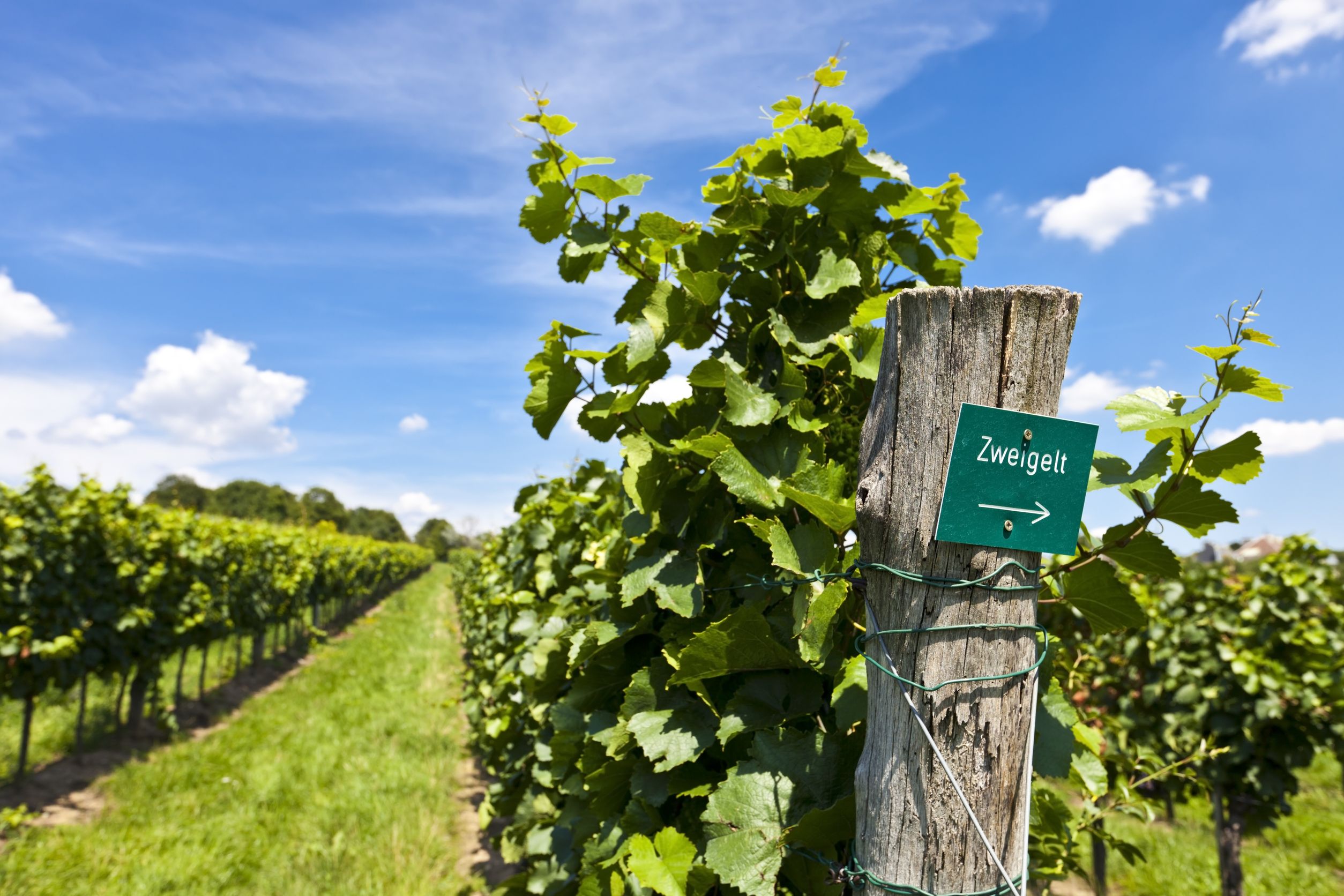
#1 – Zweigelt is the leading red grape of Austria. It is also planted in small amounts in Canada, in both Ontario and British Columbia. Zweigelt is the third most-planted grape of the Czech Republic, where is goes by the name Zweigeltrebe. A few wineries – including Wilridge Winery and Perennial Vintners – have some small plantings (a few acres or so) in Washington State.

#2 – Zweigelt is a cross of St. Laurent and Blaufränkisch/Lemberger created by Fritz Zweigelt in 1922. Fritz was working the Federal Institute for Viticulture and Pomology at Klosterneuburg, Austria at the time, which makes the Zweigelt grape a true native Austrian. It was made with the purpose of creating a red grape unique to Austria that could thrive in the cool climate, be disease-resistant, and create a red wine of medium to full body and flavor.

#3 – Dr. Zweigelt did a good job – the grape that bears his name is indeed cold-hardy, drought-resistant, and thrives in a variety of soils. It is fairly disease-resistant, but is susceptible to powdery mildew (that’s Oidium to you CSW students) and berry shrivel/grape wilt.

Zweigelt 2#4 – The name of the grape is pronounced “TSVYE-gelt” – and if you think that’s difficult to say, consider yourself lucky. The original name of the grape was Rotburger (the name of a town close to where the grape was created) but was later changed to honor its creator.  Zweigelt also goes by the name Blauer Zweigelt. By the way, don’t confuse the original name of Zweigelt – Rotburger – with the grape that goes by the name of Rotberger (who would – ha!). For the record – Rotberger (“berger with an e!”) is a white grape cross of Riesling X Trollinger.

5 – As with all wines, the characteristics of a good Zweigelt vary according to vineyard conditions and wine-making techniques. Cool-climate, unoaked versions from Austria’s northern reaches are typically violet-red in color, medium-bodied, and moderate in tannins with fruit-forward flavors favoring red and black cherry. As such, it is the most widely consumed red wine in the pubs, bars, and casual restaurants in and around Vienna. The warmer growing regions in the areas of Lower Austria (Niederösterreich) – particularly  Neusiedlersee – produce full-bodied, richer wines with firm tannins. Such wines are often oak-aged, resulting in flavors of red cherry, red plum, cinnamon, and black pepper.

References:

The Bubbly Professor is “Miss Jane” Nickles of Austin, Texas… missjane@prodigy.net
Five Fascinating Facets of Flor

Bodegas Hidalgo La Gitana (producers of La Gitana Manzanilla) in Sanlúcar de Barrameda – photo by Caleteron via Wikimedia Commons

Bodegas Hidalgo La Gitana (producers of La Gitana Manzanilla) in Sanlúcar de Barrameda – photo by Caleteron via Wikimedia Commons

Ok, I apologize for the gratuitous alliteration, but you have to admit…flor – the indigenous yeast cells that form a “veil” on the surface of certain types of Sherry as it ages – is fascinating. Flor (meaning “flower” in Spanish) is a subject that just seems to get more interesting the closer you look. As a matter of fact, I had a hard time limiting the information I found to just five facets!

#1: Flor is what separates the Finos from the Olorosos. Flor is a film-forming yeast (actually, several related strains of yeast) that is indigenous to the region around the Jerez-Xérès-Sherry DO. Flor is the main factor that causes the myriad types and styles of Sherry to divide roughly into three camps – Fino, Hybrid, and Oloroso – based on the extent of flor influence. Fino Sherries (such as those labeled as Fino or Manzanilla) are aged under the somewhat constant influence of flor. Oloroso Sherries (labeled as Oloroso or sometimes as Cream Sherry) are aged entirely without flor; while hybrids (such as Amontillado and Palo Cortado) are aged partially with flor and partially without.

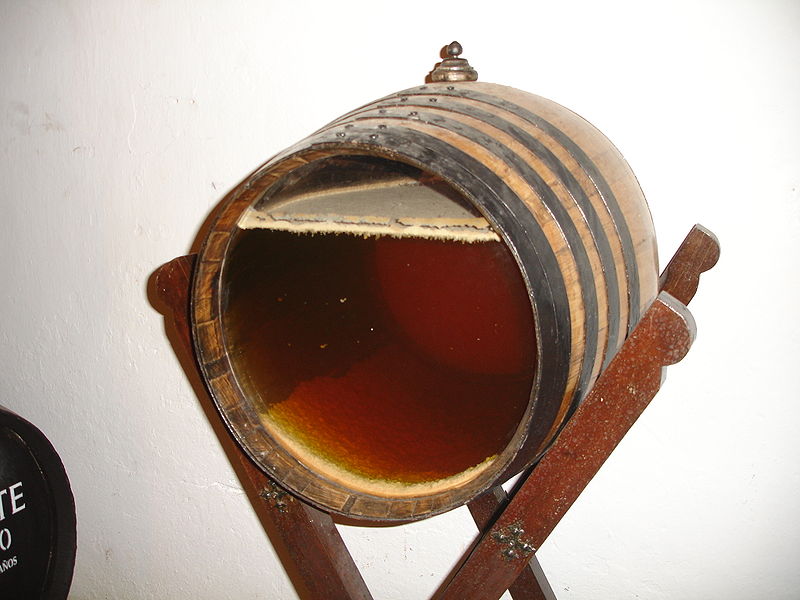
#2: Flor is that “something in the air” in Jerez. Flor imparts its magic by finding its way from the air to the young base wines being prepared each year. The flor starts to develop in the base wines, and, after the wine is fortified – as long as the maximum level of alcohol remains around 15% by volume or less – and placed in a barrel, the yeast will reproduce and start to form a veil (velo in Spanish) that covers the surface of the wine in the barrel like a blanket.  The veil has been described as a waxy foam, about two centimeters thick; or as a light “cottony” film. The “blanket” formed by flor is sturdiest and palest in spring and autumn and turns rather thin and grey in summer and winter. Talia Baiocchi, in her new book “Sherry: The Wine Industry’s Best-Kept Secret” describes a thick film of flor as resembling a “1970s popcorn ceiling.”

Sherry barrel with transparent front to demonstrate the natural development of flor - Photo by El Pantera via Wikimedia Commons

Sherry barrel with transparent front to demonstrate the natural development of flor – Photo by El Pantera via Wikimedia Commons

#3: Flor protects the wine from oxidation in a variety of ways. The veil that is created via the action of flor protects the wine resting beneath it in a myriad of ways. For one, it simply forms a protective barrier between the wine in the barrel and the oxygen above it. In addition, the flor actually consumes some of the oxygen around it, as well as some of the alcohol, glycerol, and (if present) sugar. Thus, Fino Sherries tend to be pale in color, light in body, and bone-dry.

#4 – The collective effects of flor – referred to as “biological aging” – are amazing. The main benchmark for biological aging is considered to be the wine’s aroma. Simply put, contact with flor (both while it is alive, and after it expires and sinks to the bottom of the barrel as lees) may create up to 1,000 milligrams per liter of acetaldehyde in the wine. That is, according to Ruben Luyten of the blog Sherry Notes, more than twenty times the amount of acetaldehyde found in most table wines.  Acetaldehyde’s aromas have been described, variously, as rancid apple, apple cider, almond, hazelnut, and even straw or hay. The presence of flor will also lead to an increase of in other highly aromatic compounds, such as lactones and terpenes, which may add an array of aromas – from dried herbs to green walnuts, mushrooms, and baking spices – to the wine.

#5: Flor has some definitive preferences as to climate and conditions.  Flor can only survive in wine that has an alcohol level of somewhere below 15% abv – but that’s just the beginning of its ways. Flor also needs a good deal of humidity in the air, which explains why Fino Sherries thrive in certain areas, such as the cooler, coastal areas around Sanlúcar de Barrameda and El Puerto de Santa María, while Oloroso Sherries (which are aged without flor) thrive in the hotter, drier, more inland areas around Jerez. It is well-known that solera systems (and the buildings that surround them) are often at ground level (as opposed to an underground cellar) and built with high ceilings or even left partially open to the elements, so as to encourage air flow. It’s also rumored that bungs are left gently in place in Fino Soleras to encourage the movement of the humid air inside the barrels.

Flight of Fino Sherries at London’s Bar Pepito – Photo by Ewan Munro via Wikimedia Commons

Flight of Fino Sherries at London’s Bar Pepito – Photo by Ewan Munro via Wikimedia Commons

While wines produced “under a veil” are somewhat uncommon around the world, there are a few shining examples besides Fino Sherries. These include the Vin Jaune of France’s Côtes du Jura AOC, certain types of Tokaji, a “Vin de Voile” produced by Domaine Plageoles in France’s Gaillac region, and the “Condado Pálido” produced in Spain’s Condado de Huelva DO, among others.  While these wines undergo a similar style of biological aging, it is not certain that they use the same strain(s) of yeast as are found in Jerez-Xérès-Sherry, and, of course, each of these wines is made in its own conditions of climate-atmosphere-terroir. Thus, we can safely say that there’s nothing in the world quite like the flor of Jerez, the protective foam-blanket it creates, and the resulting Fino Sherry.

References:

Decoding the Amtliche Prüfungsnummer

AP rhineThis is a blog post borne of necessity…in teaching my online CSW Prep Classes, I always dread “Module 8.” Module 8, you see, covers the wines of Germany and Austria.

This does not in any way mean that I dread talking about – or partaking of – the wines of Germany and Austria. As a matter of fact, the Grosses Gewachs Mosel Riesling or Kremstal DAC Grüner Veltliner I am sipping alongside is most likely going to be the highlight of my day.

But it’s all about the words, the language, the umlauts and the eszetts. They are all a bit intimidating and confusing to me, being a native English speaker who never traveled to Europe until the 4th decade of her life.

So, in an attempt to dive straight to the heart (in das Herz) of the matter (von tge Sache) I set about to understand something that had always baffled me: Amtliche Prüfungsnummer. It turns out, the Amtliche Prüfungsnummer, while certainly appearing cryptic and complicated, contains a lot of useful information about a German wine, and absolutely reveals the seemingly complex tangle that is German wine to be a highly organized, useful system.

First of all, for the simple language (thank you, Google Translate).

Amtliche – “Official”

Prüfungsnummer – “Exam Number”

Thus, our Amtliche Prüfungsnummer, commonly referred to as the “A.P. Number,” translates as  “official exam number,” although most wine references will refer to it as the “official approval number.”  The A.P. Number identifies the wine as to producer, village of origin, and testing center where the wine was awarded its official approval. The process is required for all wines bottled under the classifications of QbA and Prädikatswein.

The actual number consists of several blocks of figures – surely you’ve seen one, looking quite complicated, such as this example:

AP wine glassA.P. NR. 2 606 319 011 07

Here is what those numbers mean:

2 606 319 011 07: 2 – The first number represents region where the wine was tested. The wine will be tested in the same general region where it was produced, however, there are only 9 testing centers as opposed to 13 quality wine regions (Anbaugebiete). This testing center – number 2 – handles wines from the Middle Mosel and Rheingau.

2 606 319 011 07: 606 – The second number, which may be two or three digits, represents the particular village within the larger testing region, where the wine was produced.

2 606 319 011 07: The third number represents the particular bottler (producer).

2 606 319 011 07: The fourth number represents the sequential order that the wine was submitted by that produce. In other words, this is the eleventh wine submitted for testing in this particular year by the producer.

2 606 319 011 07: The fifth number represents the last two digits of the year that the wine was submitted for testing, usually the year after the vintage.

Whew! Do you have information overload? It’s a lot of data, but remember, this is all to protect the quality and reputation of German wines, which is good for everyone – even us consumers. Producers are required to keep sample bottles of each wine for a certain number of years, and thus the system is such that, if a complaint were received or someone had reason to doubt a wine’s authenticity, a bottle of the specific wine could be located and tested.

Simple? No.

Effective? Yes.

I sleep better at night knowing my Pflaz Riesling (5 594 022 17 12) and my Rheingau Spätburgunder (4 383 675 01 11) is signed, sealed, and approved!

The Bubbly Professor is…”Miss Jane” Nickles of Austin, Texas – jnickles@prodigy.net


The Good, The Bad, and the Diffuse

Structure

Structure

Last summer when I was putting together my “Palate Tune-Up” session for the SWE Conference in Seattle, I spent a great deal of time researching, thinking about, and (yuck) experiencing wine faults. After all, the main premise of the session was to learn to recognize faults – sulfur dioxide, TCA, excessive Brett and other such imbalances – in wine.

It soon occurred to me, however, that giving such a session based on the ick-factor might be something akin to career suicide. Why would people choose to attend the ick-factor session, when Cru Artisan Bordeaux was being poured right next door?

With that in mind, I decided to start the course off by pouring three spectacular wines – each chosen to represent a specific aspect of what we expect in an excellent wine – before we tested the faulty wines. So, my next challenge was to define – and then demonstrate – what makes a wine “excellent.”

As every wine lover knows, defining what makes a wine “excellent” is a challenging – and very subjective – proposal. Every time I came up with a succinct definition, I could hear the arguments and rebuttals from my future audience.

Balance

Balance

Thus, it was several weeks before I came up with my examples. I would choose a wine to represent the following three aspects of an excellent wine: Complexity, Balance, and Structure. Complexity and balance were relatively easy to define, demonstrate, and provide with near-perfect examples.

Structure, on the other hand, eluded me. I thought I knew what it meant, and I could definitely recognize both its presence and absence in a wine, but it was difficult to put into words without talking around and through the matter for less than ten minutes.

So…of course I went on a research bender. What did the wine experts among us have to say about structure?  The New Wine Lover’s Companion had a pretty good definition, basically stating that structure referred to a wine’s “architecture – its plan – including the building blocks of acid, alcohol, fruit, glycerol, and tannins.”  It went on to say that the term “structure” is meaningless without an adjective in front of it, such as “well structured” or “strong structure.”

The Wine Spectator’s online glossary also had a decent enough definition – saying it was related to “mouthfeel.”  Many other references used the rather clichéd “its like milk versus cream” line of reasoning or provided a multitude of synonyms for body – texture, backbone, weight – or provided adjectives to describe it – mouth-filling, brawny, rich, lean, gritty, velvety, smooth.

Complexity

Complexity

But I still wanted to know just what it was…the technical-sorta definition as to what provides a wine with good structure.  Professor Emile Peynaud came as close as anyone could possibly, it seemed, to delivering what I wanted to know with his definition of “structure” as “impressions of volume, form, and consistency.” In other words, structure is the taster’s sense of the wine’s physical make-up.

But it still seemed that I would need to write my own definition to convey just exactly what I meant to say. So I came up with the following: I would explain what is meant by a wine’s structure beginning with the interplay of the same set of attributes that contribute to balance in flavor. In my definition, therefore, a wine’s structure is composed of the sensory impact of acid, sugar, fruit, tannin, extract, and alcohol – but instead of noticing how these components impact flavor, we draw our attention to how they work together to create the tactile sensation of the wine.

So much for the definition! Now, I needed to define and demonstrate how a lack of structure would be described in a wine. Defining the opposite of balance was easy: unbalanced. Defining the opposite of complexity was very easy: monotony. But the only “textbook” opposite of “structure” I could find was “unstructured.” That just didn’t seem right.

Diffuse

Diffuse

So I went on another month-long research bender to find the perfect word that meant “unstructured.” I could find many ways to discuss wines with inadequate or unbalanced structure. For instance, the term “hollow” is also used to denote lack of structure; hollow wines are diluted and lack depth. A “brawny” or “rustic” wine may be described as a hefty wine with plenty of weight, flavor, and grit; but lacking in the complexity needed to bring the elements together in a refined way. And everyone’s favorite – “flabby” to describe a wine lacking in acid, or missing its “backbone.”

But there was no real “winespeak” term to define lack of balance, texturally speaking. So I found an excellent word to portray what I meant – diffuse. The term diffuse is used to describe a building or structure with no strength, or something that is scattered, spread out, or dispersed.  Remembering that “structure” refers to the elements of texture and their relationship, I think it describes a wine lacking in the regard quite well.

The Bubbly Professor is “Miss Jane” Nickles of Austin, Texas – missjane@prodigy.net


The Electric Kool-Aid Acid Test*

A lot of the students in my introductory wine classes have a hard time coming to terms with acidity in wine.  It’s like the word “acidity” reminds them of battery acid, stomach acid, or Jerry Garcia’s long strange trip.

LemonsWhile its easy to understand how acidity does not sound appealing, its a very important flavor component in wine; perhaps even the most important. I can usually bring the class over to “my way of thinking” by comparing acidity in wine to acidity in food.  Everyone understands that a boring burger can benefit from a few slices of pickle or tomato, both of which add a wallop of acid.  Even the ketchup on that burger is highly acidic, although our tongues are much too interested in its sweetness to notice the zing.

Chemically speaking, acid is present in minute quantities in wine; it generally makes up only about 0.5% to 0.7% of the overall volume of a wine. However, its presence is one of the main flavor differences between fine wine and unfermented grape juice.  Acidity gives a wine “liveliness” or “bite”.  Without sufficient acidity, a wine would taste flat, neutral, boring, and bland. Who needs that?

When leading my students through their very first tasting, I have them direct their attention to the sides of their tongues where (despite the frequent bashings of the puedo-science of the “tongue map”) we have a unique set almost gill-like taste buds that are highly sensitive to acidity.

Directing them to pay attention to the “level of zing” and not any associated aromas or flavors, we try to agree on one of the following non-scientific descriptors to apply to the level of acidity in our wine:

Cream of Tomato soupFlat:  If the wine has no noticable “zing,” we call it flat.  I tell the students to compare the level of zing in the wine to the taste of butter.  Of course, butter has almost no acid; it tastes flat. That’s the point. Also, I would never serve my students a flat wine, but at this point in the class they don’t know that yet! A wine that is flat lacks acidity has no depth or complexity.  A “flat” wine is missing one of the basic building blocks of flavor.

Soft: I ask my students if the wine has just a touch of acidity…like cream of tomato soup or blackberries. A soft wine has low acidity compared to many wines, but is still well-balanced, mellow, fruity, and pleasant.  A wine with soft acidity is generally easy to drink.  You may sense just a touch of acidity, and have a slight physiological reaction to a soft wine. (Fyi, both cream of tomato soup and blackberries clock in at about 3.9 pH….just about where the softest wines should land.)

Fresh or Refreshing:   A fresh, or refreshing, wine has enough acidity to balance the fruitiness and make the wine interesting and your mouth feel clean.  The main impression a fresh or refreshing wine leaves on your palate is one of refreshing the palate.  The term is used for a pleasant white wine that is perhaps not too complex – think Moscato d’Asti, Australian Viognier or warm-weather Chardonnay.  This term is also well-used for many red wines such as ripe Zinfandel or Mendoza Malbec, although beginning tasters generally don’t understand the difference between acidity and bitterness.  That’s a lesson for another day.

green applesCrisp:  Imagine biting into a ripe green apple.  The sides of your mouth pucker up, and yet it tastes great…good flavor accompanied by balanced acidity and fruit.  But maybe a bit too tart for those who would prefer a red apple or a nectarine.  A crisp wine’s acidity is easily recognizable but does not overwhelm the flavor of the wine.  You will feel a slight prickly sensation on the sides of your tongue.  You can taste the acidity, but the other flavors come shining through as well. Pinot Noir, Beaujolais, Chablis, White Bordeaux, many Italian White Wines, and other warm-weather white wines have a good chance of being well-described as “crisp.”

Lively:  Think of the vibrant acidity accompanied by a whoosh of flavor that you experience from a green apple Jolly Rancher candy. A lively wine that has a perfect balance of acidity, and is bursting with flavor.  This term is used for wines that have fuller flavor than wines described as “crisp,” such as many sparkling wines (the bubbles emphasize the acidity), California Sauvignon Blanc, or any other white wine that has avoided malo-lactic fermentation or was the result of a cool climate or year.

grapefruitTart:  Four words:  New Zealand Sauvignon Blanc.  One more word:  grapefruit. A tart wine is noticeably acidic.  If you are a ceviche-loving type of person who would rather have a dill pickle than a cookie for a snack, this might be your favorite type of wine. (It is mine, but then my mother once had to explain to me that peeled lemons were not an appropriate snack.) This is a high-acid wine that leaves sharp, almost hard impression on your tongue.  This wine will cause a physiological reaction in your salivary glands, but is not overwhelmingly acidic and not yet sour.

Sour:  If the wine reminds you just a bit too much of biting down on a freshly sliced lemon (or, worse yet, lime wedge), you have a wine that is out of balance with too much harsh acidity.  This is generally a negative term a might represent a defect in the wine (as would a “flat” wine).  A sour wine will remind you more of vinegar and may imply that the wine has spoiled. If you were served this wine in a restaurant, return it.  If you were served this wine at someone’s house, you might just have to sit there and cry.

Other terms I have used to describe acidity include:  sharp, vibrant, snappy, snap-crackle-pop, electric, intense, bright, precise, daggar-like, zing, tongue-curling, acidic spark, or a flavor such as “cherry-like acidity” or “a squirt of lemon”. Or my personal favorite…scandalous.

What’s your favorite?

The Bubbly Professor is…”Miss Jane” Nickles of Austin, Texas….missjane@prodigy.net
 *Kudos to any readers who caught the reference to Tom Wolfe’s famous book about Ken Kesey, “The Electric Kool-Aid Acid Test.” If you got the reference, you are probably my age (congrats on making it past your 40’s).  If you didn’t, you might recognize the brillant, white-suit wearing Mr. Wolfe as the author of “The Bonfire of the Vanities” and “The Right Stuff.”