Confusion Corner: Monte Carlo and Montecarlo
January 29, 2023 Leave a comment
 Monte Carlo and Montecarlo: they really have nothing in common. While both are named for the hill of Carlos (Charles), that’s where the similarities end. One is a posh, urban area on a glamorous riviera—and the other is an obscure wine region in the northwest of Tuscany. And yet, the names alone qualify this topic for Confusion Corner. Let’s break this down:
Monte Carlo, the town: Monte Carlo is a small town (ward) and arguably the most famous region of the Principality of Monaco—that tiny sovereign micro-state located on the French Riviera, tucked between Provence and Liguria. You won’t find any wineries in this exclusive area of wall-to-wall hotels, casinos, and luxury residences, but the Champagne Lists at the Hôtel de Paris Monte Carlo and the Casino de Monte Carlo are impressive indeed.
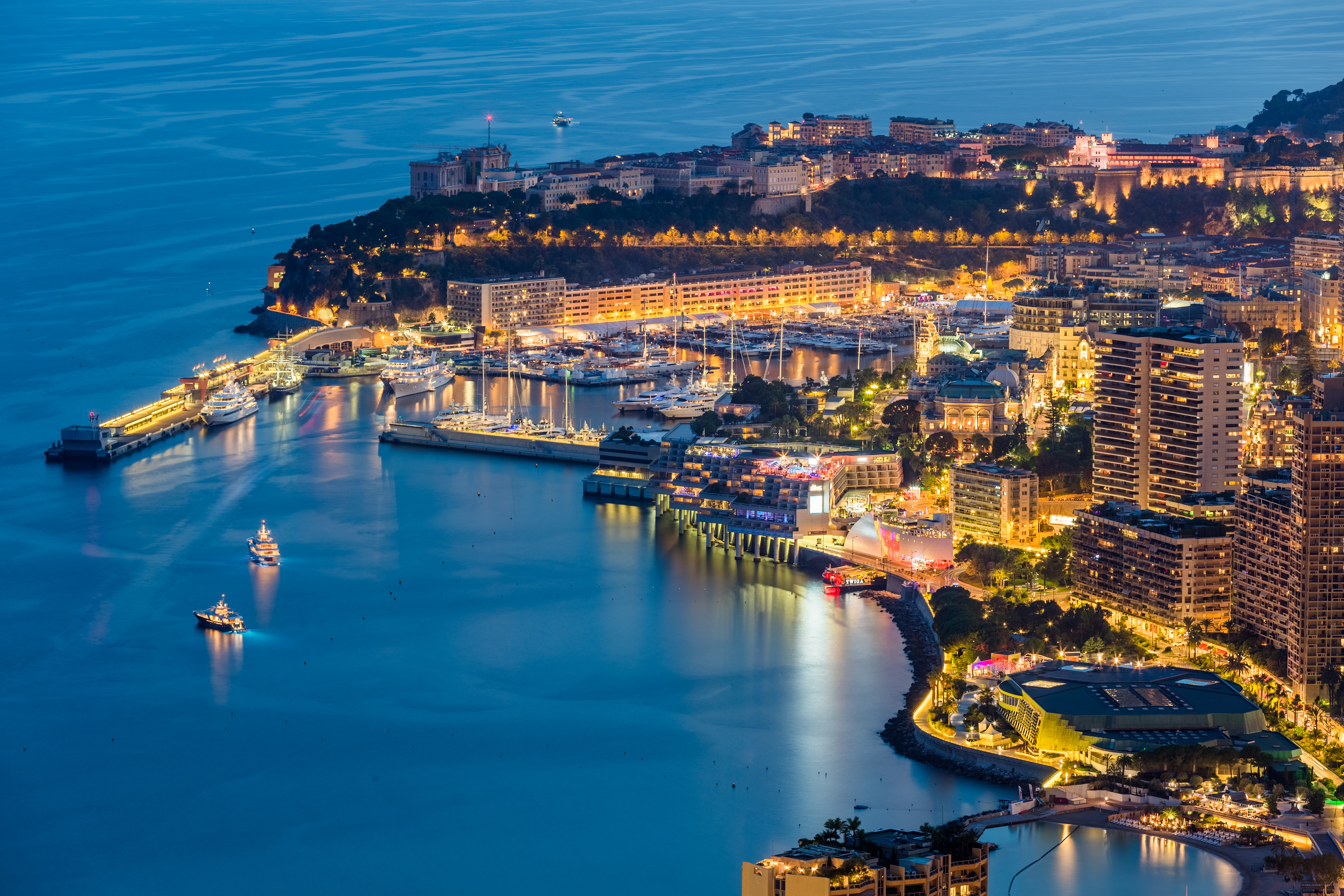
Monte Carlo, Monaco at dusk
Monte Carlo (the town) is named for Charles Honoré Grimaldi. Also known as Charles III of Monaco, he was the founder of the town’s famous casino and served as the Prince of Monaco from June of 1856 until his death in 1889.
Montecarlo, the DOC: The Montecarlo DOC (established in 1969) is named after the comune of Montecarlo, located in the Province of Lucca (Tuscany). Montecarlo lies between Florence (31 miles/50 km) to the east and Lucca (about 7 miles/12 km to the west. The village dates back to 1333, when Charles IV (the namesake of the town and future Holy Roman Emperor) defeated the city of Pisa and freed the citizens of Lucca from Pisan rule.
In addition to its namesake, the Montecarlo DOC includes the municipalities of Altopascio, Capannori, and Porcari. It overlaps a small portion of the equally obscure Valdinievole DOC and shares its western boundary with the Colline Lucchesi DOC. The edge of the uber-famous Chianti DOCG is about 15 miles/24 km away.
 Wine has been made in the area since antiquity; before the town took the name of Montecarlo it was known as Vivinaia—the Via del Vino—named for a well-traveled trade route that crossed the region’s hills. In the 1200s, Benedictine Monks produced a wine described as “clear, vermilion, pure and frank.” Several centuries later, the region provided wine to Duke Cosimo I De Medici, at whose court “the bunches of Montecarlo grapes and the Trebbiano of that community cheered the diners.” (Quotations via the disciplinare, linked below.)
In the late 1800s, the wines of the region were greatly influenced by a wine merchant known as Giulio Magnani who traveled to France and brought back vines from Bordeaux (including Sauvignon Blanc, Semillon, Merlot, Cabernet Franc, and Cabernet Sauvignon), Burgundy (including Pinot Blanc/Bianco), and the Rhône (including Syrah and Roussanne). These grapes still play a role in the wines of the Montecarlo DOC.
- The Montecarlo DOC is approved for a range of wines, including white wine, red wine, and vin santo (dried grape wine), made according to the following formulas:
- Montecarlo Bianco: 30% to 60% Trebbiano Toscano; 40% to 70% must comprise at least three of the following grapes: Semillon, Pinot Grigio, Pinot Bianco, Vermentino, Sauvignon, and/or Roussanne. (Any remainder, up to 20%, may consist of any non-aromatic white variety allowed for use in Tuscany.)
- Montecarlo Rosso: 50% to 75% Sangiovese; 15% to 40% Merlot, Syrah, and/or Canaiolo Nero; 10% to 30% Ciliegiolo, Colorino, Malvasia Nera, Cabernet Sauvignon, and/or Cabernet Franc. (Any remainder, up to 20%, may consist of any non-aromatic red or white variety allowed for use in Tuscany.)
- Varietal wines may be produced using a minimum of 85% one of the following: Vermentino, Sauvignon Blanc, Merlot, Cabernet Sauvignon, or Syrah.
- Vin Santo may be produced using any of the approved grape varieties; grapes must be air-dried, and the wine must be aged in caratelli (wooden vessels with a maximum capacity of 500 liters); vin santo may not be released until November 1 of the third year following the harvest.
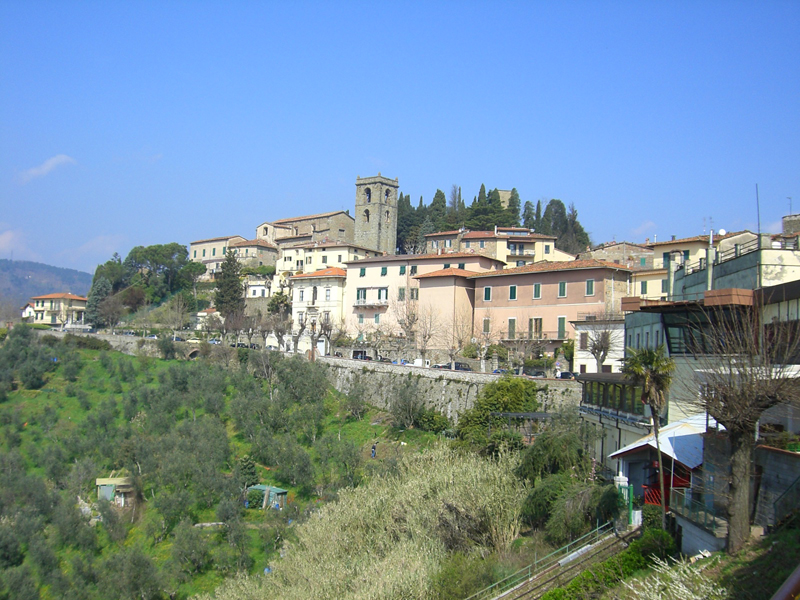
Montecarlo, Tuscany: photo by Marco Ziero via Wikimedia Commons
If you visit Montecarlo, in between wine tastings you’ll want to visit the Church of Sant’Andrea (and its fifteenth-century frescoes) as well as the Fortezza di Montecarlo . The fortress is situated atop the highest point on the hill of Montecarlo and was once the site of numerous battles between the powerful cities of Florence, Lucca, and Pisa.
References/for more information:
- Disciplinare – Montecarlo DOC
- https://www.monte-carlo.mc/en/tourism/
- https://kinglikeconcierge.com/montecarlo-doc-a-widely-appreciated-enological-tuscany-treasure-you-must-try-at-least-once
The Bubbly Professor is “Miss Jane” Nickles of Austin, Texas… missjane@prodigy.net


 The Bubbly Professor