Mind your Latitude: 40º North

We’ve looked at wine through the lens of grapes, places, soils, barrels, bottles, and stems…and for the next few weeks we’re taking a look at latitude. Today, we present: 40 degrees North!

Bairrada DOC: The Bairrada DOC is located in north/central Portugal, just inland from the Atlantic coast. The area grows a range of grapes and produces red, white, rosé, and sparkling wine. White wines are typically based on the Fernão Pires (Maria Gomes) grape, but may be produced from several other varieties as well, including Arinto (Pedernã), Chardonnay, Pinot Blanc, Rabo de Ovelha, and Verdelho.  Reds are produced using a minimum of 50% Baga. The Baga grape variety is well-known for its powerful tannin, great structure, dark color, and complex cherry-berry-plum-tobacco-coffee flavors. Some of Portugal’s best Baga-based red wines are produced in the Bairrada DOC.

Chengde, Hebei: Hebei is a province in eastern China, located on the Bohai Sea coast and surrounding the municipalities of Beijing and Tianjin. Hebei, whose name translates to “north of the river” is located north of the Yellow River. It is estimated that Hebei, together with its neighbor Tianjin, has over 50 wineries and over half of China’s total wine production. In the area’s vineyards, Cabernet Sauvignon is the leading grape variety, followed by Chardonnay, Merlot, and Marselan. The China Great Wall Wine Company (the country’s largest producer, in terms of volume) and the Sino-French Demonstration Vineyard (Domaine Franco Chinois) are both located here.

Humboldt County, CA: Humboldt County—best known for Redwood National Park and the tallest trees on earth—occupies part of the northernmost reaches of California.  Viticulture is sparse—there are perhaps 60 acres currently planted to vine in all of Humboldt County—and yet a range of cool-climate grapes are grown here, including Pinot Noir, Chardonnay, Syrah, and Merlot.  The tiny Willow Creek AVA, one of the few to be found in the area, lies in the valley of the Trinity River surrounded by the rugged Klamath Mountains. The influence of the river makes the AVA slightly warmer than the surrounding areas. PS: The Willow Creek AVA of Humboldt County should not be confused with the Paso Robles Willow Creek District AVA (located 500 miles to the south).

Madrid: The Community of Madrid—located somewhat in the center of the country—is one of the autonomous communities of Spain. The city of Madrid—the capital city of Spain, full of world class art museums (the Prado, the Thyssen-Bornemisza, the Reina Sofía), historic squares (Plaza Mayor) and amazing parks (El Retiro)—lies within its borders. However, in the context of wine, we’re going to focus on the autonomía of Madrid and its very own DO wine region:  Vinos de Madrid DO.  Red, white, rosé, and sparkling wines are produced in the Vinos de Madrid DO, using a range of grapes including Viura, Torrontés, Parellada, Tinto Fino (Tempranillo), Garnacha Tinta, Merlot, Cabernet Sauvignon, and Syrah. The Vinos de Madrid DO is also approved for “sobremadre” wines produced via an extended maceration (up to 180 days) on the madre—that is, the grape skins and stalks. During this time period, the madre slowly sinks to the bottom of the vessel and lends a gentle clarification to the wine. Both red and white (orange) wines are produced via this process.

Marmara, Turkey: Turkey’s Marmara wine region (also known as the Thracian region) is situated in the north of the country, bordering the Marmara Sea (as well as the Black Sea and the Aegean).  The region can be quite humid, to say the least: it averages 73% humidity. The region typically has mild winters and warm summers, showing characteristics of both maritime and Mediterranean climates. A range of grapes are grown in the area, including international varieties such as Cabernet Sauvignon, Cabernet Franc, Chardonnay, Sauvignon Blanc, and Viognier. Native Turkish grapes such as Adakarası, Kalecik Karası, and Papazkarası are also planted. The region produces about 13.6% of the country’s wine.

Sardinia: Located about 150 miles (240km) off the west coast of Italy, Sardinia is one of the largest islands in the  Mediterranean Sea (second only to Sicily). Despite the fact that just a small portion of the island’s 9,300 square miles are dedicated to viticulture, a wide range of grape varieties are grown on Sardinia. These include including native Italian varieties (such as Monica, Torbato, and Nasco), French varieties (such as Cabernet Sauvignon), and those believed to be native to Spain (including Grenache and Carignan). Grenache is a bit of a local hero—starring in the well-known Cannonau di Sardegna DOC—as is Vermentino, which is made into several wines, including Vermentino di Gallura (the island’s only DOCG wine).

Slopes of Meliton PDO: TheSlopes of Meliton PDO is located on the Greek mainland in the region known as Halkidiki (Chaikidki). Haikidiki is often described as resembling “a hand with three fingers.” Vineyards of the Slopes of Meltion PDO are planted in terraces up Mount Meliton, starting at elevations of 328 feet (100 m) and continuing up as high as 1,150 feet (350 m).  A range of grapes, including both Greek and international varieties are planted here. The main wines produced under the rules of the PDO include dry whites (based on Athiri, Roditis, and Assyryiko) and dry reds produced with a minimum of 70% Limnio (often blended with Cabernet Sauvignon and/or Cabernet Franc). Domaine Porto Carras is the main producer.

Taurasi DOCG: Located in Italy’s Campania region about 30 miles inland from the city of Naples, the area around Taurasi has been known for its wine for a long time…since 800 BCE, according to some. These days, this ancient region is enjoying a newly-found popularity, thanks in large part to the efforts of Antonio Mastroberardino and his truly legendary 1968 vintage. Taurasi earned its DOCG status in 1993 and according to these standards it must be made using a minimum of 85% Aglianico. Taurasi tends to be a highly tannic red wine that comes into its own with a few years of age (perhaps 8 at least). Those that have the patience (and the cellar space) will be rewarded with a well-structured, complex wine with floral-fruity-flavors of sour cherry, raspberry, dried plum, dried herbs, licorice, and spice.

Warren Hills AVA: New Jersey might not be famous for wine production, but early American colonists successfully planted grapes and made wine here as early as 1767. These days, New Jersey boasts just over 50 bonded wineries and more than 1,500 acres (607 ha) of vineyards. The state contains four AVAs (one of these—Central Delaware Valley—is shared with Pennsylvania). The Warren Hills AVA, located in the rolling hills of the New York-New Jersey Highlands  is found in the northwest of the state, about 50 miles (80 km)  inland from Raritan Bay. The Warren Hills AVA currently has five wineries and just over 100 acres (40 ha) of vines. Many of the grapes grown here are cold hardy hybrids such as Vidal, Chambourcin, and Catawba; vinifera grapes including Cabernet Franc, Gewürztraminer, and Pinot Noir are grown as well—planted betwixt and between the area’s dairy farms and apple orchards.

Click here for our post: Mind your Latitude – 38º North

References/for more information:

The Bubbly Professor is “Miss Jane” Nickles of Austin, Texas… missjane@prodigy.net

Click here for more information on our “Mind your Latitude” series

Mind your Latitude: 38° North

There are so many ways to look at and study wine…region, grape, wine-making techniques…even soil and farming methods. So…what about latitude? It’s worth a try!

Here’s a quick look at some of the wines and wine regions of the world that have very little in common…save for the fact that they all reside on the 38th parallel north…

Athens: Located on the southern part of the Greek mainland, Athens is considered part of the “Central Greece” wine region. This area is famous for being the home of Retsina, often made with the Savatiano grape variety (thought to be native to the region). There are no PDO regions in Central Greece, but the area does produce quite a bit of PGI-level wines from a range of grape varieties (from Cabernet Sauvignon to Assyrtiko and beyond).

Augusta, Missouri: Missouri might not seem like a wine hotspot to some, but the Augusta AVA was the first American Viticultural Area to be approved, back in June of 1980. Norton is the area’s “signature” grape variety, but the region also grows vinifera varieties (including Cabernet Sauvignon, Pinot Noir, and Chardonnay) as well as cold-hardy hybrids such as Chambourcin, Chardonel, Seyval Blanc, and Vidal.

Cosenza, Calabria: The tiny town of Consenza in Calabria (the “tip of the toe” of the Italian “boot’) is surrounded by the DOC region of Terre di Consenza. Many styles of wine are produced in this region—from white to red as well as sparkling, fortified, passito (dried grape), and late harvest. Interesting grapes grown in the Terre de Consenza DOC include Gaglioppo (best known as the main red grape in the Cirò DOC), Mantonico Bianco, and Calabrese (aka Nero d’Avola).

Izmir, Turkey: The province of Izmir, located on the Aegean Sea in far west Turkey is—along with the provinces of Manisa and Denizli—part of Turkey’s Aegean Wine Region. A wide range of grapes are grown here—including international varieties such as Cabernet Sauvignon and Chardonnay as well as local grapes such as Çal Karası and Papaskara (both red). Approximately 52% of all Turkish wine is produced in the country’s Aegean Wine Region.

Jumilla, Spain: Located in the autonomía of Murcia on Spain’s eastern coast, Jumilla is one of three DOs in the region—the other two being Yecla and Bullas. The Jumilla DO and with its two side-kicks all produce a range of wines in various styles, but are primarily known for concentrated reds and flavorful rosés based on Monastrell (aka Mourvèdre).

Middleburg, Virginia: Centered around the town of the same name, the Middleburg AVA is located about 50 miles south of Washington DC. It is bordered on the north by the Potomac River and encircled by mountains to the east, west, and south. The area’s nearly-300 acres of vines are planted to Cabernet Sauvignon, Cabernet Franc, Petit Verdot, Sauvignon Blanc, and Sauvignon Gris (among others).

Miyagi Prefecture, Japan: Miyagi Prefecture comprises 14 cities and a number of towns and villages; of these the capital—Sendai—is the largest and best-known. Miyagi is located on Honshu—Japan’s largest and most populous island. Honshu is also home to the majority of Japan’s vineyards and wine production. The native grape, Koshu, is grown here, as well as a variety of other grapes including Muscat of Alexandria, and Muscat Bailey-A (a Japanese hybrid).

(The city of) Napa, California: The Napa Valley AVA hardly needs an introduction…however, to be specific about the 38th parallel, the city of Napa is somewhat surrounded by the Oak Knoll, Mount Veeder, and Los Carneros AVAs. The Sonoma Valley AVA is just to the west. That means that—depending on elevation and the proximity to San Pablo Bay—this spot could produce world-class wines from Cabernet Sauvignon, Chardonnay, Pinot Noir, Sauvignon Blanc…and a host of other grapes as well.

Ningxia, China: Located about 500 miles (805 km) west of Beijing, the Ningxia Hui Autonomous Region is considered one of the most promising areas for viticulture and wine production in China. Due to its deep, finely-grained loess soils—the area is in large part an alluvial plain formed by the Yellow River— viticulture is encouraged here both for economic and ecological reasons, as the vines help prevent erosion.

Setúbal, Portugal: Setúbal is both a commune and a DOC wine region in southern Portugal. The area is located just across the Tagus (Tejo) River from the city of Lisbon, on Portugal’s Atlantic coast. The DOC is best known for its sweet licoroso (fortified) Moscatel de Setúbal—based on the Muscat of Alexandria grape.

Click here for our post: Mind your Latitude – 40º North

References/for more information:

The Bubbly Professor is “Miss Jane” Nickles of Austin, Texas… missjane@prodigy.net

Click here for more information on our “Mind your Latitude” series

Confusion Corner: Torrontés, Terrantez, Turruntés

.

Torrontés, Terrantez, and Turruntés…the name of these three grape varieties look and sound so much alike that even the most well-read wine students among us might be tempted to assume they are all the same grape—each using some local or dialect-specific of the same name.

However, let me set the record straight: these sound-alike grapes are indeed three unique varieties, and I am going to try to untangle the confusion therein. For starters, here’s the super-quick version of what to remember:

  • Torrontés—Argentina
  • Terrantez—Madeira
  • Turruntés—Spain

And now for the long version:

Torrontés: Torrontés—a white wine grape that produces a lovely, aromatic, fruit- and floral-scented white wine, is considered to be one of the signature grapes of Argentina. However…it’s not quite that simple. There are three related-yet-distinct Torrontés grape varieties grown in Argentina: Torrontés Riojano (the most widely grown), Torrontés Mendocino, and Torrontés Sanjuanino. (The label on your wine bottle, however, will most likely read just “Torrontés.”)

At least two of the three (Mendocino and Sanjuanino) varieties have been confirmed as native to Argentina, and all three have been determined to be natural crosses of Muscat of Alexandria (Moscatel). The other parent grape is assumed to be Listan Prieto (otherwise known as Crilla Chica, or the Mission grape).  The name Torrontés has been used in Argentina since the mid-1860’s; and the various versions of Torrontés (combined) now make it one of the top white gapes of Argentina—in both viticultural acreage and reputation.

Terrantez: Depending on whom you ask, Terrantez is either a rising star, or a has-been white  grape of the Portuguese island of Madeira. According to Jancis Robinson, et al, in Winegrapes, there are currently just 5 acres (2 ha) of Terrantez on Madeira, and much of that is newly planted. We also know for certain that the grape used to be quite widespread on Madeira, and many older bottles (19th and 20th  century) of Madeira sold at auction even to this day are labeled as Terrantez. The grape does, however, tend to have extremely low yields (which certainly may have contributed to its downfall).

Despite its rarity, it is (according to many sources) possible to get varietally-labeled Terrantez Madeira (see one example here) in various tasting rooms and wineries on Madeira. If you get a chance to taste one, you’ll find a lovely, delicate wine with a sweetness level somewhere between those found in Sercial and Verdelho.

.

Turruntés: It’s easy to see why this grape variety is often mistaken for Argentina’s Torrontés…but Turruntés is actually a synonym for Albillo Mayor—which is itself perhaps best-known for being used (in allowed-yet-small amounts) in the red wines of Ribera del Duero. Turruntés/Albillo Mayor is also approved for use in the white wines of the Rioja DOCa and the Cangas VCIG (in Asturias). The grapes are known to create pale yellow-green wines with fruity (green apple) and vegetal (green-grassy) aromas.

It’s natural low acidity makes Turruntés an ideal blending partner with Viura/Macabeo. There are currently about 3,500 acres/1,440 ha of Albillo Mayor/Turruntés planted in Spain.

References/for more information:

The Bubbly Professor is “Miss Jane” Nickles of Austin, Texas… missjane@prodigy.net

Un-study techniques: A Christmas Wine Quiz

.

I know you probably don’t want to study tonight, but you also don’t want to lose your study rhythm! How about a nice compromise….just a short little quiz on wine for Christmas.

If you want to go for it, click here.

Happy Holidays to those that are celebrating, and best wishes to all!

The Bubbly Professor is “Miss Jane” Nickles of Austin, Texas… missjane@prodigy.net

Un-Study Techniques: Say it, Scream it, Sing it

.

This is the fifth post in our series about “un-study techniques” for use in wine and spirits studies.  Click here to see our other posts about un-study techniques.

An un-study technique is something you can do to help you learn about wine—in those times and situations when you are tired, unmotivated, or just plain sick of studying. We’ve all been there.

If you just can’t stand to study….perhaps you won’t mind a bit of talking? Grab one page of notes or a short stack of flashcards—this is a great time to go straight for the information you can never seem to recall or understand. Just make sure to keep your material to a minimum so there’s no chance of overwhelming yourself.

Once you have your notes, read them out loud. When I do this I like to go all-in. Stand up straight, say it loud, say it proud, repeat it three times directly into the (fake) microphone. Then do it again. Say it, scream it, or sing it until you have it memorized. Then paraphrase it and say it again. Elaborate on it a bit—what else do you know about this topic? Once you elaborate, you are using a study technique known as “elaborative rehearsal.” (Good move!)

Keep going. Repeat it ten times. Do it with a glass of wine or a shot of Bourbon and it gets fun and silly…and it’s very, very effective.

.

Here’s why:

In the vocabulary of memory science, there’s something called the “production effect.” To put it simply, the production effect relates to the fact that a person will remember something that they said (even if it is a random string of words or sounds) much more than something that they read (silently) or something they heard someone else say.

I am inclined to think that this is likely to do with the fact that we like to hear ourselves talk (ahem), but the experts will tell us it is more than that—and the research that proves it is impressive. In a study reported by Psychology Today (as provided by Dr. W. R. Klemm) students who read a list of 160 items silently were able to recognize about 64% of them two weeks later…and the students who read them aloud were able to recall 77%. That’s worth speaking up for.

One explanation for the production effect is distinctiveness—something that is read, spoken, and heard is more distinctive (and therefore more memorable) than words that are “just” read silently. The literature describes this as such: “the additional dimensions of encoding for items read aloud can be subsequently used during retrieval” (Icht, Mama, and Algom, 2014). In other words, it helps us remember.

.

Another reason this works is that it involves multiple senses (hearing and seeing) as well as motor activities (speaking). This fits in with the meaning of “production” – in the sense that you “produce something” when you use information rather than just reading it or hearing it. While it might be nice if the “production” created was a cupcake rather than a sound, a sound will do for purposes of your hungry-for-wine-knowledge long-term memory.

In addition to all of the scientific explanations, there is another, simpler one: we are seldom more engaged as when we are hearing ourselves talk.

So, the next time a day (or night) rolls around and you “just can’t stand to study,” well, don’t study. Instead, grab a small section of your notes, and talk it out.

References/for more information on the production effect:

The Bubbly Professor is “Miss Jane” Nickles of Austin, Texas… missjane@prodigy.net

Un-study Techniques: Watch the River Run 

.

This is the fourth post in our series about “un-study techniques” for use in wine and spirits studies.  An un-study technique is an activity that will help you learn about what you need to know, but will NOT force you to crack open a book or flip over a flash card. An un-study technique is something you can do to help you learn about wine—in those times and situations when you are tired, unmotivated, or just plain sick of studying. We’ve all been there.

This week’s idea is called Watch the River Run.

It works like this: Consider a river. Rivers are so relaxing and beautiful. I’ve always found rivers to be fascinating; they spring to life from someplace high in the hills, find their way to the valley floor, and snake their way across hundreds of miles  until they reach their final destination.

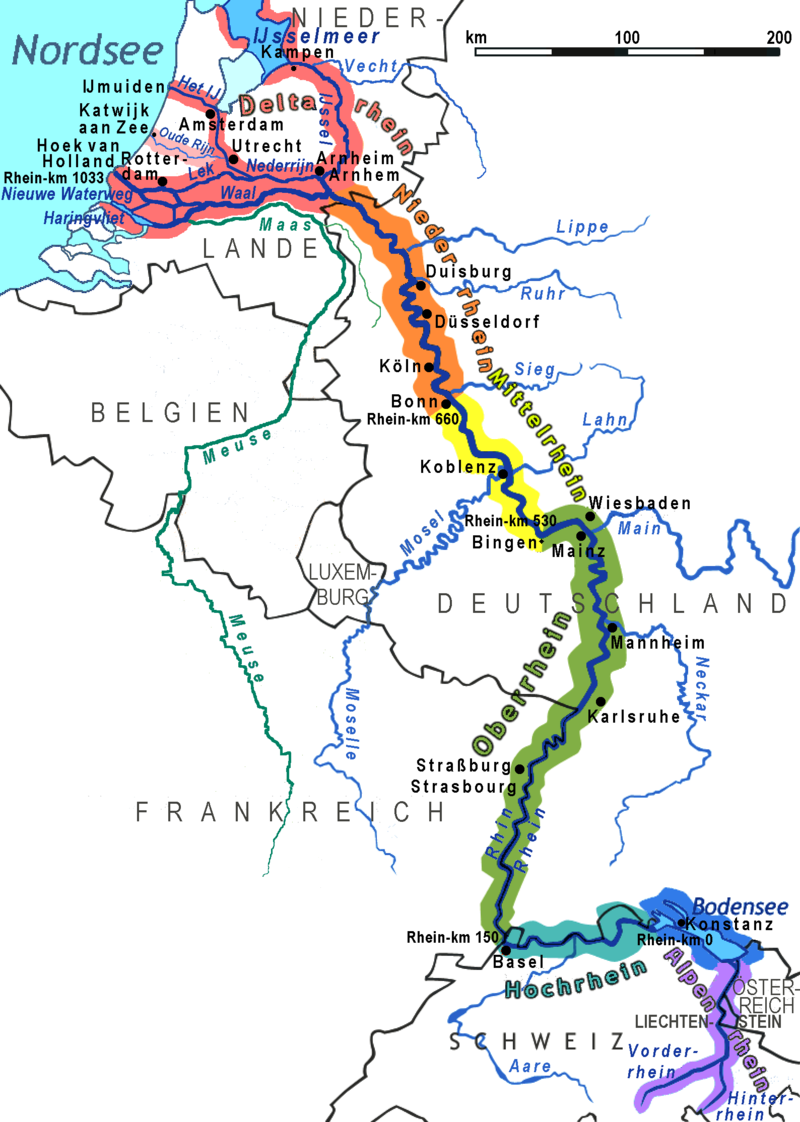
Map credit: Daniel Ullrich (Threedots) via Wikimedia Commons.

Lucky for us, we can contemplate a river all night…and wind up learning a lot about wine as well. Rivers are easy to research via google…Wikipedia will even work, although I’ve had the best luck with the online version of the Encyclopedia Britannica. To tie this into your wine studies (albeit ever so subtly), have your wine maps handy before you get started. To demonstrate this un-study technique, let’s follow the path of the Rhine River and see where it takes us!

The Journey: The Rhine River begins its journey high up in the glaciers of the Swiss Alps. From there it flows for over 765 miles until it reaches the Netherlands and flows into the North Sea.

The Source: The Rhine is actually formed from two headstreams, both beginning in southeastern Switzerland. The Vorderrhein River emerges from Lake Toma at an altitude of 7,690 feet (2,344 m).  The Hinterrhein Rivers begins at a place called San Bernardino Pass—about 20 miles away from Lake Toma—at an elevation of 6,775 feet (2,065 m).  These two rivers join at the Swiss village of Reichenau (elevation: 1,946 feet/593 m) to form the Rhine.

Switzerland to Liechtenstein to Austria: From Reichenau, the Rhine flows north to form the border between Switzerland and Liechtenstein. Slightly further north, the river creates the border between Switzerland and Austria (in Austria’s far west, mountainous zone).

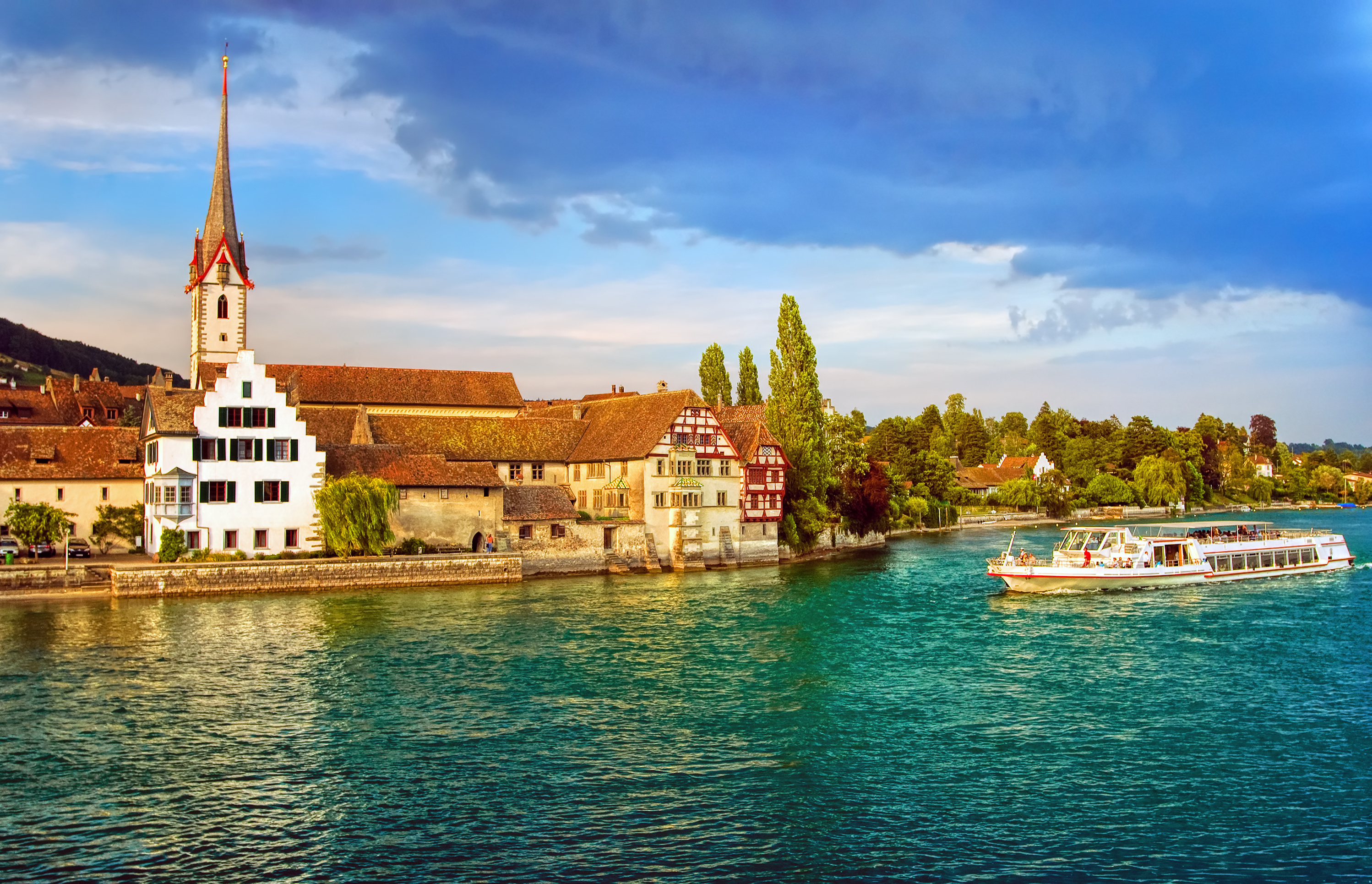
Stein am Rhein—a small town just west of Lake Bodensee in the Swiss Canton of Schaffhausen

Onward towards Germany: Just south of the northern border of Austria, The Rhine blends into Lake Bodensee—only to emerge by taking a sharp turn to the west. At this point, the Rhine is forming the border between Switzerland (to the south) and Germany (to the north) with just a small detour that means Rhine Falls (the largest waterfall in Europe) is located entirely within Switzerland.

Between Alsace and Baden:  After a 20-mile run on fairly flat land, the Rhine takes a sharp turn north near the Swiss city of Basel, and forms the border between France and Germany. The French wine region of Alsace is just to the west of the river, and just beyond the vineyards lie the Vosges Mountains. The German wine region of Baden, and beyond that the Black Forest, are located on the eastern side.

Beyond Baden: Once north of the French Border, the Vosges Mountains become the Hardt Hills, and the Rhine River continues northward between the the Pflaz and Rheinhessen regions to the west, and the small Hessische Bergstrassethe region to the east.

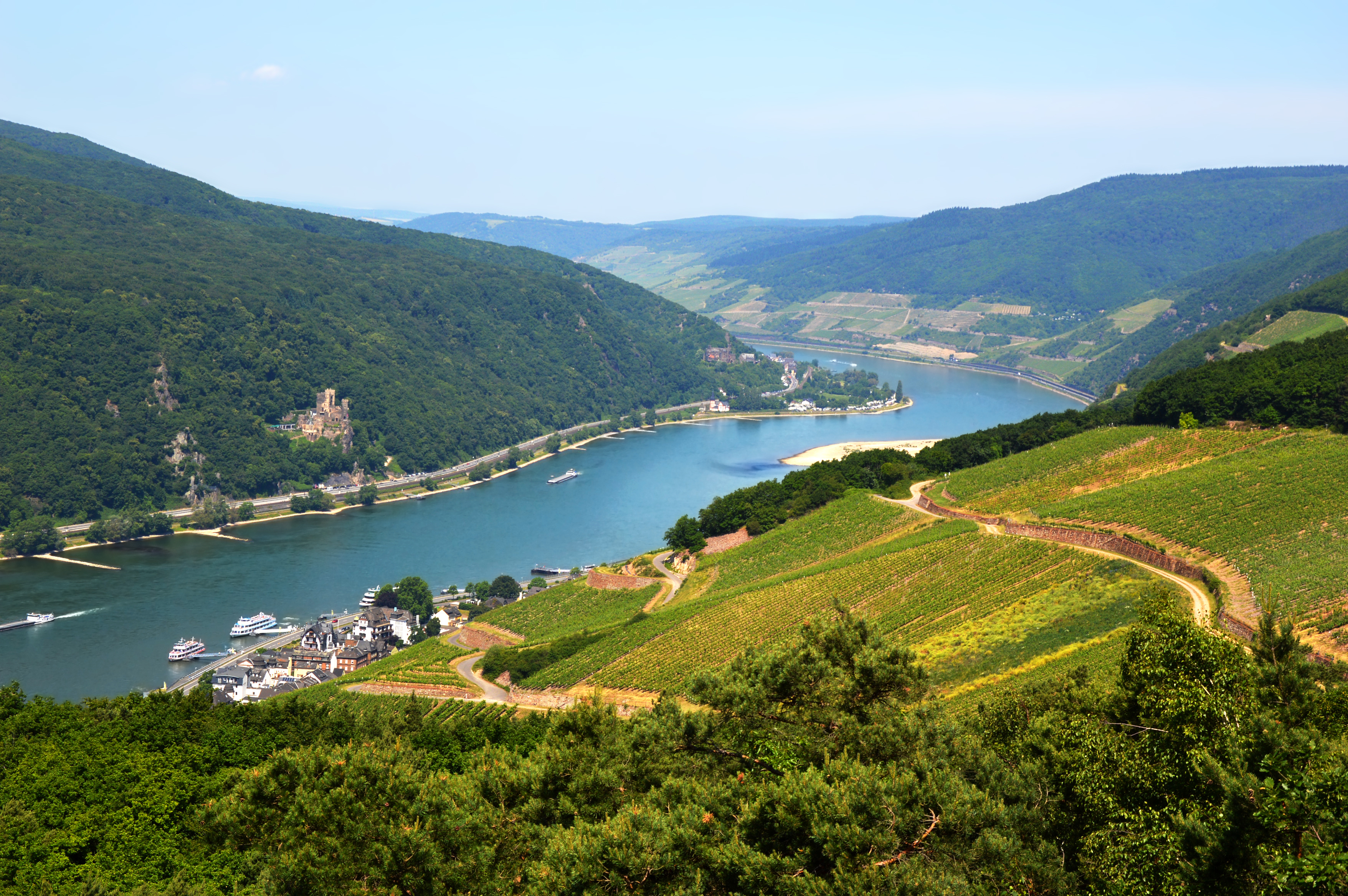
Rüdesheim am Rhein—a German wine-making town in the Rheingau Region

Sharp turn west: After the Main River flows through the Franken Region, it flows into the Rhine. Here, the Rhine River takes a sharp turn and flows westward alongside the Rheingau and a corner of the Nahe region.

The Middle Rhine: Just beyond the small town of Bingen, the Rhine turns again—this time to the northwest—and begins its journey along the 90-miles of the Middle Rhine. This is the area where the river flows through the Mittlelrhine wine region, cutting between the steep, slate-covered Hunsrück Mountains to the west and the Taunus Mountains to the east. This is also the area where the Mosel River (flanked by the vineyards of the region of the same name) flows into the Rhine.

Cologne and beyond: Once past the vineyards of Germany, the Rhine River passes through the German city of Cologne. Just beyond the German border, as the river flows into the Netherlands, it breaks into several wide branches and makes its way to the North Sea.

.

If you want to make your session more interactive, try “free-style” drawing the course of the Rhine River from its source to the North Sea. See if you draw in the surrounding countries (and try not to forget tiny little Liechtenstein), and then pencil in the wine regions of Germany and Alsace. If you are feeling a touch less ambitious, use one of these Blank maps – rivers of Europe to get you started.

References/for more information on the Rhine River:

The Bubbly Professor is “Miss Jane” Nickles of Austin, Texas… missjane@prodigy.net

Un-Study Techniques: Your Five Minutes of Fame

.

This is the third post in our series about “un-study techniques” for use in wine and spirits studies. For our first post, click here.  For our second installment, click here.

An un-study technique is an activity that will help you learn about what you need to know, but will NOT force you to crack open a book or flip over a flash card. An un-study technique is something you can do to help you learn about wine—in those times and situations when you are tired, unmotivated, or just plain sick of studying. We’ve all been there.

Here is this week’s idea; we call it Your Five Minutes of Fame. It works like this:

Instead of studying, pretend that you have an assignment to give a five minute presentation on wine (any wine, any subject). If you work with wine, assume that you are going to present to your employees or co-workers. If you don’t work in wine, let’s assume this is a five-minute talk given to students in an intro to wine class.

Your first step: Choose a topic. We’re just talking five minutes here, so you’ll need to choose a very specific topic. Here are a few ideas:

  • The white grapes of Bordeaux
  • Anjou rosés
  • Subregions of Champagne
  • Terroir of the Sonoma Valley AVA
  • The noble grapes of Alsace
  • Vin Santo
  • Soave
  • Chile’s east-west appellations
  • Vinho Verde
  • The Great Dividing Range
  • Cool-climate regions of Australia

.

Narrow it down: As you can see, it’s easy to come up with a topic. Your next challenge is to narrow your focus down so you can create a five-minute presentation! Keeping your presentation short will force you to focus on the most important pieces of information concerning a topic…in other words, you need to use your critical thinking skills to determine the context and relative importance of all of the available information.

Five key points: For a five-minute presentation, you can easily make five key points. (Don’t fret if you need to expand into plus-or-minus-one-or-two, such is life.) If you are presenting on the rosé wines of Anjou, you five key points might be:

  1. Approximately 45% of Anjou wine is rosé (Anjou makes a range of wines, is most famous for Chenin-blanc based Vouvray, but rosé is a major product.)
  2. The grapes (Cabernet Franc, Grolleau, Grolleau Gris, Cabernet Sauvignon, Malbec, Gamay, Pineau d’Aunis)
  3. Cabernet d’Anjou AOC (Cab Franc + Cab Sauv, min 1.0% R.S.)
  4. Rosé d’Anjou AOC (mainly Grolleau, min 0.7% R.S.)
  5. Rosé de Loire AOC (produced throughout the Central Loire, but a good choice for a dry rosé at a maximum 0.3% R.S.)

That’s it!

.

Keep it Simple: This caveat has nothing to do with your (pretend) audience, but rather this simple truth: you can’t explain something in clear, concise terms unless you have a true understanding of the subject. Anyone can ramble on about a topic…but only someone who really understands the topic can distill it down to a sentence or two. Albert Einstein said it better than I can, “If you can’t explain it simply, you don’t understand it well enough.”

Slides, slides, everywhere the slides: Whether or not you use power point or other types of slides “in real life” – this is a good exercise in consolidating your information and keeping this concise. So…make a slide deck with five slides only, and one of your key points per slide. (When you are done, you can add in an introductory slide and a conclusion, we won’t tell anyone.) Remember to stick to the “real rules” of slide design and do not fill them with words (no fair “reading slides” during your presentation.) Find a photo or make a graphic, and use a statement or two. Use the notes page of the slide to fill in as much detail as you want—this is where a lot of your “un-study” learning will come in.

Learn-by-teaching, learn-by-practice: Practice your presentation and have fun with it! You’ll soon experience the learn-by-teaching effect. Give the presentation to your family, friends, teddy bears, or the mirror. Record yourself and play it back. The point here is to internalize the information until you can talk about the subject naturally and with confidence…to the point where you could give the presentation extemporaneously. Once you’re there, you’ve learned the material—un-study techniques in action!

The Bubbly Professor is “Miss Jane” Nickles of Austin, Texas… missjane@prodigy.net

Keep Calm and Make a Plan (for wine and spirits studies)

.

As mentioned in last few posts, I have been bombarded lately by questions about the what, how, when, and even why of studying. I’ve written a lot about study techniques in the past, and last week I tackled the question where to find the time. This week I’d like to offer up some advice on how to plan your studies by taking your gigantic-goal-at-the-end-of-the-rainbow and breaking it down in manageable week-by-week and day-by-day goals.

In other words, this post is about how to create your study plan. Here’s my take on the subject:

Eyes on the prize: The first step is to establish your long-term goal. If you are seriously into the study of wine or spirits, your goal is likely to be a certification exam—but it certainly could be to get accepted into a certain school or program of study, to land a certain job, or just to increase your knowledge. It’s all good, and it’s up to you.

Establish your timeline: A goal needs to have an end date. As Harvey MacKay says, “A dream is just a dream. A goal is a dream with a plan and a deadline.” Write the end date down and calculate how many days, weeks, and months are left between you and your goal.

.

Gather your materials: Before you can complete your plan, you need to know what you are studying. If you are studying for the CSS, CSW, or any other intro- or intermediate-level wine or spirits certification, you will most likely have a text book (or books). If you do not have an assigned text (or pre-made list of sources), you will need to create your curriculum, starting with a list of topics, and then locate the resources (books, periodicals, websites) yourself.

Break it up: Take the number of weeks you have until your goal, and divide by half. This will be the length of your initial study plan with the goal of making it through a first reading of your material. (After your initial dive through the material, you should create another plan where you revise the material and commit it to memory.) Divide your study materials by the number of calculated weeks. If you have a text book, this should be fairly simple: week 1—pages 1 to 45, week 2—pages 46 to 89, and so on. If you have a list of topics, it could look something like this: week 1—red grapes, week 2—white grapes, week 3—Northern Rhône Valley, week 4—Southern Rhône Valley, and so on. Make a list of your study materials broken down by one-week increments and put a big red star on every fourth week.

Break it down: Take your first week’s study material and divide it more-or-less evenly over six days. For starters, it is best to do this one week at a time. Using a template like this generic weekly study planner can help, but plain old notebook paper will as well. At the top of the page, list what you need to cover for the week. Next, fill in your study goals for six days. The seventh day each week can be a free day, or a make-up day for those weeks when life goes wonky (and it will). Having weekly and daily goals will help keep you on track, create checkpoints for the material, and help you to organize your study materials ahead of time. This step is where the magic happens; a six-month journey through a 300-page text book is daunting; a daily goal to read and take notes on seven pages is easy (easier)..

.

Create your study blocks: Ideally, you should schedule one or two “long” study blocks each day (for 30 minutes to one hour) at the same time each day. One in the morning and one in the afternoon or evening is ideal, but you are going to have to look at your available time during the week and create some study time. In addition, schedule at least three “short” (10-minute study) blocks each day. Click here for advice on how to find the time to study.  Note: it has always worked best for me to schedule in the specific time slots for each study block week-by-week. It’s one of my “things to do” every Sunday morning.

For the longer study blocks: You have three goals for the first half of your study plan: (1) read through the materials, (2) take notes on (or highlight) the materials, and (3) make flashcards or notecards from the materials. Your focus should be on discovering the material and grasping the “big picture” of the subject matter. Use your longer study blocks to progressively plow through the material—at least until you have covered the assigned pages/topics for the day. (At the end of this first half, you’ll create a new plan for the second half of your timeline that will include revision, repetition/memorization drills, critical thinking exercises, and practice tests).

For the shorter study blocks: Use the first short study block of the day to review your latest readings. Use the second to do some follow-up research on topics you are not clear on, or some background research to create context and deeper meaning/understanding of the material. Use the last one to go through your ever-growing stack of flashcards or note cards.

.

Notes to yourself: As you complete your study blocks, jot down a quick note to yourself—just a few words—about what you covered on your study planner. For your longer study blocks, record what chapters, pages, or references you read or reviewed. For the short blocks make a quick note of what activity you completed (for instance; reviewed chapter 1, researched the Gironde River, studied flashcards from chapter 6).

The routine: Having a study block at the same time each day has a myriad of benefits: your schedule is easy to memorize, you can create a routine, and you will develop a positive habit.

Here’s the hard part: Stick to the schedule—there’s not much point in making a study plan if you don’t stick with it (so much easier said than done). However, as life has a tendency to get in the way of even the best of plans, give yourself a break. Remember those big red stars you placed on your schedule every four weeks? If you can make up any study lags or losses by the end of each four-week period, you should consider yourself a study schedule success story!

Do you have any ideas for creating a study plan? Let us know!

Click here to view most posts chock-full of tips and tricks for learning!

The Bubbly Professor is “Miss Jane” Nickles of Austin, Texas… missjane@prodigy.net

The Timewarp: How to Find the Time (for Wine and Spirits Study)

.

Where to find the time?

I’ve been bombarded by “how, when, and why to study” questions lately. I’ve written a lot about how to study in the past, but would like to tackle the never-ending question of “where to find the time in a busy, stressed-out, hacked-up world” today. I am sure that none of these suggestions are ground-breaking (or time-warping), but these tactics have worked—at different stages of life—for me and many of my students, and maybe one or two will work for you!

Be dressed and ready to go (early): Whatever your deadlines are for the day—leave for work at 8:00 am, be ready to go to dinner at 7:00 pm, have the housework done for the day by 8:00 pm so you can watch Grey’s Anatomy in peace—try to be primped, dressed, and ready-to-go early, and use that time to study. In the morning, you might be able to make this happen so that you have a half an hour of “found” time. Later in the day, the goal might be five or ten minutes of spare study time. Whatever the time frame, it’s a perfect excuse to fit in a few minutes of no-stress study time.

.

Show up early: Whenever you have an interview, an appointment, a lunch date, or even a dentist appointment, get there early and you will have a beautiful block of stress-free study time. Plant yourself as close to your appointment as you can—in a coffee shop, the building lobby, or even in your car—and hit the books (or flashcards).

Stay late: At the end of your shift, stay after work for a half hour or so and study. If you have an office, just shut the door and pretend that you are not there. If you don’t have an office, consider using your desk, the building lobby, an employee break room, a coffee shop, or just go sit in your car. If you work nine-to-five, this half hour of “found study time” might have the added benefit of easing the crush of the evening rush hour. One caveat: this might not be the best idea for those of you who work the late-night shift.

Brush it up: Everybody brushes their teeth (let’s hope) in the morning and again at night (and most likely a time or two in between—I am talking to you, popcorn and cotton candy eaters). Why not tack on an extra five or ten minutes to your morning and/or evening routine, and schedule one of your shorter study sessions for right after your brush your teeth? You’ve already carved out these segments of the day as personal time, so it’s an established habit—no behavior modification necessary.

.

Skip it: First things first: there is no way I am skipping Jeopardy. However…we all know that an hour a day (or even a half hour) of study time can lead to big results. If you really can’t find that kind of time in your schedule, consider swapping out one hour or half hour of activity a day. Skip the first half hour of Morning Joe. Skip the 6 pm news. Skip the re-run of Family Feud you watch before dinner (I know, that one’s tough). Cut your Candy Crush time in half. Cut your social media time down by 40%.

Everybody get up: Get up a half hour earlier than you need to, make a fast cup of coffee or tea, and make studying the first project of each day before the rest of the world even knows you are awake.

Use that drive time: It is easy to study if you use public transportation—just dive right in to your books, notes, or flashcards. However, if you drive yourself, you need to be more creative. Consider making short recordings of yourself—read from your study guide or textbooks, read from your notes, or recite short lists of information (regions of Chile, styles of Champagne, lists of approved grape varieties [for instance]). You can even make verbal quizzes for yourself (ask a question, wait ten seconds, read the answer). This study technique has all kinds of active learning benefits built right in. Of course, many people use drive time to listen to their favorite podcasts, radio programs, or audiobooks; this is a great idea made all the better if you can find one that is applicable to your current studies.

If you have any time-warping ideas of your own, help us all out by letting us in on your secrets in the comments!

Click here for more tips on how to study wine and spirits…we have a lot!

The Bubbly Professor is “Miss Jane” Nickles of Austin, Texas… missjane@prodigy.net

(Un-study Techniques) The Big Picture is Worth a Thousand Words

.

This post is the second in our series on Un-study Techniques, or How to learn about wine when you just can’t stand to study any longer.

An un-study technique is an activity that will help you learn about what you need to know, but will NOT force you to crack open a book or flip over a flash card. An un-study technique is something you can do to help you learn about wine—in those times and situations when you are tired, unmotivated, or just plain sick of studying. We’ve all been there.

This week we offer an un-study technique we call “The Big Picture is Worth a Thousand Words.” Here’s how it works:

For starters, choose a wine-related (or wine-adjacent) place or thing—not a wine, winery, or an appellation—but rather something like a mountain, river, monument, city, statue, or village. This can be approached one of two ways: either start with something that is of particular interest to you, or go random and throw a dart. Here are a few ideas for your first topic:

  • The Hill of Hermitage
  • The Riddoch Highway
  • Lake Garda
  • Santa María la Real de Irache (the Monastery of Irache)
  • Mount Aconcagua
  • The Abbey of Sant’Antimo
  • The Cathedral of Reims

If none of these float your boat, we have more. Click here for a pdf of: The Big Picture is worth a Thousand Word – Suggested Topics

.

Once you’ve chosen your place-or-thing, do a Google Image search and find an image that you just love (and, ideally, piques your curiosity or wanderlust). Print out the picture (or just leave it on your computer screen) and go for it—do some research, and find out everything you can about your chosen mountain-river-monument-city-village-building-statue-or whatever. Be on the lookout for something fun, humorous, or just plain fascinating about the topic. What you’re doing is building some meaningful context that will help in the next step…which is, of course, studying the wines of the place.

The point of this exercise is that your newly-found contextual knowledge—besides the fact that it is engaging and will undoubtedly make you a more fascinating companion—is that it is likely to allow you to more easily understand and recall the need-to-know details about wines of the area. And yes, that’s the next step…study the wines of the area! Ideally, your new-found background knowledge will spike your curiosity and help you break through that “can’t stand to study” rut you’ve temporarily fallen into.

Be advised: this study technique is likely to result in you heading out the door to find a bottle of said wine—that is, if you didn’t purchase one in advance. Just don’t forget to record your tasting notes before the bottle is gone.

Stay tuned for more un-study techniques in the coming weeks and months, and as always, enjoy your (un) studies!

The Bubbly Professor is “Miss Jane” Nickles of Austin, Texas… missjane@prodigy.net