Five Fast Facts about the Edna Valley AVA

Base map via the TTB AVA Explorer

I am teaching a wine and food pairing class this afternoon, which just happens to feature a lovely Pinot Noir from the Edna Valley. As such, today is a great day to look at five fast facts about the Edna Valley AVA!

#1: It’s named after a town: The Edna Valley AVA—located in California’s San Luis Obispo County—is named after the rural town of Edna (population: 193). Edna was founded in the 1880s by a dairyman Edgar Steele.

#2: Time and place: The Edna Valley AVA was established in 1982 as a sub-appellation of California’s larger Central Coast AVA. At this time, it was the first sub-appellation to be established in San Luis Obispo County. Other AVAs in San Luis Obispo later followed, including several which are much better-known than the Edna Valley; these include the Paso Robles AVA (and her 12 sub-appellations), the Arroyo Grande AVA , York Mountain, and the Templeton Gap. The Edna AVA became a sub-appellation of the San Luis Obispo Coast (SLO Coast) AVA once it was established in 2022. If you are hanging out in the Edna Valley AVA, you can practically wave “hello” to your friends at Cal Poly and drive the 5 miles to Pismo Beach in about 10 minutes. The Edna Valley AVA is often discussed in tandem with its neighbor-to-the-immediate south, the Arroyo Grande Valley AVA.

#3: It’s a cool-climate paradise: The Edna Valley AVA extends along a low-lying northwest-southeast canyon tucked into Santa Lucia Mountains.  The western edge of the Edna Valley AVA is located just about 7 miles from the coast and is situated at the southeast end of the Los Osos Valley. The Los Osos Valley extends all the way to Morro Bay and helps to keep the area cool—and only moderately sunny—by siphoning an influx of ocean breezes and maritime fog down into Edna Valley. Combined, these influences provide the Edna Valley AVA with an overall cool climate and a super-long growing season (some say it has the longest growing season of all of California).

#4: Agriculture is well-established: Many successful agricultural endeavors were established in the Edna Valley in the 19th century. These included some viticulture (Mission grapes) as well as dairy farms, orchards (apple, pear, and citrus) and oat and barley farms. These businesses thrived well into the 1970s, when vinifera-based viticulture and winemaking caught on.

#5: Come for the Pinot, stay for the Chardonnay: Accounting for just over 30% of total vineyard plantings, Pinot Noir is the most widely planted grape variety in the Edna Valley AVA. Chardonnay—planted in about 28% of the vineyards—comes in second place. Other notable varieties include Syrah, Sauvignon Blanc, Albariño, Pinot Gris, and Viognier. This is a gorgeous area for wine tourism and tasting (and don’t forget a quick detour to the beach). Welcoming wineries located in the Edna Valley AVA include Tolosa Winery, Saucelito Canyon, and Wolff Vineyards.

References/for more information:

The Bubbly Professor is “Miss Jane” Nickles of San Marcos, Texas… missjane@prodigy.net

Five Fast Facts about Mencía

.

Mencía is a red grape variety grown mainly in northern Spain with additional plantings in central Portugal. It is known for producing nicely acidic, moderately tannic, and delightfully flavorful red wines.

If that is all that you know about Mencía, you are doing pretty well! However, if you’d like to learn a few more fascinating facts about Mencía, please read on!

#1: It is pronounced “Men-thee-ah.”

#2: It was once thought that Mencía was the same grape as—or closely related to—Cabernet Franc. However, modern DNA testing has proven that Mencía and Cabernet Franc are not particularly closely related. Mencía is, however, identical to a Portuguese grape known as Jaen—aka Jaen du Dão. It is possible that Mencía is native to the north of Spain and spread from there to Portugal’s Dão Region—perhaps via pilgrims trekking home from Santiago de Compostela. However, it is also possible that it originated in the Dão and later made its way to Spain.

.

#3: These days, Mencía is best-known as the main grape of Spain’s Bierzo DO (located in the region of Castilla y León), where it accounts for nearly 75% of the vine acreage. Mencía is also grown in Galicia (Spain) in the Valdeorras DO, Monterrei DO, and Ribeira Sacra DO. In Portugal, it is grown in the Dão, Lisboa, and Beira Interior Regions.

#4: In the not-too-distant past, Mencía was primarily grown in the fertile, rain-abundant plains and valleys of Portugal and Galicia. These plantings produced high yields, which were in turn used to produce large volumes of high-acid, fruity, quaffable wines often compared to certain lovable-but-not-serious versions of Beaujolais. As these things usually go, there certainly were a handful of quality-minded producers all along, and the idea of ultra-high quality Mencía was fully realized when—in the 1990s—Alvaro Palacios came to town. Palacios, already famous for creating ultra-high-quality wines in Priorat, began to produce Bierzo DO wines from 40-to-60-year-old Mencía vines grown on the well-drained soils of the area’s hillsides. The resulting wines, now produced by Descendientes de J. Palacios, are rich, concentrated, serious wines (including some single-vineyard bottlings that can fetch prices of $500 a bottle or more). Other top producers of hillside-grown Mencía include Dominio de Tares, Raùl Pérez, and Castro Ventosa (whose holdings include a pre-phylloxera Mencía vineyard planted on the only sandy soils to be found in Bierzo).

.

#5: Quaffable wines produced from the Mencía grape variety will be pleasant enough and have a nice cherry-red color, good acidity, and moderate tannins as well as aromas of strawberry, raspberry, cherry, and pomegranate with some floral undertones. Lower-yield, higher-quality Mencía can show all of the above as well as hints of licorice, black pepper, and a whiff of minerality—often described as a “gravel-like scent”. These wines can be deep red/violet in color, rich in meaty tannins, and as age-worthy as the finest Pinot Noir.

According to the latest figures, there are about 25,000 acres (10,100 ha) of Mencía in Spain, as well as about 7,000 acres (2,835 ha) in Portugal.

References/for further information:

The Bubbly Professor is “Miss Jane” Nickles of Austin, Texas… missjane@prodigy.net

Five Fast Facts about Saperavi

In one of the most extreme and impressive examples of everything old is new again that I have ever seen, the Saperavi grape is having a moment in the spotlight. Read on to learn more about the modern incarnation of this most ancient grape!

#1—It is a true Georgia native: Georgia (the country) has been making wine for over 8,000 years and is fittingly referred to as “the birthplace of wine.” With all that time for the vines to adapt and co-mingle, it should come as no surprise that over 500 specific grape varieties are native to the area. While most of these 500+ grapes are still thriving, the two most widely planted grapes of the country are Saperavi (our hero), and Rkatsiteli (a white grape that is both the most widely planted in Georgia and also one of the leading grapes throughout the Caucasus and Eastern Europe).

#2—What is a teinturier? Saperavi is a teinturier: A teinturier is a rare type of red wine grape that has reddish-pinkish colored flesh in addition to the red-blue-black-purple of the skin. Most red grapes—as wine students certainly know—contain white/greyish pulp, which is why maceration (contact with the grape skins) during fermentation is required to produce a wine with a hue on the pink–red–purple spectrum. Other teinturiers—in addition to Saperavi—include Alicante Bouschet and Chambourcin.

#3—Saperavi is to dye for: All that color—the tinted juice as well as the thick, anthocyanin-rich, deep-almost-black color of the skin—means that Saperavi is often used to kick up the color in red wine blends. As such, it makes total sense that the name of the grape is derived from a Georgian word meaning paint, dye, or place of color.

#4—Everything (Saperavi) old is (Saperavi) new again: These days, Saperavi has significant plantings in Ukraine, Moldova, Armenia, Russia, Bulgaria, and Australia. It has even spread to the Finger Lakes AVA in New York State. It is the leading red grape of Georgia’s well-known Kakheti PDO and is planted throughout many of the other wine regions of the country. In addition to its well-known inky, dark color, rich tannins, and lively acidity, Saperavi-based wines often show aromas of black fruit (dark berries and black currants), sweet spices (nutmeg and cinnamon), tobacco, cocoa, and roasted coffee beans.

#5—Saperavi has a son (or a daughter?): Saperavi is—along with Severny (a complex Vitis amurensis hybrid)—a parent! The result of this pairing—accomplished in the laboratory of Ya Potapenko at the Russian Center for Viticulture and Winemaking in Novocherkassk—is known as Saperavi Saverny and referred to as Northern Saperavi. Northern Saperavi is very cold tolerant (which makes sense for a grape bred to be grown in the Riostov region Russia) is known to produce highly tannic, age-worthy wine. Often blended with its parent grape (Saperavi), the wine thus produced often shows a fruity and herbaceous character.

References/for more information:

The Bubbly Professor is “Miss Jane” Nickles of San Marcos, Texas… missjane@prodigy.net
Sweet Secrets of the Northern Rhône (the Misfits Series)

.

The 30-mile (72-km)-long stretch from Vienne to Valence in France’s Northern Rhône Valley is famous for its sturdy, Syrah-dominant red wines. Just whispering the word Hermitage (or Cornas or Côte-Rôtie) is enough to make a red wine lover smile. Equally well-known—albeit produced in much smaller amounts—are the fruity, floral, and powerful white wines of Condrieu and Château-Grillet (made from 100% Viognier). The area also produces sparkling wines down along its southern edge in the Saint-Péray AOC. While the Marsanne and Roussanne-based bubblies of Saint-Péray may seem somewhat out-of-place in the rough-and-tumble Northern Rhône, they are nevertheless well-known and acknowledged among well-informed enthusiasts and students of wine.

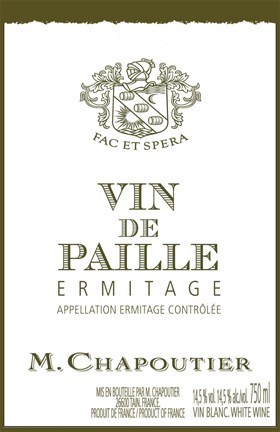
However, there is a secret whispered among the steep, hillside vines of the Northern Rhône, and you can hear it if you really try. It sounds like this—sweet wines are made here too. You may need to tread deep into the cellars to find these wines, but they are here: Hermitage Vin de Paille and Condrieu Doux.

The Condrieu AOC—located towards the northern end of the Northern Rhône, just south of the Côte-Rôtie—is a white wine-only appellation producing richly flavored and -textured wines from 100% Viognier. Like most Viognier-based wines, Condrieu AOC tends to be wildly aromatic, showing perfume-like scents of fruit (apricot, peach, tangerine, mango, fruit cocktail); flowers (honeysuckle, rose petals, jasmine) and baking spice (cinnamon, nutmeg, anise).

It’s a little-known fact, but (like many French wines), Condrieu was historically produced as a sweet wine. Harvest would traditionally begin on All Saint’s Day (November 1). It was not until the mid-1950s that the leading style of Condrieu shifted to the heady, dry wines that make up the majority of the production today.

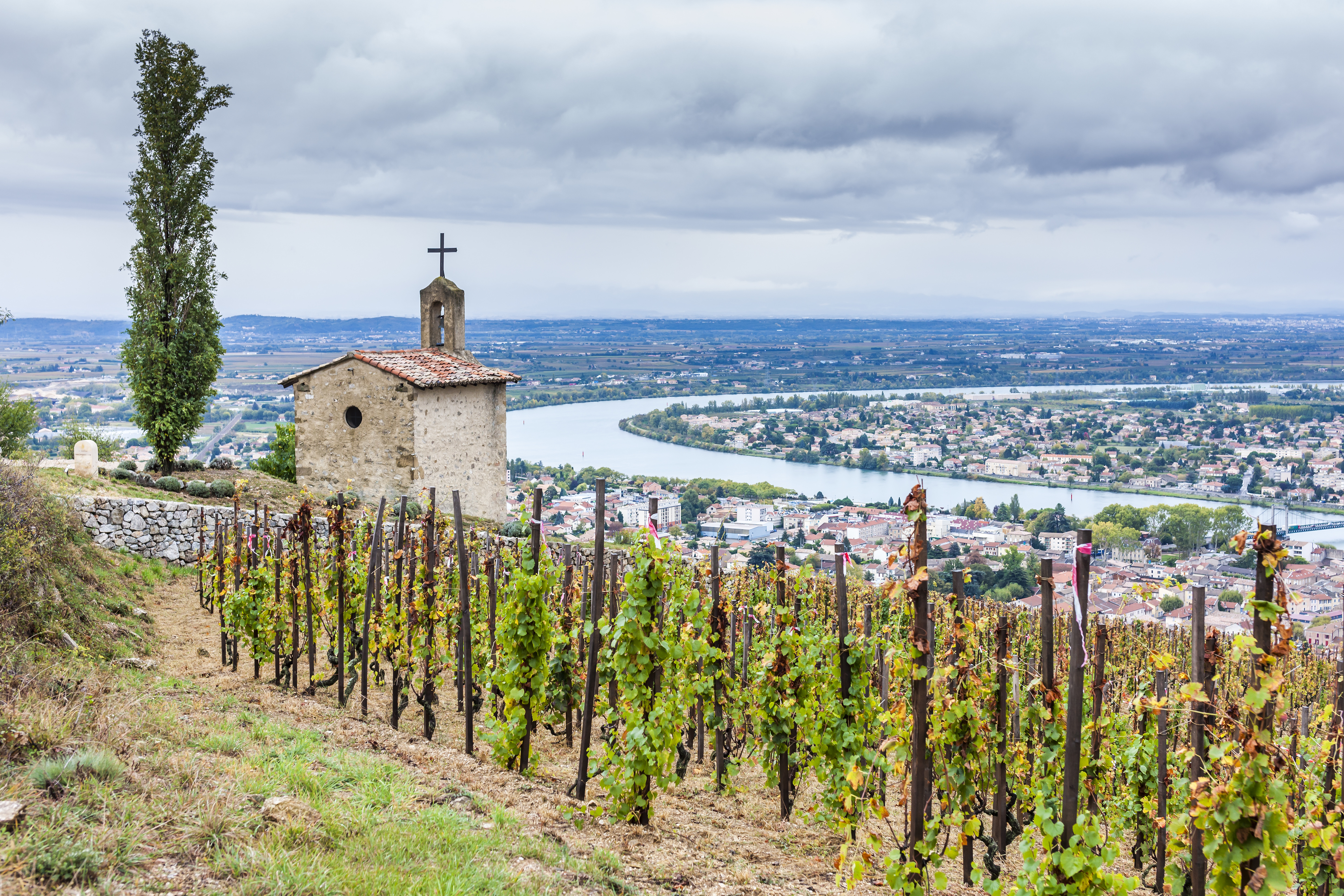
In keeping with tradition, some wineries in Condrieu still produce sweet wines (alongside their dry versions). Cave Yves Cuilleron produces a sweet (11% RS) Condrieu, Condrieu Ayguets Doux. According to their website, the south-facing aspect of the vineyard promotes over-ripeness, and the grapes (harvested in stages from mid-October to mid-November) were at least partially affected by botrytis in the 2018 vintage. The resulting sweet wine was matured for eight months in oak barriques and emerged with “notes of candied fruits, honey, wax and mild spice.”

Other examples of sweet Condrieu include Domaine du Monteillet’s Condrieu doux Candice (made from 50% botrytized grapes), Domaine Christophe Pichon Cuvée Patience, and E. Guigal Condrieu Luminescence (produced only a few times over the history of the estate using ultra-over-ripe grapes).

.

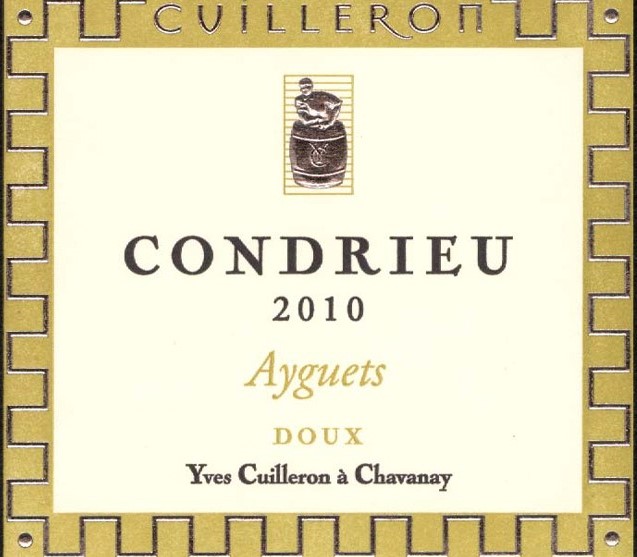
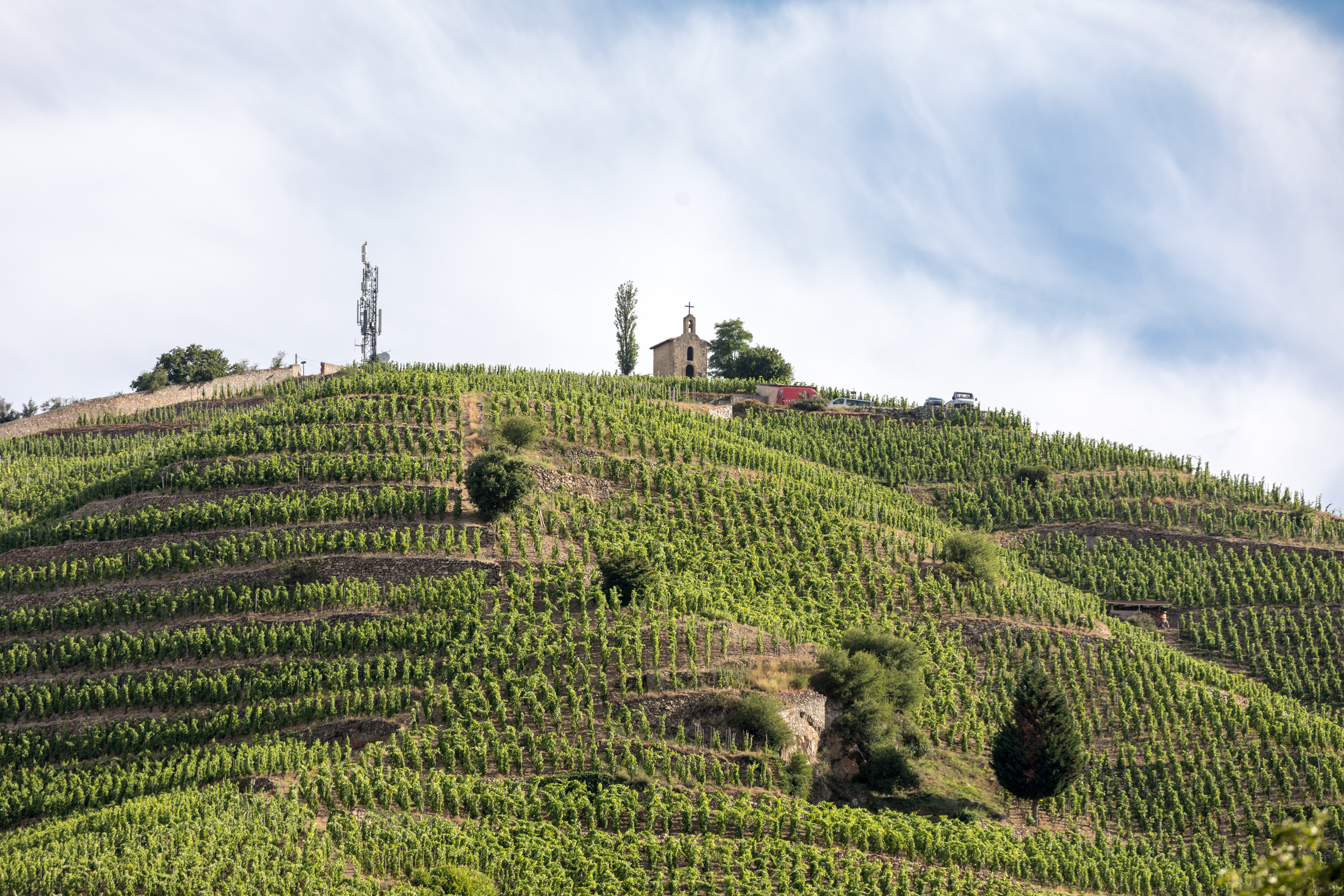
The Hermitage AOC—located on a famous south-facing, terraced hillside towering above the curving Rhône River and the town of Tain-Hermitage—is well-known for its sturdy, fruity-but-earthy Syrah-dominant red wines. The red wines of the region allow for the use of up to 15% (combined) Marsanne and Roussanne grapes, and white wines—based mainly on the Marsanne grape variety and known for being dry, sturdy, and long-lived—are produced as well.

Viticulture in Hermitage can be traced back thousands of years, and many people believe this hillside to be the actual—or perhaps just spiritual—birthplace of the Syrah variety. Vines were tended, and wine was produced in the area as far back as Roman times, when the local wine was referred to as the “wines of Vienne.” Among these ancient wines were sweet wines made from grapes allow to dry (raisinate) on straw mats after harvest. This style of wine—now known in this area as Vin de Paille—is being produced again, now under the auspices of the Hermitage AOC.

According to the rules and regulations, Hermitage Vin de Paille may be produced using the Marsanne and/or Roussanne grape variety. The grapes—which may be picked at a “typical” level of sugar ripeness—are left to dry on straw mats for a minimum of 45 days and until they have a minimum must weight of 350 g/l. While not required, the rich, sweet juice is typically barrel fermented and oak aged for several years before bottling. The resulting wines are intended to be very aromatic—redolent of candied fruit—with good levels of sugar and alcohol, and very well poised for long aging.

M. Chapoutier has—since 1990—occasionally produced a Hermitage Vin de Paille; the 2009 vintage was made from 100% Marsanne grapes that had been dried on straw mats for two months before pressing. The wine produced in 2009—which the winery advises may continue to successfully age for up to 50 years—has almost 15% abv and 10.5% residual sugar. The wine (as reported by the estate) has a deep, golden yellow color and intense aromas of candied fruits and honey. It is suggested to be served with fruit desserts…or as a dessert by itself.

Sweet wines of the Northern Rhône…they are fascinating, ancient, and true misfits, but secret no more!

References/for more information:

The Bubbly Professor is “Miss Jane” Nickles of San Marcos, Texas… missjane@prodigy.net
Aspect: East, West, (and Romeo’s)

What light through yonder window breaks? It is the east, and Juliet is the sun.

Many people will recognize these famous lines  from Shakespeare’s Romeo and Juliet (Act 2, Scene 2) . However, it would take a true-and-total wine geek to understand how hearing that line—one of the most romantic ever written—inspired me to write a blog post about east-west aspect and its effect on a vineyard (and yet it did). Something about Romeo invoking the sun rising in the east reminded me of the concept of eastern aspect—as it was used in a recent discussion of the vineyards of the Côte d’Or—and here we are.

.

Wine students are well-aware that in the Northern Hemisphere, south-facing slopes (hillsides with southern aspect) receive the benefit of more direct sunlight (solar radiation/insolation) than other areas (those that are flat or facing north). These directions are flip-flopped in the Southern Hemisphere, where hillsides with a northern aspect have the sunshine advantage. The CliffsNotes version of north-south aspect is that if a hill faces the equator, it receives the bonus insolation.

Lesser known to wine students (but very important to realtors, as I learned) are the effects of eastern and western aspects, as discussed below:

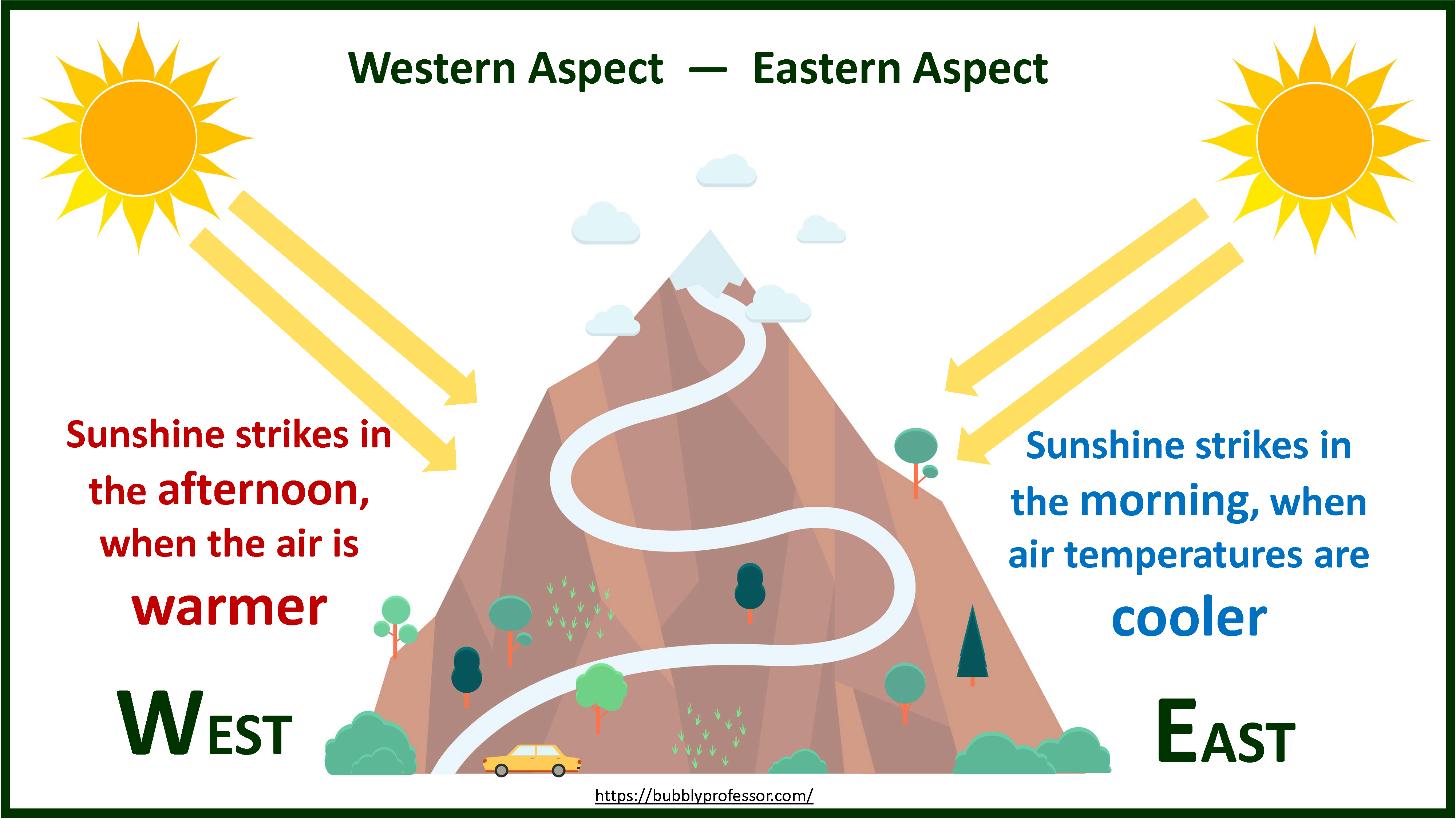
Eastern aspect: These vineyards receive sunshine in the morning, when the sun’s rays are at their gentlest, and the ambient temperature is comparatively cool. This morning glow helps to dry out the vineyards from dew and overnight rain, helping to prevent fungi, mildew, and some disease. Eastern aspect can “kick-start” photosynthesis in the morning and can also help prevent vines from over-heating in the hot afternoons. Vineyards with eastern aspect tend to have lower maximum daytime temperatures, cooler overall ambient temperatures, and may experience delayed budbreak as compared to other spots.

Western aspect: Vineyards on west-facing slopes receive a good deal of sunlight during the afternoon—typically the warmest time of the day. Vineyards with western aspect may warm earlier in the spring and be among the first vines to undergo budbreak. Western aspect can be especially beneficial in areas near the coast and other places that are susceptible to wind and marginal weather. Western aspect can be a boon to late-ripening and heat-seeking grapes that require a lot of warmth and energy in order to fully ripen. However, It can be a challenge in areas prone to humidity, as the drying-out of dew-, fog-, or rain-related moisture will occur later in the day (as compared to east-facing vines).

Does that make sense to you, Romeo?

References/for more information:

The Bubbly Professor is “Miss Jane” Nickles of San Marcos, Texas… missjane@prodigy.net
 

Confusion Corner: The Cerasuolos

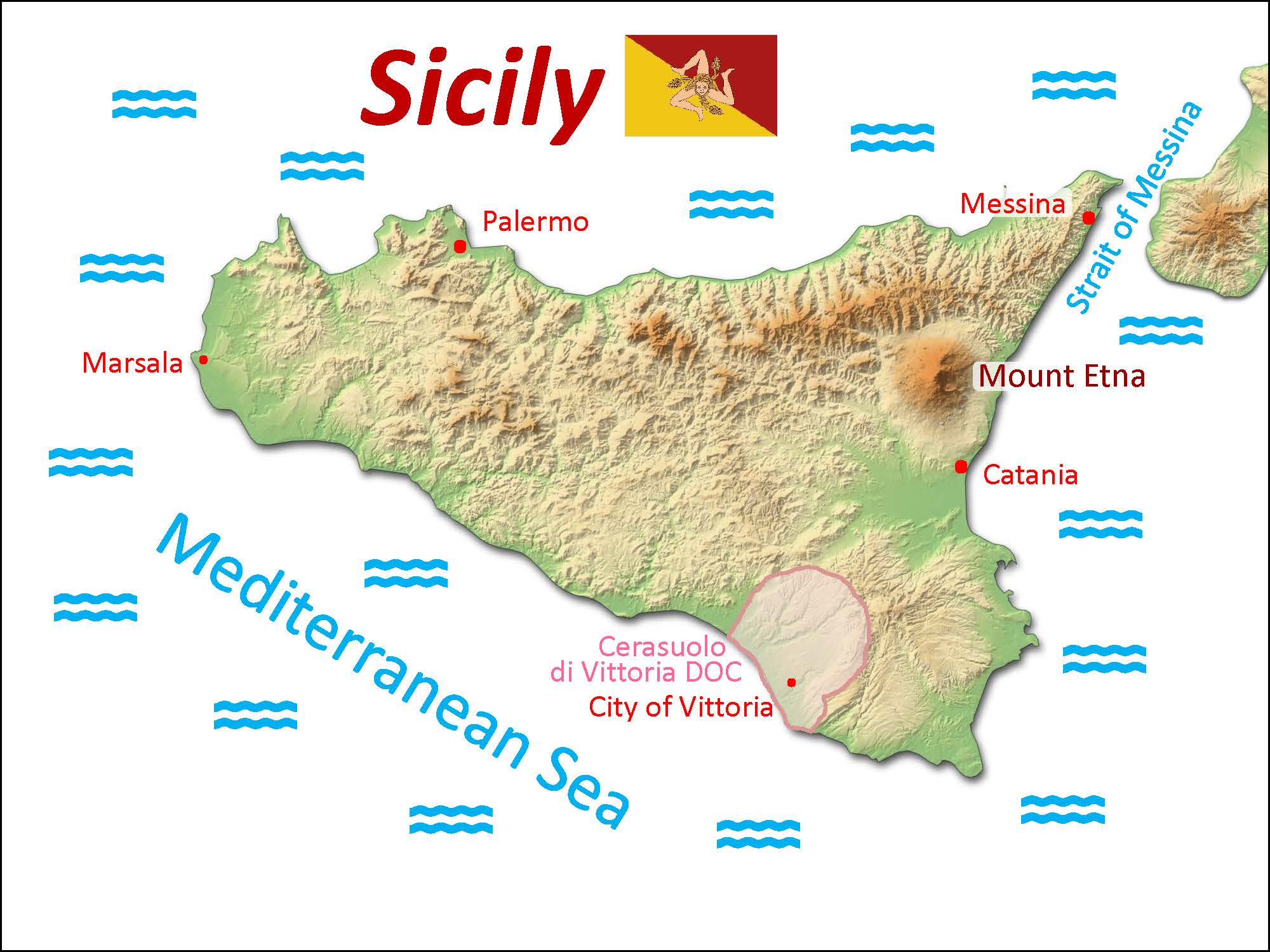
Two Italian wines use the term cerasuolo in their titles: Cerasuolo di Vittoria DOCG and Cerasuolo d’Abruzzo DOC. These two appellations consistently end up in the confusion corner, for obvious reasons.

The term cerasuolo is related to the Latin word cerasia—meaning cherry—and does indeed refer to some sort of cherry-like attribute. However, that in itself does not mean that these two wines are the similar in style.

To clear up any confusion, let’s take a closer look at the cerasuolos.

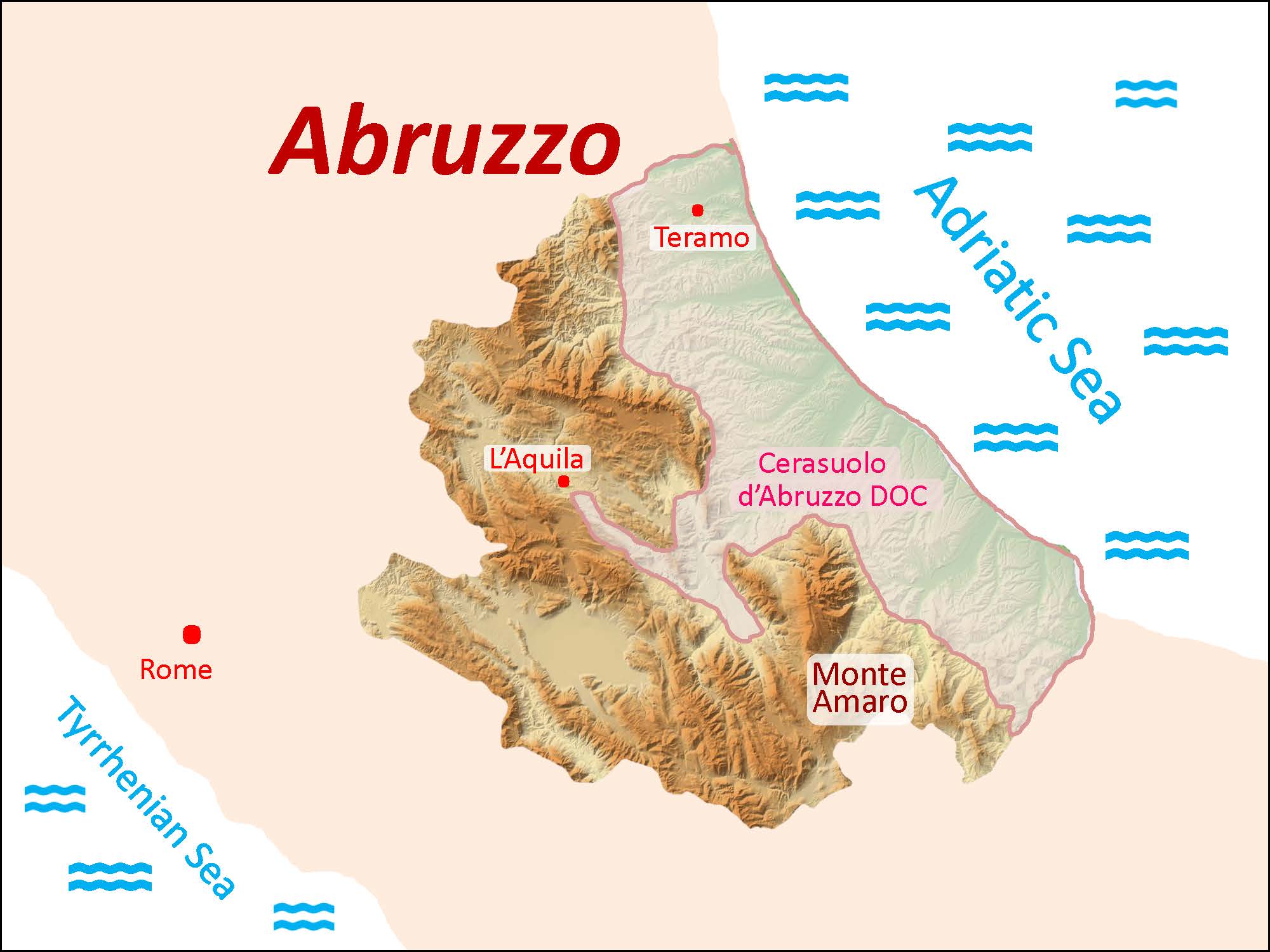
Cerasuolo d’Abruzzo DOC: This Abruzzo-based cerasuolo is a wine with a “cherry-pink” color; famous for being one of the few Italian appellations with a focus on rosato.  The required formula includes a minimum of 85% Montepulciano grapes—with the other 15% allowed to be comprised of any red grape allowed for cultivation in Abruzzo.

The color is described—via the disciplinare—as rosa ciliegia più o meno carico (“more or less intense cherry pink”). This characteristic color is produced via vinificate…in presenza della buccia per un limitato periodo di fermentazione, al fine di conferire al vino ottenuto il caratteristico colore rosa ciliegia (see the disciplinare, article 5, as posted below). Translation: “The grapes are to be vinified in the presence of the grape skins for a limited fermentation period to give the resulting wine its characteristic cherry pink color.”

The Cerasuolo d’Abruzzo DOC covers a large part of the Abruzzo province and co-exists (in the exact same geographic area) as the well-known Montepulciano d’Abruzzo DOC. The appellation rules require that most of the vines be planted at elevations of or 500 meters (1,640 ft) or lower. As such, the appellation includes the entire coastline and the coastal plains of Abruzzo before zigging and zagging through the interior of the region, hugging the lower-elevation valleys and foothills of the Apennines.

Cerasuolo d’Abruzzo was awarded its DOC in 2010; prior to this date these wines were bottled as a specific style of wine produced within the Montepulciano d’Abruzzo appellation (Montepulciano d’Abruzzo Cerasuolo DOC).

Cerasuolo di Vittoria DOCG: This cerasuolo is a wine with “cherry-like” aromas and a deep red color. Cerasuolo di Vittoria is famous as Sicily’s one-and-only DOCG.

The rules require this wine to be produced using 30% to 50% Frappato and 50% to 70% Nero d’Avola. The Frappato grapes are credited with giving the wine its distinctive cherry-strawberry aromas. Thin-skinned Frappato does not, however, bring much in terms of tannin or structure to the wine. These attributes are, however, well-provided by the Nero d’Avola. Nero d’Avola grapes are also largely responsible for the wine’s deep color, which is described as da rosso ciliegia a violaceo (“from cherry-red to purplish”) via the disciplinare.

The defined area for the production of Cerasuolo di Vittoria DOCG is located in the southeastern corner of the island of Sicily, encompassing the coast (and the city of Vittoria) and extending inland for almost 45 miles (70 km). The Vittoria DOC—which allows for the production of red blends as well as varietal bottlings of Nero d’Avola, Frappato, and Ansonica—occupies the exact same area as the Cerasuolo di Vottoria DOCG.

One more—Cerasuolo, Molise: Just to make it crowded in the confusion corner, Cerasuolo is also the name of a small town (hamlet) in Molise. Located within the commune of Filignano, this Cerasuolo is located right along the border between Molise and Lazio. Cerasuolo in Molise lies within a mountainous region of the Apennines and It is not really known as a wine capital, although it does lie within the (nearly) region-wide Molise DOC.  Rather, this Cerasuolo is super-small mountain town (around 300 buildings) located just outside of a large national park—the Parco Nazionale d’Abruzzo, Lazio, e Molise.  Click here for a dreamy, beautiful visual tour of Cerasuolo in Molise, via Michael Pacitti.

References/for more information:

The Bubbly Professor is “Miss Jane” Nickles of San Marcos, Texas… missjane@prodigy.net
Happy Beaujolais Nouveau Day!

(Wine Geo) Burgundy’s River—the Saône

From its source west of the Vosges Mountains, France’s Saône River flows past Burgundy’s Côte-d’Or and the finest vineyards of Beaujolais before it joins the Rhône River in the city of Lyon. Read on to discover five fast facts about the Saône River!

#1—It’s Burgundy’s River: The Saône River flows—generally to the southeast—for just over 294 miles (473 km) across eastern France. For much of its length, it helps to define the wine region of Burgundy and Beaujolais (located along or west of its western shores). Many of the grands crus of the Côte-d’Or are located a mere 10 miles/16 km to the west of the Saône, and once the river makes its way a bit further south, it forms a small part of the eastern border of the Mâcon AOC before heading further south toward Beaujolais. The river then flows past the northern and central portions of the Beaujolais AOC (about 6 miles/9 km from the eastern edge of the vineyards) before it takes a sharp turn to the east just past the town of Villefranche-sur-Saône on its journey to the Rhône.

Map of the Saône River by PRA via Wikimedia Commons

#2—It all begins in the Faucilles: The source of the Saône River can be found within the rolling hills of the Monts Faucilles (Faucilles Mountains).  The Faucilles Mountains mark the boundary between the Lorraine Plateau (to the west) and the Vosges Mountains (to the east). The precise source of the river— a spring located at the foot of a cliff (elevation: 518 feet/158 m)—may be found in the Grand Est commune of Vioménil.

 #3—It’s Petite and then it’s Grande: The Saône meanders as a slow, winding river—known as the Petite  Saône through the Faucilles Mountains and across the Lorraine Plateau for about 93 miles/150 km until it is joined by the Doubs River in the town of Verdun-sur-le-Doubs. At the point of its confluence, the Doubs is a much more impressive waterway than the Saône (and some would argue that the Saône joins the Doubs instead of the other way around). From Verdun-sur-le-Doubs to its confluence with the Rhône—where it is known as the Grande Saône—river is a high-capacity waterway crisscrossed with canals leading to the vineyards of Burgundy as well as many other large rivers—including the Loire, the Marne, and the Rhine.

Photo of the Presqu’île by David Monniaux with Wikimedia Commons

#4—There is “almost an island” near the end: Located with the 1st and 2nd arrondissements of the city of Lyon, the Presqu’île is a peninsula extending from Croix-Rousse hill in the north and surrounded by the Rhône and Saône Rivers—precisely at the point where they join. The word presqu’île translates literally to “almost an island,” an apt way to describe the prestigious area, recognized as a UNESCO World Heritage site and home to Lyon’s City Hall (the  Hôtel de Ville) and the 14th-Century Church of St. Nizier in addition to a plethora of restaurants, cafés, and department stores.

#5—It feeds the Rhône: In the city of Lyon, the Saône flows into the Rhône as a right-bank (and the Rhône’s largest) tributary. From Lyon, the Rhône flows south through a valley (well-known to wine lovers as the Vallée du Rhône/Rhône Valley) tucked between the Alps and The Massif Central. Just past Arles, it breaks into two arms and forms the Camargue Delta on its way to the Mediterranean Sea.

References/for more information:

The Bubbly Professor is “Miss Jane” Nickles of San Marcos, Texas… missjane@prodigy.net
Confusion Corner: the Montepulcianos

.

Welcome to confusion corner, Montepulciano! Well-deserved! To wit: Montepulciano is a place (a town in Tuscany), a grape (a red variety), and the name of several wines. Let’s see if we can de-muddle some of the Montepulciano mayhem by taking them one by one. Before we get started, you need to know this (and this is going to hurt): Montepulciano the grape is NOT grown in Montepulciano the town. 

Montepulciano—the town: Montepulciano is an ancient hilltop town located in Tuscany—about 43 miles (70 km) southeast of Siena. The town—once a Roman fort charged with guarding the main roads of the area—sits on a 1,985-foot- (605-m-) high limestone ridge. The town’s historic center is home of a range of Renaissance palaces (Palazzo Comunale, Palazzo Tarugi), a delightful town square (Piazza Grande), and more than one imposing place of worship (don’t miss the Santa Maria Assunta Cathedral). Beyond Montepulciano’s medieval walls lie rolling hills, vineyards, and cypress trees as far as the eye can see. Such towns are what Tuscan dreams are made of.

The Palazzo Comunale (Town Hall) in Piazza Grande, Montepulciano

The wines of Montepulciano (the town): Those vineyards surrounding the town of Montepulciano are mainly planted to Sangiovese—although here it goes by the name of Prugnolo Gentile. The most famous wine of the area—Vino Nobile de Montepulciano DOCG—is produced using a minimum of 70% Prugnolo Gentile. In addition, it often contains a smattering of other red grapes and maybe a dash or two (maximum 5%) Malvasia Bianca Lunga or other white grapes. Vino Nobile de Montepulciano DOCG requires a minimum of one year in oak and a total of two years of aging (measured from January 1 of the year following the harvest) before its release.

Rosso di Montepulciano DOC—a more modern, fruit-forward red wine of the region—is produced using the same grape varieties but only requires a few months of aging. With some exceptions, Rosso di Montepulciano DOC may be released on March 1 of the year following harvest. In April of 2020, the consorzio for Rosso di Montepulciano DOC sought to assuage some of the Montepulciano madness by requiring that the wine bear the term Toscana on the label along with the name of the wine.

Montepulciano: the grape

Montepulciano—the grape: The grape variety known as Montepulciano is most likely native to the area around Abruzzo. Montepulciano—widely planted across central Italy—is a prolific grape known to produce red wines of deep color and ample tannin. After Sangiovese, it is the second-most-widely planted red grape in Italy and as such, it makes sense that Montepulciano (the grape) is often used as a blending partner for Italy’s superstar Sangiovese.

On its own, Montepulciano can be made into medium-bodied, easy-drinking pizza wines with cherry-berry aromas and a good zing of acidity. However—particularly when grown on old vines and vinified with a touch of oak—Montepulciano can produce a serious, age-worthy wine redolent of red plum, black fruit (boysenberry, blackberry), herbs, and tar (sounds weird, but Syrah and Nebbiolo can show tar aromas as well).

Photo of Montepulciano d’Abruzzo by Agne27 via Wikimedia Commons

The wines of Montepulciano (the grape): The Montepulciano grape variety is used (in varying amounts) in over 50 DOC/DOCG wines of Italy. Offida Rosso DOCG, Rosso Conero DOC, and Terre Tollesi DOCG are among those that best showcase this grape.

However, the confusion corner sets in with the wines named for the grape itself: Montepulciano d’Abruzzo DOC and Montepulciano d’Abruzzo Colline Teramane DOCG. Montepulciano d’Abruzzo DOC, produced in a large swath of the Abruzzo province stretching along and inland from the Adriatic Sea, is one of Italy’s most widely produced and popular wines. Beloved for its fruity flavors, soft tannins, and delightfully inexpensive price point, it is an easy wine to love.

Montepulciano d’Abruzzo Colline Teramane DOCG—made only in the hilly, northwest section of the larger DOC area—is made with a minimum of 90% Montepulciano grapes; the remaining 10% may be Sangiovese (or more Montepulciano). The wine required a minimum of 2 years of aging (from November 1 of the harvest year). This two-year aging regiment must include at least one year in oak or chestnut and at least six months of bottle aging.  Montepulciano d’Abruzzo Colline Teramane DOCG is a uniquely opulent wine with intense flavors of fruit (dark cherries, red plum), spice, and smoke.

TLDR: Montepulciano is a town in Tuscany; the wine known as Vino Nobile di Montepulciano DOCG is made from Prugnolo Gentile (Sangiovese). Montepulciano—the red grape—is a specialty of central Italy and made into a wide range of wines; Montepulciano d’Abruzzo DOC is among the best known.

Any questions?

References/for more information:

The Bubbly Professor is “Miss Jane” Nickles of San Marcos, Texas… missjane@prodigy.net
Five Fast Facts about Budbreak

.

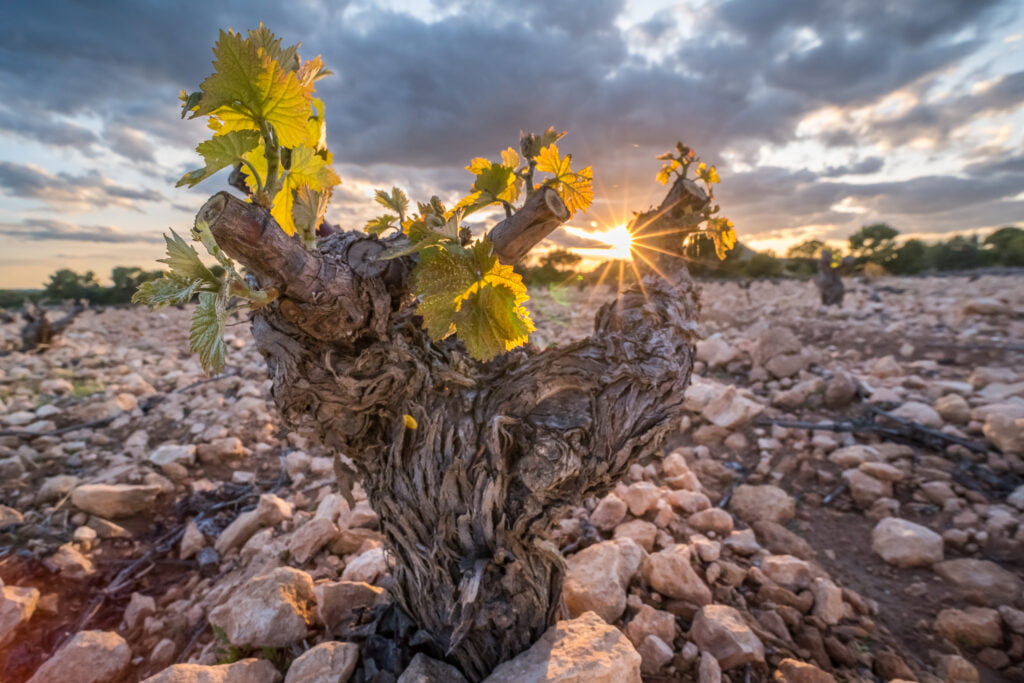
Despite the craziness of the world around us, the natural cycle of life continues. One of the most fascinating to witness—for students of wine—is the life cycle of the vineyard. For those of us in the Northern Hemisphere, we are witnessing the blooming of spring—and along with it—the breaking of buds in the vineyard.

In homage to this annual miracle, here are five fast (fascinating) facts about budbreak in the vineyard.

#1: In a typical year in the Northern Hemisphere, budbreak will begin in mid-March. In years of oddball weather, it may begin to occur as early as mid-February or as late as mid-April. In the Southern Hemisphere, the process typically begins in mid-September, but can be as early as August or as late as October.

.

#2: Within a single vine, those buds that are furthest away from the trunk will break first; in some cases, this may occur several days before those located closer to the trunk. This is particularly apparent when canes are left upright; in such cases the buds furthest from the trunk (the more distal buds) will be observed to burst several days before those closer to the trunk (basal buds). This phenomenon, known as apical dominance, can be avoided by bending or cracking the cane.

#3: The most direct correlation between mother nature and budbreak is the cumulative effect of the warming air temperature once it hits an average of 10°C/50°F. This temperature is sometimes referred to as the “growth threshold” and will signal the nascent buds to shed their fuzzy exterior and break free. Soil temperature may also be a contributing factor, so a wet-and-cold late winter (resulting in wet soils that retain the cold temperatures) can slide bud break back a few days or weeks. (According to the website of Penn State Extension/Wine and Grapes there is conflicting information on whether or not soil temperature affects the timing of bud break. In some studies, Cabernet Sauvignon vines show a correlation between the date of bud break and rising soil temperatures. Alternatively, some studies show no correlation between soil temperatures and the timing of bud break in Syrah.) Other factors that influence the timing of budbreak include photoperiod (day length) and chemical (hormonal) plant growth regulators that help to maintain the plant’s period of dormancy even in the face of mid-winter warm spells.

.

#4: While many factors contribute to the timing of budbreak in a given vineyard in a given year, some varieties are known for their tendency towards early budbreak. Likewise, some grapes tend to be late breakers. Here is a list of some of the better-known varieties, arranged by their tendencies regarding bud-break and ripening:

  • Early bud break/early ripening: Chardonnay, Pinot Noir, Merlot
  • Early bud break/mid-to-late ripening: Chenin Blanc, Grenache, Viognier
  • Late bud break/early ripening: Sauvignon Blanc, Syrah
  • Late bud break/mid-to-late ripening: Riesling, Cabernet Sauvignon

#5: Fun with fruit trivia: Grapevines need a slightly higher base (air) temperature than is required to induce bud break in many other fruits. Fruit trees such as apple, peach, cherry, and apricot tend to break bud when the average air temperature reaches 39° to 41 °F (3.8° to 5°C).

The most important aspect of bud break, at least in my opinion, is that is represents the hope for a successful year, to be followed by flowering, fruit set, veraison, ripening, harvest, and (several months or several years later) more wine for all of us lucky humans. Bring on the buds!

References/for more information:

The Bubbly Professor is “Miss Jane” Nickles of San Marcos, Texas… missjane@prodigy.net