Train the Trainer: Critical Thinking in the Wine Classroom
August 18, 2012 14 Comments
 One of my rallying cries in wine education and ALL education for that matter, is to teach our student skills far, far beyond the basic memorization of facts. I’ve spoken at many a conference on this matter, and have dedicated many of my posts on this blog to the subject. It’s all about teaching to the “higher order thinking skills” known as (I’m not making this up) “HOTS” rather than just teaching to knowledge or memorization, known as “lower order thinking skills” or “LOTS”.
One of the best ways to teach to the “HOTS” is to guide your students to use the information rather than just remember it. For instance, in my red wine class for beginners, I hope that my students will not just memorize the names of the red wines and the vocabulary words we discussed, but be able to use the information in some meaningful way, such as:
- Describe what tannin is, and discuss how it adds to the overall character of a wine.
- Discuss acidity in red wines and how it compares to acidity in white wine.
- Describe a wine’s method of production and how it lead to some certain character of the wine…
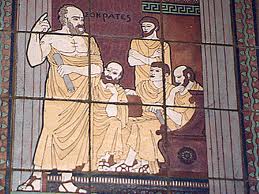 What we are doing here is teaching critical thinking skills. Critical thinking can be traced in Western thought to the Socratic method of teaching used in Ancient Greece, and in the East, to the Buddhist Kalama Sutta. It is a part of the formal education process, increasingly significant as students progress through the higher grades, and should be the main concern in college and graduate-level teaching. Obviously, critical thinking is an important part of just about every profession.
According to Wikipedia, “There is debate among educators about its precise meaning and scope.” Thank you, Wiki..very well said. Crtical thinking is indeed one of those concepts, like “Politics” or “The Economy” that everyone understands but is hard pressed to actually define. So here goes, my contribution to the debate…my definition of critical thinking: The process of actively using new information by application, analysis, or evaluation. I tried to keep it simple.
 Here is a list of my favorite techniques for adding critical thinking to the wine classroom:
- Compare and contrast wines (or regions, or winemakers) by style.
- Group wines into categories and explain why and how you chose the categories.
- List wines in order (lightest to fullest, simplest to most complex).
- Support an opinion with evidence. For instance, this wine is complex because…
- Discuss whether or not a certain wine appeals to you, and tell us why/why not.
- Describe a certain aspect of a wine (tannin, alcohol, residual sugar) and discuss how it relates to the other elements of flavor.
- Predict how a wine will interact with a certain food.
And to make it easy, you can use what I call a “Bubbly Professor Brain Crank”. I like to call this one “The Instant Critical Thinking Tool”:
This wine is ____________ because ______________.
I like to use this sentence for class discussions, and it has a tendency to show up on my final exams. I love it because it appears simple and un-intimidating, and yet you must use critical thinking to answer the question. It’s also perfect for discussion because there are an infinite number of correct answers. Students like that feature for test questions as well.

Here’s a sample…just how would you answer this question?
This Beringer Private Reserve Cabernet Sauvignon 2019 is ___________ because ________________.
Made you think!
The Bubbly Professor is “Miss Jane” Nickles of Austin, Texas…









 The Bubbly Professor