The Outer Limits: AOC Châteaumeillant

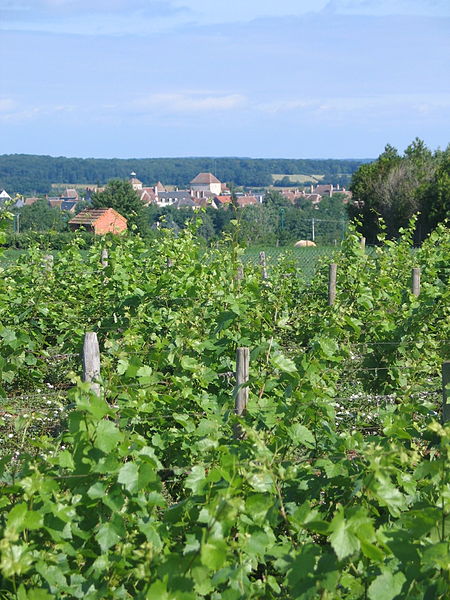
Vineyards in Châteaumeillant - Photo by Ameliris, via Wikimedia

Vineyards in Châteaumeillant – Photo by Ameliris, via Wikimedia

Tucked away into the southwestern corner of France’s Cher département, the Châteaumeillant AOC is located quite literally in the outer limits of the Loire Valley wine region. About 45 miles south of Quincy, it’s the last Loire Valley AOC on the road out of town.

The Châteaumeillant AOC is named after the town it surrounds  in the foothills of the Massif Central. The town of Châteaumeillant has about 2,000 residents. The AOC of the same name somewhat straddles the line between the Indre and Cher départments. It has been called the most central vineyard in France—and it does appear to rest firmly in the middle of the country.

Wine has been part of the local economy here since the fifth century BC, as proven by the discovery of over 300 amphora that were unearthed during a construction dig.

In the fifth century, the area was a Roman town named Mediolanum. Due to its location, Mediolanum was an important part of the wine trade and something of a way-station for Italian wines being sent to troops stationed in (what was then) western Gaul. Some time later, the area began growing grapes and producing wine.

The Châteaumeillant AOC is a small producer. There are currently just 173 acres (70 ha) dedicated to red wines and another 49 acres (20 ha) for rosé (vin gris). Red wines are made from a minimum of 40% Gamay with Pinot Noir allowed to fill in the rest. The pale vin gris (rosé) is made from the same basic formula, but also allows for a maximum of 15% Pinot Gris in the blend. Rumor has it that the appellation is going to steadily increase the minimum portion of Gamay until it reaches 60% sometime after the year 2027. White wines made primarily from Chardonnay and Sauvignon Blanc are also produced in the region, but are labeled with Val de Loire IGP status.

Culan Castle

Culan Castle

Châteaumeillant became a vin délimité de qualité supérieure (the now-defunct VDQS category) in 1965 and was promoted to AOC status in 2010. There seem to be only around 10 wine estates in the area; noted producers include Domaine Roux, Domaine Goyer, and Domaine du Chaillot.

If you would like to visit Châteaumeillant, it’s about a two-and-a-half hour drive from Paris. Once there, you can see the ancient amphora of the region at the Archeological Museum of Chateaumeillant, tour Culan Castle (built in the 13th century), and visit the Chapitre d’Albret (dating from the 1500s). The region also has a variety of farms that produce some of the Loire Valley’s famous goat cheeses, which should be a great match with the vin gris of the AOC Châteaumeillant.

It sounds like a trip to the outer limits that you might enjoy!

References/for further information:

The Bubbly Professor is “Miss Jane” Nickles of Austin, Texas… missjane@prodigy.net

The Outer Limits is my series of appreciative posts about small, obscure, or out-of-the-way wine regions.

Lorraine: Quiche, Plums, and a bit of Wine

.

.

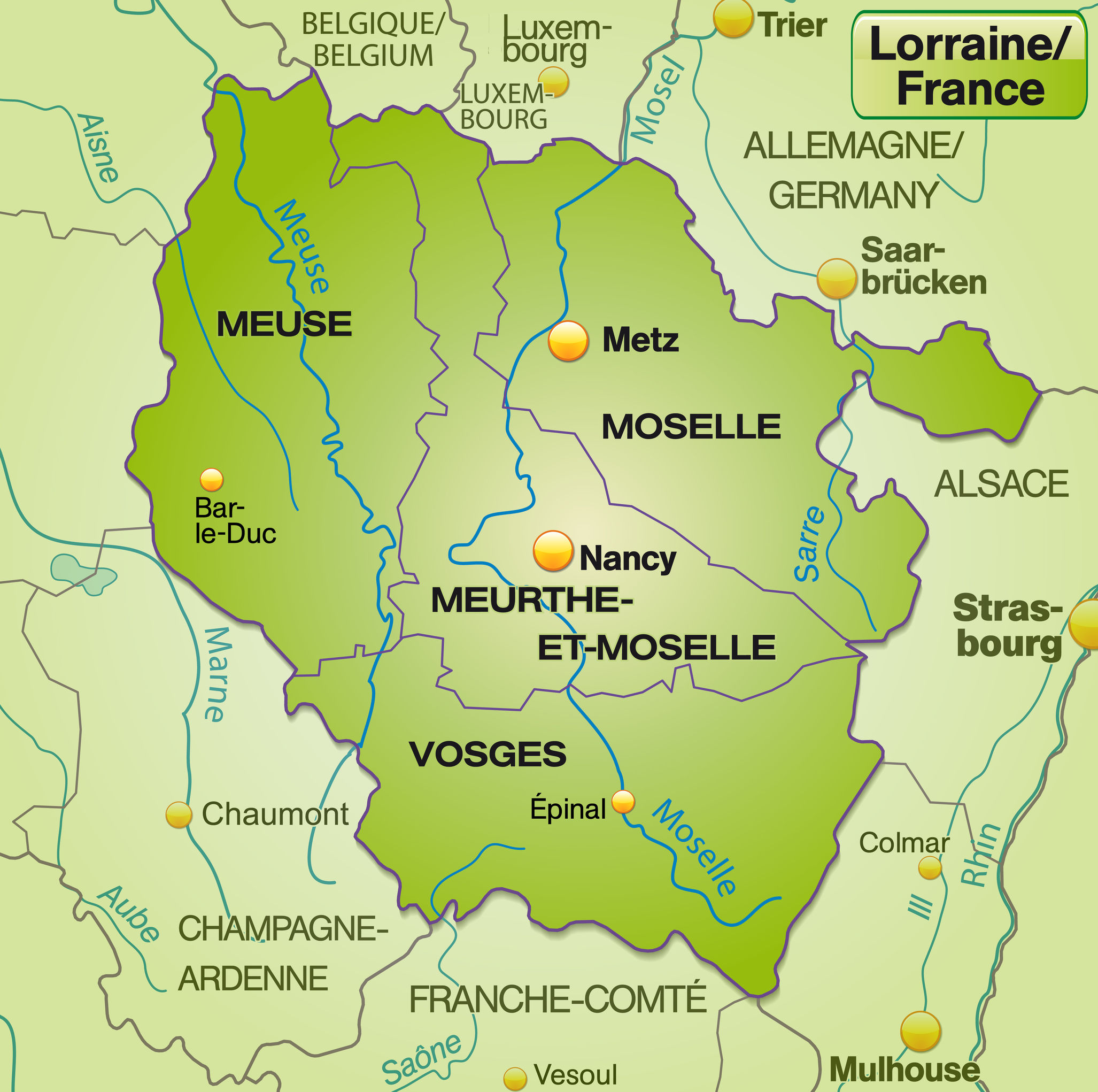
Lorraine—home of the famous quiche, a particular plum, and just a little bit of wine—is located in northeast France, just west of Alsace. Lorraine was an administrative region of France from 1982 until January 2016; since that time it has been part of the region known as Alsace-Champagne-Ardenne-Lorraine. Lorraine makes up over half of the French border with Germany, and is also the only French (historical) region to border three countries (Germany, Belgium, and Luxembourg).

Lorraine has never really caught my attention in a big way, as most of my knowledge of French geography (and to be honest, world geography) is based on my wine studies. As the Lorraine area is home of only two AOCs (Côtes de Toul and Moselle) in addition to the Côtes de Meuse IGP, I kind of overlooked the area. I have, however, always been a fan of Quiche Lorraine—and I am quite embarrassed to admit I always thought that the “Lorraine” referred to the Loire. Time to remedy this—read on to learn about three of the leading products of the Loire: Quiche Lorraine, Mirabelle plums, and the wine!

.

.

Quiche Lorraine: Definitely one of the best-known dishes in French cuisine, Quiche Lorraine is part of the Lorraine area’s German heritage. Quiche actually originated in Germany, and the word “quiche” is derived by “kuchen” (cake). While the original (German) version of the dish was baked in a brioche shell, the French version is a cream-and-egg pie baked in a savory pie-style pastry shell. True Quiche Lorraine is made with eggs, cream, and lardons—and no cheese! Most modern recipes include eggs, cream, bacon or chopped ham, and a good measure of cheese such Gruyère or Emmentaler.

Also good to know: Two of France’s most famous cookies—the Madeleine and the Macaron—also have ties to the Lorraine area. The Madeleine, a shell-shaped, cake-like cookie, is believed to have originated in the town of Commercy and named after the cook for Stanislas Leczinski, Duke of Lorraine. The cookies are often referred to as Madeleines de Commercy.

The Macaron, aka Macarons de Nancy—the delightful almond and meringue sandwich cookies that are currently enjoying quite a popular run—originated in the town of Nancy. Legend holds that they were first produced by the Sisters of Les Dames du Saint Sacrement who were expert bakers due to the fact that meat was prohibited in their Convent!

Mirabelle Plums: The yellow plum of the area, the Mirabelle, actually has PGI status as the Mirabelle de Lorraine. (There is also a PGI for the eau-de-vie made from the plums—more on that later.) Mirabelle plums have been appreciated world-wide since the famous French food critic Jean-Pierre Coffe (who was born in Lorraine) stated “Happiness exists. I’ve met it. It weighs 14.3 grams and it comes from Lorraine.”

Lorraine actually produces over 70% of the world’s Mirabelle plums. While they certainly can be enjoyed on their own, the plums are often made into tarts, jams and the famous clafoutis of the area in addition to being used in savory dishes such as honey-glazed duck with mirabelle plums.

Two specific types of the plum, Mirabelle de Nancy and Mirabelle de Metz, are used to produce a local brandy known as Eau-de-Vie de Mirabelle or simply “Mirabelle.” Eau-de-Vie de Mirabelle has PGI (protected geographic indication) status as well as being classified as an AOR (appellation d’origine réglementée—a specific classification used for certain eaux-de-vie and marcs that are produced outside the larger areas such as Bordeaux and Burgundy).

Eau-de-vie de Mirabelle has been described as aromatic with intense flavors of plums and baking spices with a bit of sweetness on the palate. Versions of Mirabelle (and other types of plum brandy) are made in many areas of the world, but the Mirabelle de Lorraine PGI/AOR product is special. The best I have ever tasted was from the Distillerie Maucourt located in Marieulles, just a few miles south of Metz.

The city of Metz, along the Moselle River

The city of Metz, along the Moselle River

A Little Bit of Wine:  Lorraine is a small producer as far as French regions go, and only contains two AOCs. The Moselle AOC is named after the French department of the same name as well as the Moselle River (better known to wine lovers as the famous Mosel River of Germany). The source of the Moselle is in France’s Vosges Mountains near the border of Alsace and Lorraine. The Moselle flows (mostly north) through Lorraine for 195 miles (315 km), then forms the border between Germany and Luxembourg for 25 miles (40 km) before it becomes the famous river of Germany’s Mosel Valley (at least until if flows into the Rhine).

The Moselle AOC is located in the northern portion of Lorraine, along the Moselle River, very near the city of Metz, and close to the border with Luxembourg and Germany. The AOC produces a small amount of wine, mainly dry and off-dry, in red, white, and rosé. White wines are produced using at least 50% Auxerrois; the remainder may be Müller-Thurgau, Pinot Gris, Pinot Blanc, or Riesling. A maximum of 10% Gewurztraminer may also be used, and varietally-labeled Pinot Gris and Müller-Thurgau is also produced.  The red wines of the Moselle AOC are 100% Pinot Noir, and the rosés are a blend of Pinot Noir (minimum 70%) and Gamay.

.

.

The Côtes de Toul AOC is located a bit further to the south, closer to the town of Nancy. The Côtes de Toul AOC also produces red, white, and rosé wines, with its specialty begin vin gris (very pale rosé made using the direct press method). These rosés are made from a blend of Pinot Noir and Gamay (both are required), and may also include Pinot Meunier, Aubin, and Auxerrois. The white wines of the Côtes de Toul AOC are produced from Auxerrois or Aubin, and the red wines are Pinot Noir.

Note: Interestingly enough, in Pre-AOC days, grapes grown in Lorraine were shipped to Champagne to be made into the world’s favorite sparkling wine. This worked out well for a while, as Lorraine stayed phylloxera-free much longer than many other regions in France, including Champagne. Eventually grape growers in the actual Champagne region put a stop to the grape invaders, as AOC laws were passed (then revised, then ignored, then passed again). After phylloxera (eventually) devastated the vineyards of Lorraine, they never recovered to their former levels.

References/for more information:

The Bubbly Professor is “Miss Jane” Nickles of Austin, Texas… missjane@prodigy.net

Folle Blanche and the Baco Brothers

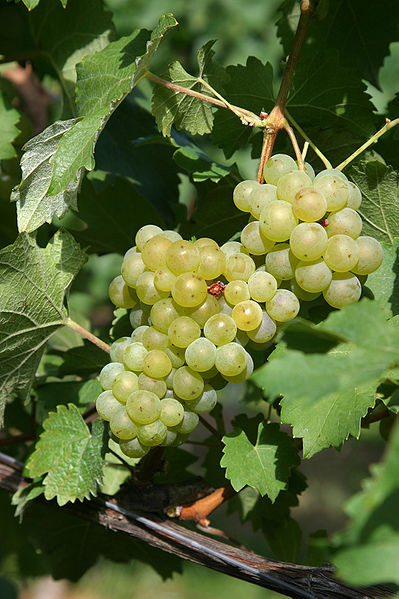
Photo of Folle Blanche, Conservatoire du Vignoble Charentais by Pancrat, via Wikimedia Commons

Photo of Folle Blanche, Conservatoire du Vignoble Charentais by Pancrat, via Wikimedia Commons

I taught the “Brandy” chapter of the CSS class yesterday, which is always a fun day; after all, the class includes a drink-along suggestion of Cognac VSOP—which works well even for the morning session.

Brandy is a huge subject—there’s Cognac, Armagnac, Calvados, Applejack, Pisco, Kirschwasser, Slivovitz, Pálinka, Grappa, Poire William…the list goes on and on. As such, in this class I need to focus on one or two representative products and just “drill down.” Yesterday I chose the classic French (grape-based) brandies of Cognac and Armagnac—and discussed the finer points of the regions, the grapes, the production processes, and the aging of the brandies.

As for the grapes, Ugni Blanc (aka Trebbiano Toscano, aka Saint Émilion) is the leading variety used in both Cognac and Armagnac. It seems a good use for this grape, which is both widely grown and a prolific producer despite the fact that it produces wines that are sometimes described as “bland.”

Also common to both brandies, there is a secondary grape lurking in the background in both regions: Folle Blanche.

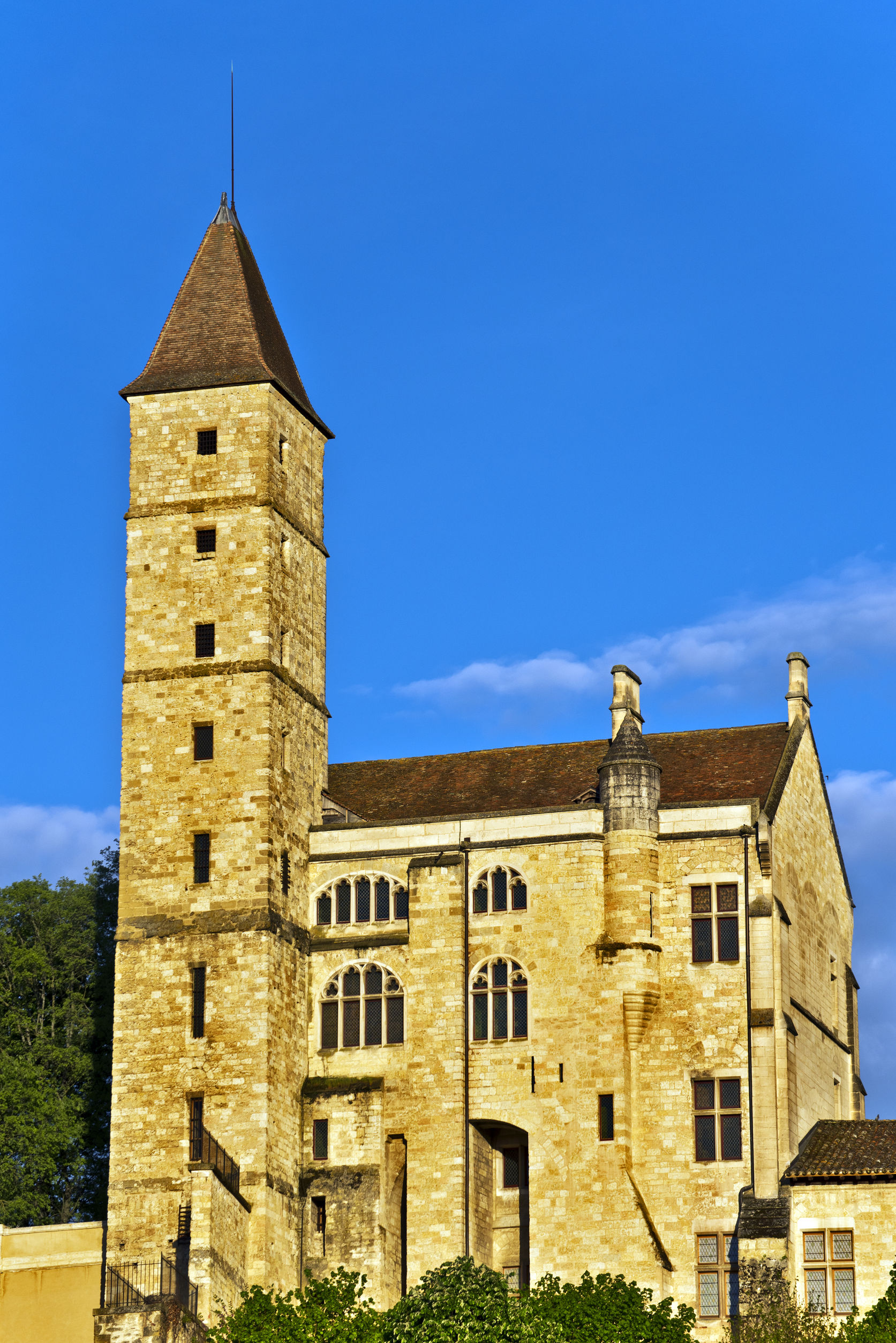
Armagnac Tower in the city of Auch

Armagnac Tower in the city of Auch

Folle Blanche is considered by many to be the “original” (pre-phylloxera) grape of the Cognac and Armagnac regions and was documented in the area as early as 1696 via a list of grapes growing in the Charente-Maritime department. It is believed that the name Folle was derived from the French word Feu—meaning “mad” and perhaps referring to the grape’s maddening tendency to grow with unreserved vegetative vigor wherever it was planted. Other synonyms for the grape seem to back up this tale; the grape is sometimes known as Enrageat (from the French enragé—which needs no translation) and is known as Gros Plant (Big Vine) in parts of the Loire Valley.

Besides its stand-in role in the great brandies of France, Folle Blanche (under its synonym) is the star in the dry white wines of the Gros Plant du Pays Nantais AOC. This sur lie-aged wine is produced in the same area as the far more famous Muscadet and tends to produce wines with fruity-mineral character and high levels of acidity. Most Gros Plant du Pays Nantais AOC is consumed locally so it is rare to encounter it outside of France.

According to DNA analysis, Folle Blanche is an offspring (along with sister Chardonnay) of Gouis Blanc; the other parent is an unknown. It also appears to be genetically close to Petit Meslier and Meslier Saint-Francois, which makes it fairly certain that the grape originated in Southwest France, from whence it spread north to Charente and eventually all the way up to the Loire Valley.

While Folle Blanche may never achieve grape variety superstar status, it has a lasting legacy nonetheless as the parent of Baco Blanc, Baco Noir, and Folignan. All of these grapes have a small but fascinating role to play in viticulture, and all are the result of the long arm of science stretching its way to the vine.

...

Folignan, an Ugni Blanc X Folle Blanche cross, was created by the Institut National de la Recherché Agronomique/INRA (National Institute of Agricultural Research) in Bordeaux in 1965. Forty years later, in 2005, it was approved for use in the Cognac AOC (although its contribution is capped at 10% of the total blend). This move made Folignan the first INRA cross to be approved for use in an AOC.

The Baco Brothers (as I am referring to Baco Blanc and Baco Noir) were both created under the watchful eye of François Baco, a French nurseryman, back in the late 1890s/early 1900s. Baco was attempting to create a grape with resistance to black rot.

Baco Blanc (sometimes known as Baco 22A) is a hybrid of Folle Blanche crossed with the Noah grape variety (itself already a complicated labrusca X riparia hybrid). It was created in 1898 and for a time, was planted in a variety of areas across France—in its heyday there were over 2,000 acres (825 ha) planted in France. These days, there exists just a smattering of Baco Blanc vines in the Armagnac region of France and a tiny bit in New Zealand. However, it enjoys some significant notoriety in Armagnac, where it is approved as one of the ten grape varieties allowed for use in the brandies of the Armagnac AOC. This makes Baco Blanc the only hybrid grape variety allowed for use in a French AOC (PDO) product. Not bad, Baco, not bad.

Baco Noir was created in 1902 as a hybrid of Folle Blanche with Grand Glabre—a highly obscure grape of the Vitis riparia species. Baco Noir was once widely planted in France, however, these days its appearance in Europe seems to be limited to about 2.5 acres (about 1 ha) in Switzerland. However, Baco Noir does not seem to be saddled with the “foxy” aromas found in many hybrid grapes, so it is enjoying some limited success in the colder wine growing regions of the New World. As such, it may be found in New York State (particularly in the Finger Lakes and Hudson River AVAs), and Canada (particularly in Ontario, Nova Scotia, and Quebec).

Sources/for further information:

The Bubbly Professor is “Miss Jane” Nickles of Austin, Texas… missjane@prodigy.net


Greywacke (and Greywacke Jones)

Greywacke stones along the Haast River in New Zealand Greywacke stones along the Haast River in New Zealand

Greywacke (pronounced “grey-wacky”) is a drab, grey stone—technically, a sedimentary rock–made up of layers of very hard, clay-based, muddy grey sandstone criss-crossed through with layers of argillite (a type of mudstone) and grains of quartz, feldspar, and other small rock and mineral fragments. The term Greywacke can refer to the entire rock (or boulder), the sandstone base of the rock, or—especially in the case of wine enthusiasts, a type of soil derived from the stone.

In case you are wondering how such a plain looking rock acquired such a crazy-sounding name, “wacke” is the German word for sandstone, and the term (Grauwacke) was first used to describe rocks located in the Harz Mountains of northern Germany.

Greywacke soils do well with viticulture. The clay-derived portion of the stone weathers into clay-based soil, which is appreciated for its abilities to remain cool, retain vine nutrients, and retain water. The rock and mineral fragments remain behind in Greywacke soil to counter the clay with coarse-grained gravel, providing aeration and drainage. And, of course, some of the rocks stay behind on the top of the soil, absorbing and releasing heat.

Greywacke boulders on Te Mata Peak (Hawke's Bay, New Zealand) Greywacke boulders on Te Mata Peak (Hawke’s Bay, New Zealand)

This gravelly soil is most notably found in the vineyards of New Zealand; which makes sense as hard greywacke stone makes up a large part of the Southern Alps as well as the smaller mountain ranges of New Zealand’s North Island. The famous “Gimblett’s Gravels” soils of Hawkes Bay, as well as large swaths of Marlborough, Gisborne, Canterbury, and Nelson are all Greywacke-based. Greywacke is almost considered the “national stone” of New Zealand (or would be, if New Zealand ever decided to have a national rock, according to The Encyclopedia of New Zealand.) Click here for a map of Greywacke in New Zealand.

Fans of New Zealand Sauvignon Blanc (which I certainly am) will no doubt recognize the name Greywacke in terms of a New Zealand wine brand, produced by none other than Kevin Judd – the beloved original winemaker at Cloudy Bay. Kevin continues his string of winemaking successes at Greywacke, producing a range of wine including a delicious albeit typical “zesty” Marlborough Sauvignon Blanc as well as a native yeast-fermented, lees-aged, oak-influenced Sauvignon Blanc (“Wild Sauvignon”) that has become a staple at both my Sunday night dinners and my Intro to Wine Classes. Other Greywacke wines include Chardonnay, Pinot Gris, Riesling, Pinot Noir, and even a late-harvest Riesling—all delicious.

Detail of greywacke soil in Algarve, Portugal Detail of greywacke soil in Algarve, Portugal

Greywacke bedrock and soils are found in many parts of the wine world, including the Algarve region of Portugal; Germany’s Mosel, Ahr, and Mittelrhein; the Western Cape of South Africa; California’s Russian River Valley; and the Barossa. The term “Greywacke” is used often in the context of wines and vineyards from all over the world, as well. Cosa Obra Wines in the Russian River Valley has a “Greywacke Vineyard” located within the Russian River Valley AVA, about where the Russian River makes it westward turn towards the Pacific Ocean. In Australia’s Barossa, Thorn-Clarke Winery, very much into the soils, produces a Shiraz labeled as “Shiraz on Cambrian Greywacke Soil.”

About that subtitle: There is a character named Greywacke Jones in “Slinky Malinki,” a children’s book by New Zealand author Lynley Dodd. Greywacke Jones is a mischievous grey kitten who hangs out with her pals Slinky Malinki, Hairy Maclary, Butterball Brown, and the rest of the gang. So now you know.

References/for more information:

The Bubbly Professor is “Miss Jane” Nickles of Austin, Texas… missjane@prodigy.net

Bacchus and Bacchus

Photo Credit: Dr. Joachim Schmidt, via Wikimedia Commons

Bacchus grapes on the vine: Photo Credit: Dr. Joachim Schmidt, via Wikimedia Commons

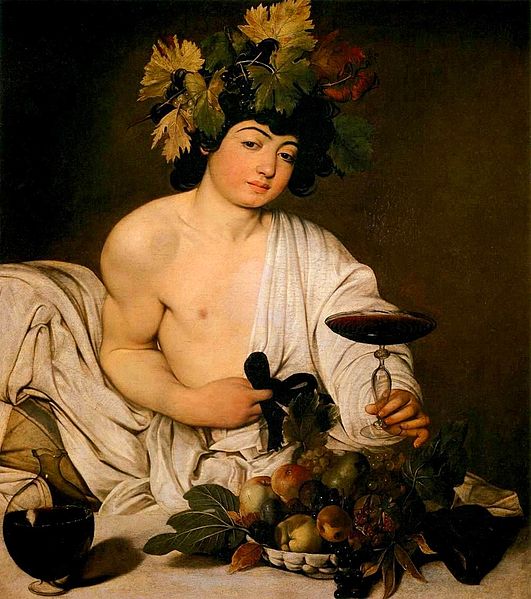
The name “Bacchus” means a lot to wine folk. First and foremost, Bacchus is the Roman god of wine and as such, he is the subject of a good deal of famous artwork produced from antiquity to modern times. Bacchus is also a grape variety of the vinifera species, a double-Riesling cross that thrives in  cold climates, but doesn’t do nearly as well at retaining acidity as its parent(s).

There’s also a Bacchus Wine Bar in Houston, a Krewe of Bacchus in New Orleans, and a European Research Initiative pertaining to clouds known as BACCHUS.  But for today, let’s focus on the god and the grape.

Bacchus: the god

Bacchus (or, as he was known in Greek mythology, Dionysus) is known as the god of wine and viticulture, and is often credited with the “invention” of wine. He is also–understandably so–the god of drunkenness (or, as the Greeks referred to it, “ritual madness”) and fertility. In later mythology, he was seen as a great patron of the arts and the god of the theater.

In the Greek myth, Dionysus is the son of Zeus (king of the gods) and Semele, a princess of Thebes. Thus, he is the only Greek god with a human parent. When Hera, the wife of Zeus, found out about her husband’s out-of-wedlock son Dionysus, she became enraged and ordered Dionysus to be killed. She succeeded, and the baby was murdered. Dionysus was next miraculously brought back to life, and Zeus conferred him with immortality. Zeus gave the baby to the mountain nymphs to be raised. In artwork, Dionysus is often depicted during this pampered stage of his life, as a fat, happy (and often naked) baby surrounded by wine, fruit, and luscious furnishings.

Bacchus by Caravaggio (c. 1595–Uffizi Gallery, Florence)

Bacchus by Caravaggio (c. 1595–Uffizi Gallery, Florence)

Dionysus is one of the few characters in Greek mythology credited with both being brought back from the dead himself and bringing someone back from the dead (he once rescued Semele [his mother] from the underworld). It is said that this cycle of birth and death is reflected in the annual cycle of viticulture, where the vines go dormant each year and must be pruned back before spring in order to ensure a good crop the following harvest.

Dionysus became one of the most important figures in the Greek and Roman mythology, but unlike the other gods, his followers did not always meet in temples dedicated to his worship. Instead, his followers held their worship services in the woods. In this way, Dionysus became “one” with his followers and during religious events his followers would become like gods themselves; first experiencing joy and ecstasy but often devolving into anger and rage. This represents not only “Greek god-like behavior” but also the dual nature of wine.

The festival for Dionysus was held in the spring in order to coincide with bud break. This festival became one of the most important religious holidays in the Greek calendar, and many Greek plays were originally written to be performed at the festival of Dionysus (beginning the tie between Dionysus and theater).

From its Greek beginnings, the cult of Bacchus became important to the Romans around 200 BCE. The Roman festival of Bacchus, the Bacchanalia, became well-known (and well documented) as a frenzied, sexual, scandalous, and extremely volatile rite that included both genders as well as people of all ages and social classes. Not surprisingly, the Roman Senate tried to shut down the cult of Bacchus. However, instead of being trampled, the cult of Bacchus merely moved “underground” and became a secret society. Decades later, the Senate approved a sanitized version of the worship of Bacchus and Bacchanalia became legal and outwardly popular once again.

Bacchanal before a Statue of Pan by Nicolas Poussin (c. 1633, National Gallery London)

Bacchanal before a Statue of Pan by Nicolas Poussin (c. 1633, National Gallery London)

This adoration of Bacchus continues, in a way at least–even in modern times.

Bacchus: the grape

The Bacchus grape variety is a white vinifera cross created by German agronomist Peter Morio in 1933. Morio, working for the Geilwilerof Research Center (now the Julius Kühn Institut) located in Germany’s Pfalz region, also created the Domina, Optima, and Morio Muskat grape varieties.

Bacchus is the offspring of an unnamed Silvaner X Riesling cross with Müller-Thurgau (a Riesling X Madeleine Royale cross).  So we’ll say that Bacchus is a double-offspring of Riesling instead of saying that its parents were siblings (enough said).

Like Riesling, Bacchus thrives in cold climates and can be quite expressive with fruity and floral aromas and flavors. That, however, is where the comparisons with Riesling should probably end, as Bacchus is not known for elegance–which Riesling exudes. Bacchus is also an early, high-sugar-ripener akin to Müller-Thurgau, and tends to be low acid. For these reasons, particularly in Germany, Bacchus is typically appreciated as a blending partner rather than a stand-alone variety.

Bacchus is grown in small amounts throughout Germany, including plantings in Rheinhessen, Franken, Mosel, the Nahe and the Pfalz. The total acreage in Germany is about 5,000 acres (2,010 ha).

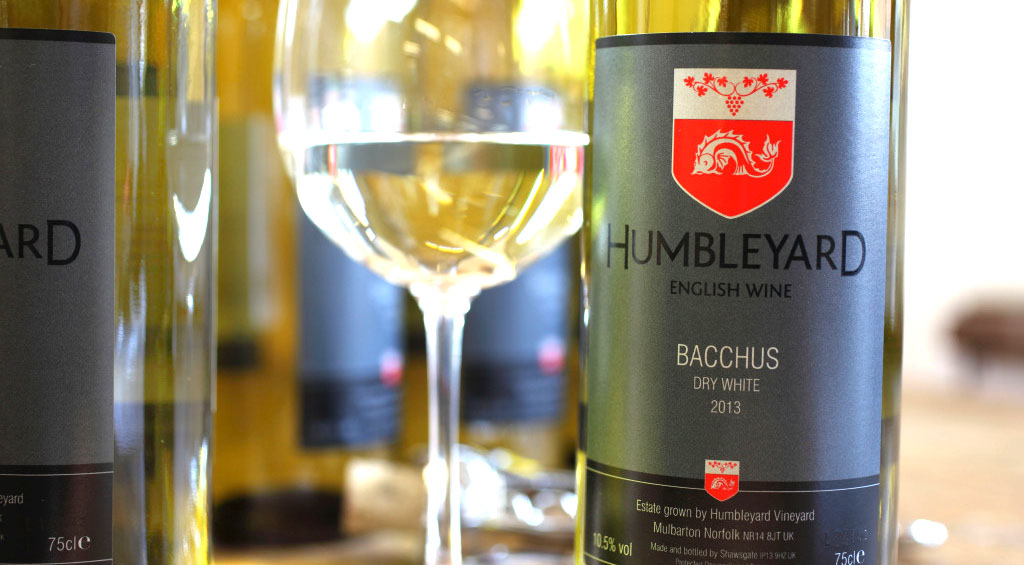
These days, Bacchus might have found its place in the sun in England, where it is the second most widely cultivated white grape variety behind Chardonnay. Bacchus is made into varietal wines in both England and Wales, where the cooler climates help the grape hold on to its acidity and produce fresh, aromatic white wines. In the vineyards of the English countryside, Bacchus is noted to produce grapes that show a green-grassy character, leading to its nickname as “the Sauvignon Blanc of England.”

Small plantings are also found in Switzerland, Canada, and Japan. Bacchus (the god) would be proud.

Sources/for further information:

The Bubbly Professor is “Miss Jane” Nickles of Austin, Texas… missjane@prodigy.net

Of Saints and Satellites

333

333

Saints and satellites help paint the story of Saint-Émilion

The Saint:

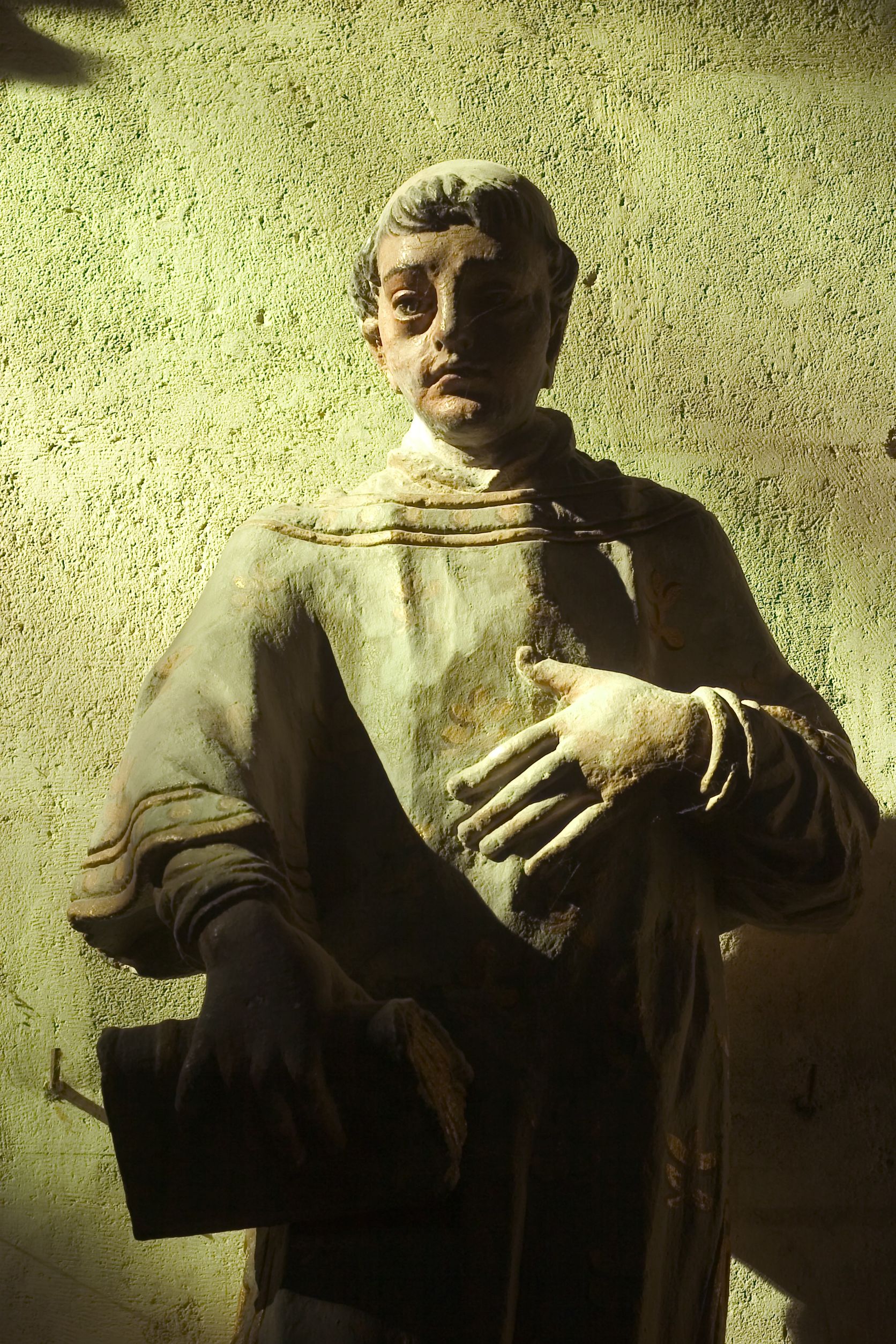
History tells of a Benedictine Monk named Émilion who lived in Brittany during the eighth century. He swore his loyalty to a count in southwest France and agreed to go with him and work in his household. Émilion was a baker and would often give some of his master’s bread to the poor. When the count found this out, he fired Émilion from his service and threw him out of his house.

Upon his ousting, Émilion vowed to spend the rest of his life in worship and solitude. He journeyed a ways up the Dordogne River and settled near an enormous piece of limestone rock. Émilion spent the next several years carving an underground cave out of the limestone, complete with a stone bed and chair carved into the wall. With time, it was said that Émilion was able to perform miracles, and people began to visit the hermit monk for healing. Faithful people soon developed into a following who lived with him, helping him carve out his cave. Émilion lived the rest of his days in the cave with his followers. He died in 787.

The Monolithic Church of Saint-Émilion

The Monolithic Church of Saint-Émilion

After his death successive generations of monks carried on with Émilion’s project and carved a vast network of underground caves and catacombs. The fame of the area, now known as the town of Saint-Émilion, grew and it became a major religious center. Many faithful passed through on the pilgrimage route to Santiago de Compostela. Some of these faithful remained and these followers are credited with the planting of vineyards and the growth of the region’s wine industry. With time, the tiny town of Saint-Émilion became a center of religious importance with a reputation for its excellent wine.

The Monolithic Church of Saint-Émilion was originally constructed in the early twelfth century from the same limestone rock where Émilion first dug his cave. The now-famous church stands watch over the 2,000 inhabitants of Saint-Émilion as well as the world-renowned vineyards that surround the town. Deep below the church–with its three naves, its gothic windows, and its 175-foot high bell tower–lies the original cave of Émilion, the hermit monk.

The Satellites:

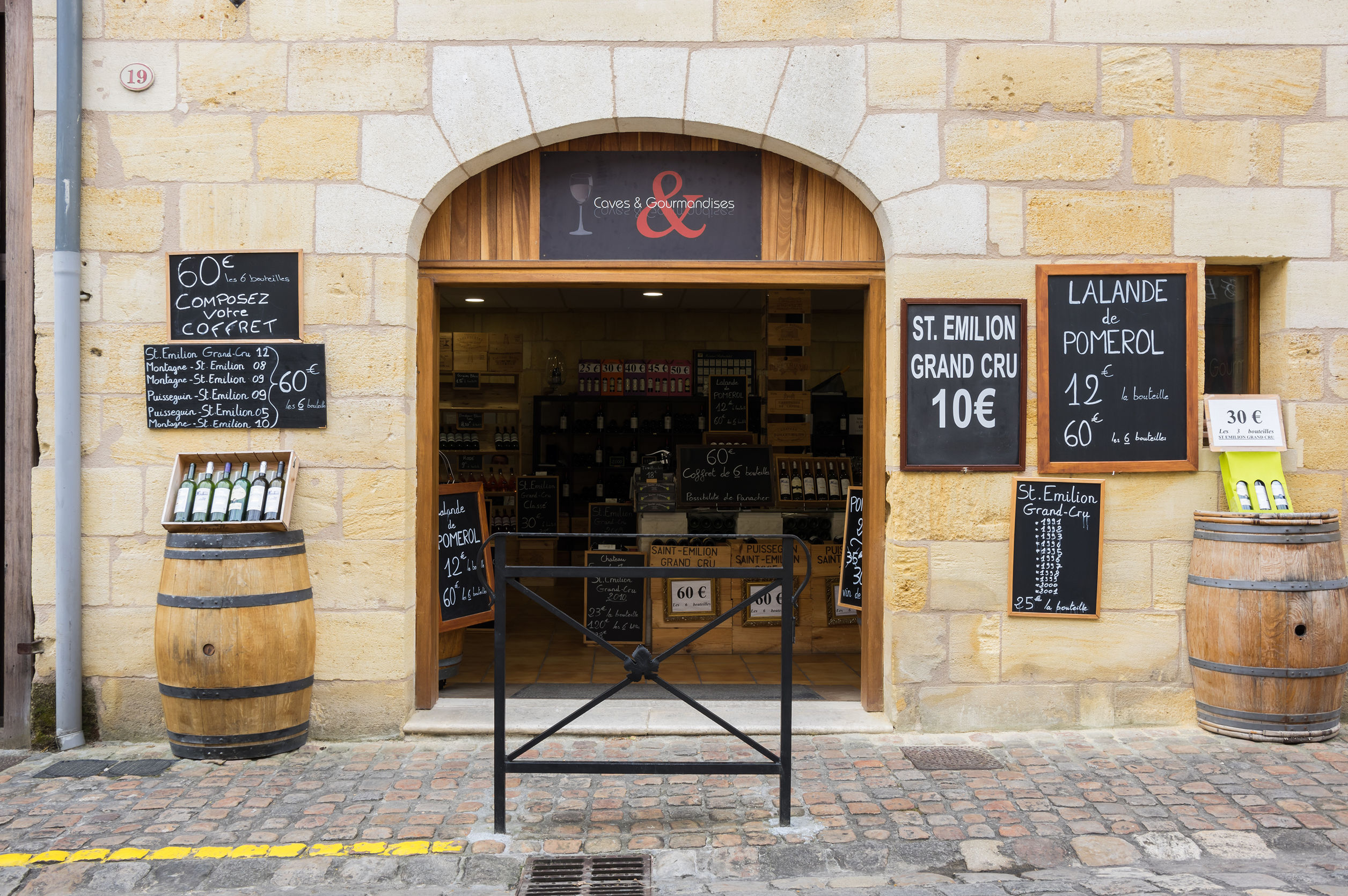
Today the town of Saint-Émilion is a UNESCO World Heritage site with Romanesque ruins, religious monuments, and a maze of medieval streets. It is also one of the leading wine regions of the world, renowned for its red wines based on the Right Bank version of the Bordeaux blend–heavy on the Merlot, a good dose of Cabernet Franc, a sprinkle of Cabernet Sauvignon and filled out (perhaps) with tiny touches of Malbec, Petit Verdot, and Carmenère.

Statue of Saint-Émilion

Statue of Saint-Émilion

The four leading properties of the region–the Premier Grand Cru Classé A châteaux of Cheval Blanc, Angélus, Ausone, and Pavie–are known to wine students and wine lovers alike. (You may even be able to recite the 14 châteaux of the Grand Cru Classé-Classé B, and if you are really good, take a stab at the other 64 properties of the Grand Cru Classé.)

Surrounding this luscious region are several villages that produce deep, flavorful red wine similar in style and standards to those of Saint-Émilion itself. Four of these have earned the right to append the name of Saint-Émilion onto the name of their village in the labeling of their wines and are thus considered to the satellites of Saint-Émilion. These four satellites are the villages of Saint-Georges, Montagne, Puisseguin, and Lussac.

Saint-Georges-Saint-Émilion: Located directly to the north of Saint-Émilion, the Saint-Georges-Saint-Émilion AOC is the smallest of the four satellites and occupies a tiny spot along the edge of the Saint-Émilion region itself. The vineyards are planted to approximately 75% Merlot, 20% Cabernet Franc, and 5% Cabernet Sauvignon. The village of Saint-Georges (often referred to as a hamlet) has a population of around 500 people and is part of the Montagne Commune. The wines produced from the vineyards of Saint-Georges are allowed to use either name (Saint-Georges or Montagne).

Montagne-Saint-Émilion: The Montagne-Saint-Émilion AOC literally surrounds the Saint-Georges region and lies along the remainder of the northern boundary of the Saint-Émilion AOC, which is itself–for the most part–defined by the path of the Barbanne River (La Barbanne). Montagne is the largest of the satellites of Saint-Émilion. The Montagne (the Butte de Calon) itself is the highest point on the Right Bank. The soils range from sand and clay in the north, to a central plateau of clay and limestone and limestone slopes in the south. Vineyards are believed to be planted to 75% Merlot, 20% Cabernet Franc, and 5% Cabernet Sauvignon. The wines of Montagne-Saint-Émilion are known to be full-bodied and rich with supple tannins.

...

Puisseguin-Saint-Émilion: The Puisseguin-Saint-Émilion AOC is located north of the border with Montage and east of Lussac. The town of Puisseguin (population: 861) is filled with ruins from Roman times, and takes its name from two words, “Puy” and “Seguin.” Puy is an old Celtic term for “the hill of powerful wine.” Seguin is the name of a Roman officer who served under Charlemagne and settled in the region around 800 AD. The terroir of Puisseguin is similar to that of the surrounding regions and contains a mix limestone, clay, alluvial gravel, and sandstone soils. The vineyards are reported to be planted to 80% Merlot, with the remainder mainly Cabernet Franc (and a bit of Cabernet Sauvignon). The wines of the region have been described a quite fruit-forward while young, with aromas and flavors of licorice, mint, and other herbs evolving as the wines reach 6 to 8 years of age.

Lussac-Saint-Émilion: The appellation of Lussac-Saint-Émilion is the northernmost of the satellites. The village of Lussac, named for a gentleman called Lucius or Lucaniacus who is credited with introducing viticulture to the area during Roman times, is so low-key that the tourist bureau lists a visit to the town of Saint-Émilion (5 miles away) as the top tourist activity. The topography of Lussac- Saint-Émilion is diverse; the south-east covered with slopes of clay and limestone, the north a mix of gravel, clay, and sand; while the west, a slightly elevated plateau, is mostly sandy gravel. Vineyards are reportedly planted 70% to Merlot and 20% Cabernet Franc, leaving just 10% planted to Cabernet Sauvignon (with a rare sprinkling–perhaps–of Malbec, Carmenère, and Petit Verdot). The wines of Lussac-Saint-Émilion tend to be elegant, velvety, and generous and are often compared to those of Montage-Saint-Émilion–its neighbor to the south.

...

The Lost Satellites: Between 1936 (when the AOCs for Saint-Émilion and its satellites were approved) and the 1970s, two other regions–Parsac and Sables–were allowed to append their names to that of the Saint-Émilion AOC. However, they are no more. Sometime in the 1970s, Parsac merged with Montagne, and Sables was annexed into the Saint-Émilion AOC.

Click here for an excellent handbook of the regions of Saint-Émilion (and the rest of the Right Bank as well), provided by the Union des Maisons de Bordeaux.

References/for further information:

The Bubbly Professor is “Miss Jane” Nickles of Austin, Texas… missjane@prodigy.net

The Murray, the Darling, and the Alps of Australia

...

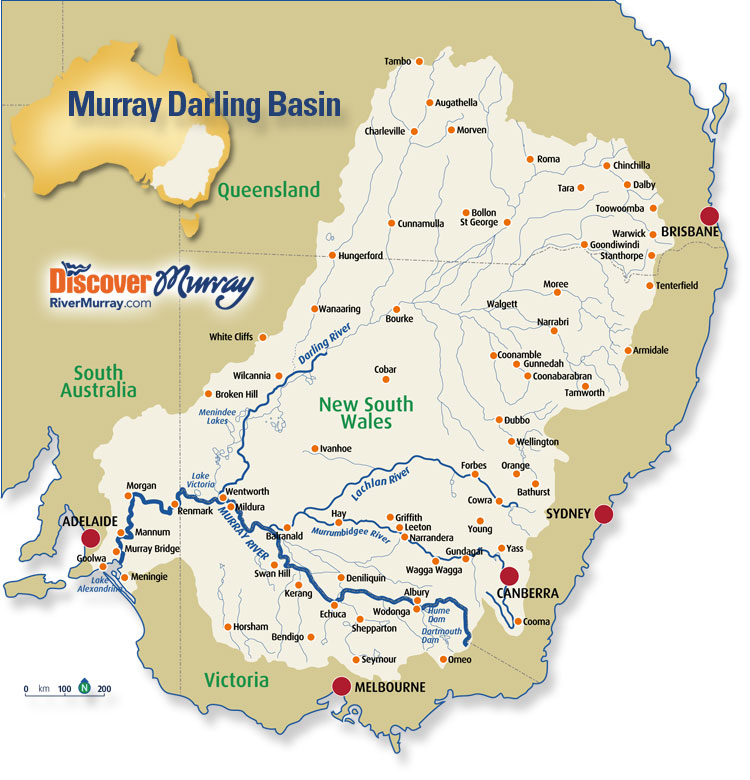
Murray Darling (as serious wine students certainly will know) is a wine region in Australia. Known primarily for Chardonnay but also widely planted with Shiraz and Cabernet Sauvignon, it is a big region–the second largest (by geographical area) in the country.

The Murray Darling wine region transcends political boundaries to an extent, as it straddles the borders of two states–Victoria and New South Wales. The New South Wales portion of the region is considered to be part of the Big Rivers viticultural zone–which makes total sense as it is named for the longest and the third longest rivers in Australia.

The longer of the two rivers–the Murray–is the longest river in Australia, clocking in at 1,558 miles (2,508 km) long. The source of the Murray is in the Australian Alps, and from there it flows down the western side of the mountains, twisting and turning across the inland plains and forming part of the border between the states of New South Wales and Victoria before it reaches the state of South Australia. From there, the Murray heads southward for almost 200 miles (315 km) before it joins the Southern Ocean (also known as the South Pacific Ocean) at Lake Alexandria.

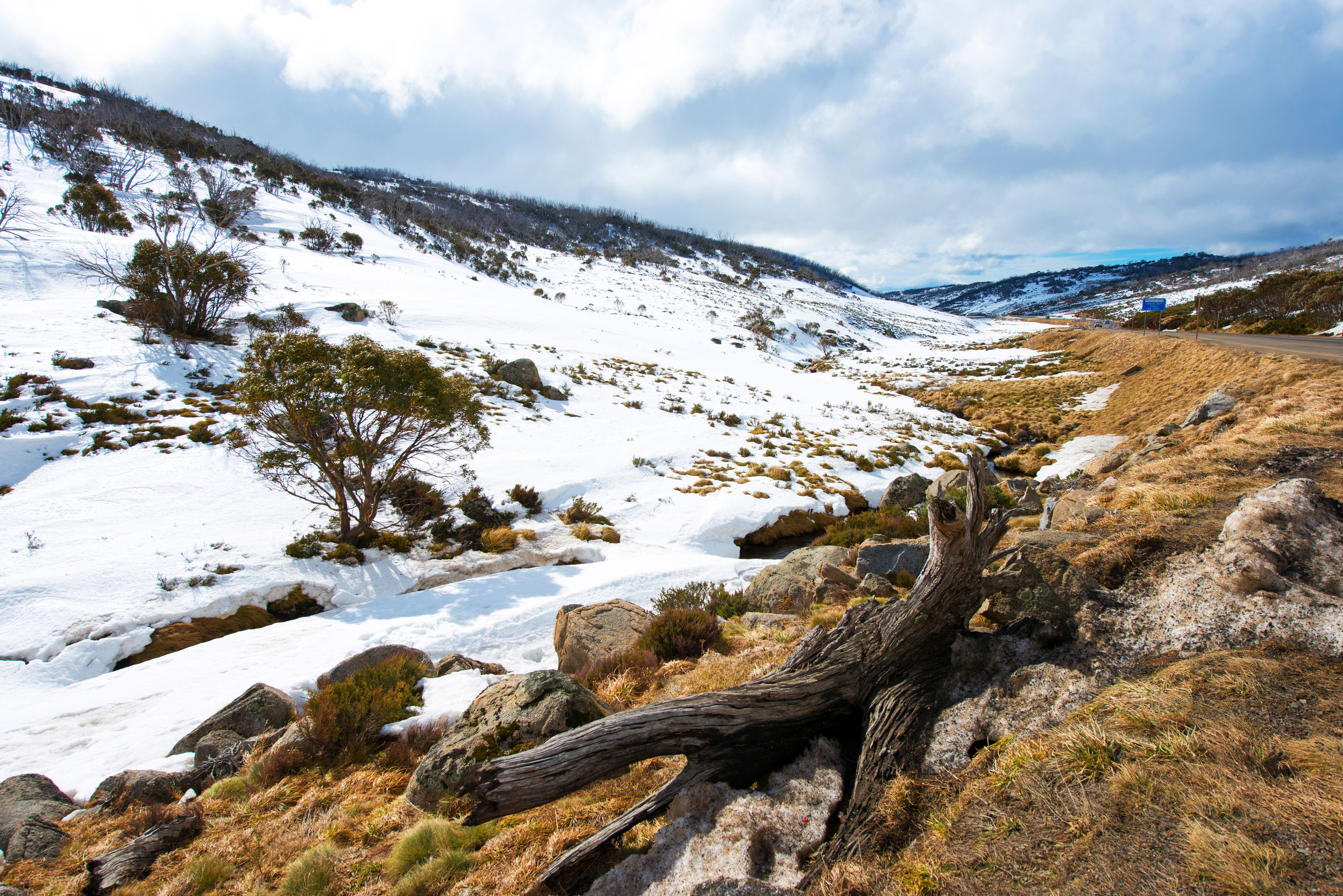
Kosciuszko National Park, Australia

Kosciuszko National Park, Australia

Wait a minute–did she just say the Australian Alps? Yes, she did–and that’s the thing that led to this post. Before doing a bit of digging into the background of the Murray Darling region I had no idea that Australia had its own Alps.

The Australian Alps, it turns out, are part of the Great Dividing Range (now it starts to make sense). The Alps are the highest mountain range in Australia, and the only place in Australia that receives deep snow fall every year. Mount Kosciuszko, the highest point in Australia (7,310 feet/2,228 meters above sea level) is part of the Alps system. There is even a system of Alpine National Parks, understandably  a center for skiing and other mountain sports in Australia.

So–back to our rivers. The source of the Darling River is also in the Great Dividing Range, yet far to the north of the Murray in the northern portion of New South Wales. The Darling River, the third longest river in Australia, flows south-southwest across New South Wales to the border of the state of Victoria, where it joins the Murray.

The combined Murray-Darling catchment system provides irrigation for one seventh of Australia’s total landmass, including most of Victoria, New South Wales, southern Queensland, and parts of South Australia. This area is of great agricultural significance and has even earned the nickname of the “food bowl” of the nation. The agriculture output of the Murray-Darling Basin includes dairy, citrus, stone fruit, livestock, cotton, almonds, and over half of Australia’s cereal crops.

Of course, of great interest to me are the grapes, as a great majority of the wine regions of New South Wales and Victoria–as well as a portion of South Australia–fall under the water catchment of the Murray-Darling. The importance of these rivers (as well as the other rivers in the basin, which include the Lachlan and the Murrumbidgee) really cannot be overstated. We can thank these rivers for Hunter Valley Semillon, Mudgee Cabernet, Rutherglen Muscat, Heathcote Shiraz, and Murray Darling Chardonnay. Thank you!

References/For more information:

The Bubbly Professor is “Miss Jane” Nickles of Austin, Texas… missjane@prodigy.net


Cape Kidnappers and the Farewell Spit

This post, along with my last post on Poverty Bay and the Bay of Plenty, is a result of my wandering mind while studying wine…I tend to wonder how “Poverty Bay” acquired such a name, and why Nelson (on New Zealand’s South Island) has a land feature known as the “Farewell Spit.” If these kinds of things inquire your mind as well…read on!

Farewell Spit: Nasa Satellite Image

Farewell Spit: Nasa Satellite Image

Sunny Nelson and the Farewell Spit

Nelson—a region on the South Island of New Zealand and a wine-producing area as well—enjoys one of the sunniest climates in the country, due to the rain shadow of the West Nelson Mountains.  Tucked behind an area known as Golden Bay, the region seems to be a wonderland for natural beauty and tourism (and it is). So why…does it include a feature known as the “Farewell Spit?” Just sounds nasty.

A spit doesn’t sound as weird when one uses the full  terminology: sandspit.  A sandspit is a type of coastal landform found along the coast where the direction of the shore changes, causing the ocean current to spread out and deposit sand. The longest spit in the world—at 68 miles long— is the Arabat Spit in the Sea of Azov (Crimea).

Nelson’s Farewell Spit (known to the Maori as Onetuhuna) on New Zealand’s South Island is approximately 20 miles long. It is made up primarily of sand eroded from the Southern Alps and deposited into Golden Bay. The name “Farewell Spit” was derived from the name given to the area by Captain James Cook as he departed NZ NelsonNew Zealand for Australia in 1770. The Cape was the last landform the crew was able to see as they sailed away, and the maps produced from his visit showed the area as the “Farewell Cape.”  The name stuck among English speakers and today the sandspit is known as the “Farewell Spit.” The New Zealand Department of Conservation administers the area as a sea bird and wild life reserve.

  • From the wine department: Nelson is one of the smaller regions in terms of wine production; with just 2,700 acres (1,120 ha) of vines, this region produces a mere 2.4% of New Zealand’s wine. The region, known for being the only wine growing area on New Zealand’s South Island that is located to the west of the Southern Alps, still enjoys its “sunny Nelson” reputation due to the presence of smaller mountain ranges that protect its west and south sides from excessive rainfall, while the Southern Alps cradle it to the east. Nelson grows a little bit of Pinot Noir, but focuses on Chardonnay and Sauvignon Blanc as well as a spattering of aromatic whites such as Gewurztraminer, Riesling, and Pinot Gris.

Hawke’s Bay and Cape Kidnappers

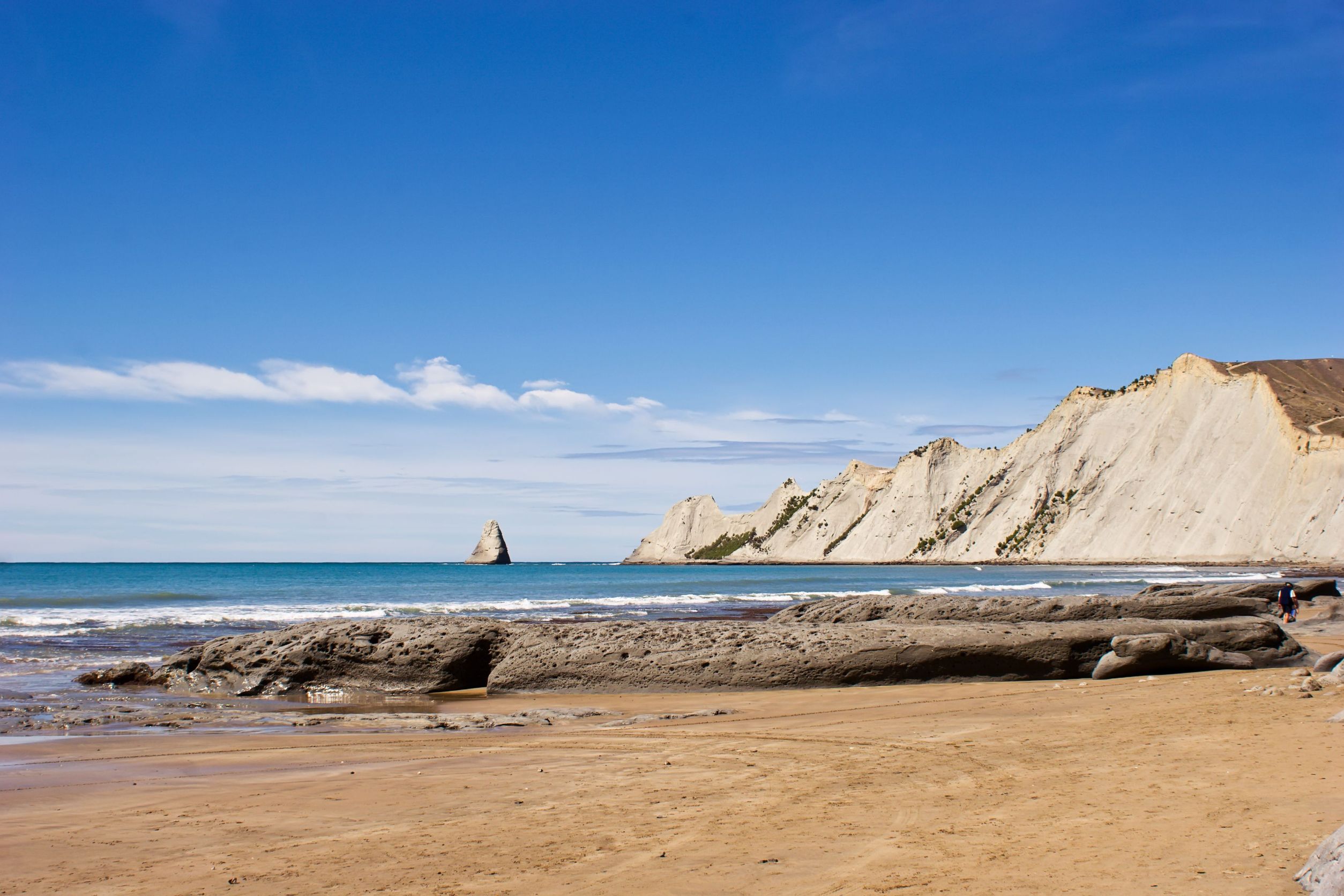
Cape Kidnappers

Cape Kidnappers

Cape Kidnappers is a headland located in the south-east extreme of the Hawke’s Bay region on New Zealand’s North Island. A headland is a narrow piece of land that projects from a coastline into the sea; sometimes otherwise known as a cape, bluff, or promontory. Cape Kidnappers extends from Clifton–a small beach town and camping area–into the Pacific Ocean.

Cape Kidnappers takes its English-language name from Captain James Cook’s 1769 voyage to–and around–New Zealand aboard the ship Endeavor. With the caveat that this may be only one side of the story, it was named after an attempted kidnapping. As the story goes, when the Endeavor was anchored off-shore, a crewmember named Tiata was in the water beside the ship when a Māori fishing boat pulled alongside and attempted to drag him aboard. Sailors from the Endeavour opened fire on the fishing boat, killing and injuring several of the Māori. The surviving Māori sped off, and Tiata returned to the Endeavour. Cook, who described the region as having steep white cliffs on either side, thus named the area “Cape Kidnappers.”

NZ Hawkes BayCape Kidnappers is now a protected area and home to several colonies of the Australasian Gannet. The bird reserves are closed to the public, but may be viewed from the beach which is which is accessible by foot, off-road vehicle, or kayak.

The Māori name for Cape Kidnappers is Mataupo Maui, meaning “the fish hook of Maui.” Another name, used less often, is Tapuwaeroa, which refers to “long footsteps” left behind by the giant Rongokako.

  • From the wine department: Hawke’s Bay is one of New Zealand’s  largest wine-producing regions in term of production. The region enjoys an overall maritime climate, but its location in the wider portion of the country means that it is, in spots, quite a bit sunnier and warmer than other parts of the country. For this reason, along with its now-famous gravelly, well-drained soils (particularly in the Gimblett Gravels area), Hawke’s Bay has a reputation for red-Bordeaux blends featuring Cabernet Sauvignon and Merlot, as well as Syrah–mainly grown in the areas further inland. The areas closer to the coast produce Chardonnay and Pinot Gris as well as plenty of wine using NZ’s signature grape–Sauvignon Blanc.

Bonus question: Why is part of the ultra-cute town of Westport known as Cape Foulwind? Cape Foulwind is a headland on the New Zealand’s South Island, located close to the art-deco town of Westport (itself located on New Zealand’s west coast overlooking the Tasman Sea). The headland was previously named Rocky Cape, but was christened Cape Foulwind by Captain James Cook after a strong wind off the cape blew the Endeavour quite a distance out to sea.

References:

 The Bubbly Professor is…”Miss Jane” Nickles of Austin, Texas

Poverty Bay and the Bay of Plenty

Vineyards in New Zealand's Gisborne/Poverty Bay area (photo via http://www.nzwine.com/)

Vineyards in New Zealand’s Gisborne/Poverty Bay area (photo via http://www.nzwine.com/)

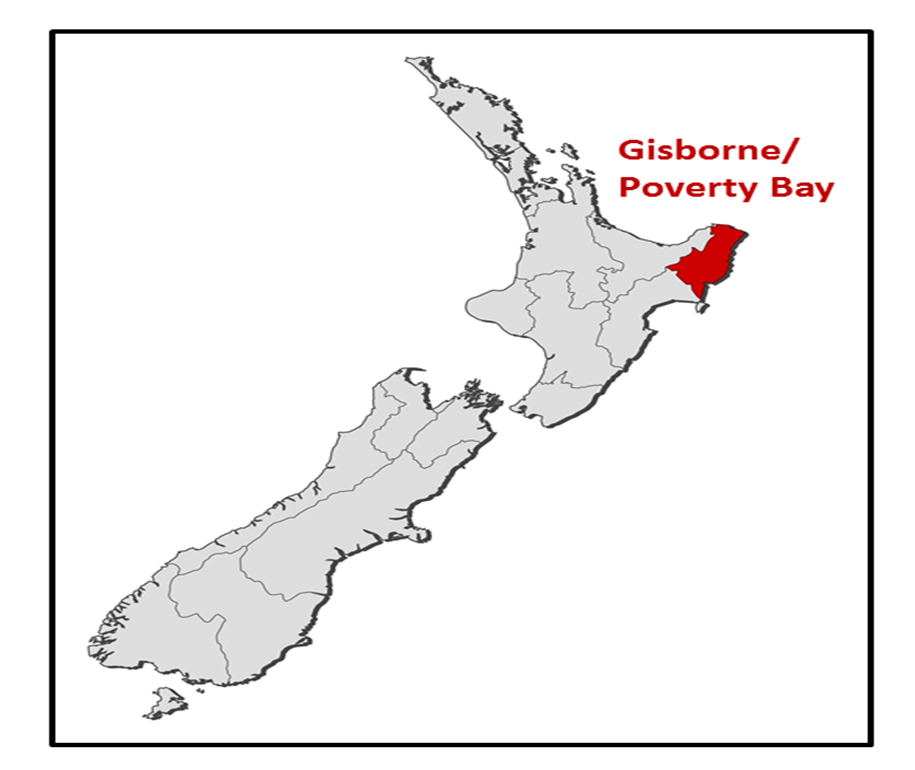
This post is totally based on my own curiosity about geography—which pops up at random times during wine studies—such as last night while I was reviewing the wine map of New Zealand. I noticed that Gisborne is also known as Poverty Bay. What place on earth would want to be known as Poverty Bay?

To me, this is a burning question, in need of well-researched answers—and some wine-related context as well! There’s a fine line, it seems, between a wine geek and a geography geek; and we might as well throw history geek in there as well, because the name Poverty Bay, and its (perhaps) better half up the road a bit, the Bay of Plenty, relate back to Captain James Cook (1728-1779), a captain in the British Royal Navy who made three voyages to the Pacific Ocean, and is believed to be the first European to reach Australia and the Hawaiian Islands and to circumnavigate New Zealand.

Poverty Bay

...

There is a lovely series of bays where the city of Gisborne, on New Zealand’s North Island, meets the South Pacific Ocean.  The largest of these is known as Poverty Bay, which stretches for about 6 miles south to a place called Young Nick’s Head. (This too must be explained…it seems that the area, a headland, was the first land sighted by the crew of Captain Cook’s ship, The Endeavour, on October 7, 1769. A reward of a barrel of rum and the right to name the landmass had been offered to the first crewman to sight land; the reward was claimed by 12-year-old Nicholas Young.)

Later that day, the ship’s crew went ashore.  They encountered the residents of the land, the Maori, and it did not go well. The first meeting led to the death of 6 Maori, and the crew, quite battered themselves, returned to their ship without any of the provisions they had hoped to acquire. For this reason, Captain Cook gave the area the name “Poverty Bay.” Perhaps they should have stayed with Maori name, which at the time was Teoneroa; today it is Te Kuri o Paoa.

From the department of I thought this was a wine blog: These days, Gisborne/Poverty Bay is the third largest producer of wine (in terms of volume) in New Zealand, and yet it seems to be somewhat obscure. Perhaps it’s the out-of-the way location. The area currently has 4,735 acres (1,915 ha) of vines. Chardonnay is the most widely planted variety, at about 2,312 acres (936 ha). Pinot Gris is next, with 950 acres (381 ha). Gewurztraminer, Merlot, and Viognier are widely planted as well. New Zealand’s super-star grape, Sauvignon Blanc, actually comes in around sixth place in Gisborne, with about 138 acres (56 ha) planted.

Vineyards in the Waikato/Bay of Plenty area (photo via http://www.nzwine.com/)

Vineyards in the Waikato/Bay of Plenty area (photo via http://www.nzwine.com/)

Being part of the widest part of the North Island, Gisborne records some of the most sunlight hours and warmest overall temperatures in New Zealand, so much so that the grapes here are often the first in the country to be ready for harvest. Gisborne is also the easternmost part of New Zealand, meaning the vineyards here are the first vineyards in the world to greet each new day.

The Bay of Plenty

After the unfortunate encounter at Gisborne, Captain Cook’s crew sailed north to what is now known as the Bay of Plenty. Here he was able to get the provisions he needed, and noted that it was an area “full of plantations and villages” that was “a bay of plenty.” Bay of Plenty is still a lush area, with orchards of kiwi fruit, avocadoes, and citrus, not to mention the vineyards and abundant seafood nearby. The Māori name for the Bay of Plenty is Te Moana-a-Toi (“the sea of Toi”), in honor of the Maori explorer Toi-te-Huatahi.

In the interest of the “wine” part of this blog: The regions of Bay of Plenty and its neighbor-to-the-west, Waikato, are generally lumped together when discussing the wine of the area. These regions, located just south of Auckland, currently have a tiny but growing wine industry—mainly small vineyards tucked between fruit orchards and dairy farms. Chardonnay is the leading grape variety here, followed by Cabernet Sauvignon and Sauvignon Blanc.

...

The area is one of the warmer regions in New Zealand, owing to its more northerly location (remember this is the Southern Hemisphere),  the width of the land mass, and the protection of the Hakarimata Mountain Range  The soils are quite fertile, due to the wide floodplain of the Waikato River and several other rivers.  Some areas around Waikato/Bay of Plenty were previously swampland, made accessible for agriculture via large drainage programs implemented by European settlers.

Stay tuned for more on New Zealand’s landmarks—such as Cape Foulwind, the Farewell Spit, and Cape Kidnappers (complete with wine information from the regions of “Sunny Nelson” and Hawke’s Bay).

 The Bubbly Professor is “Miss Jane” Nickles of Austin, Texas… missjane@prodigy.net

The Icy Benguela

...

I’ve been curious about the Benguela Current for a while. My original curiosity about the Benguela Current was about the name —how did it get that very cool name? It seems it all begins with Portuguese sailors in the 1500s.

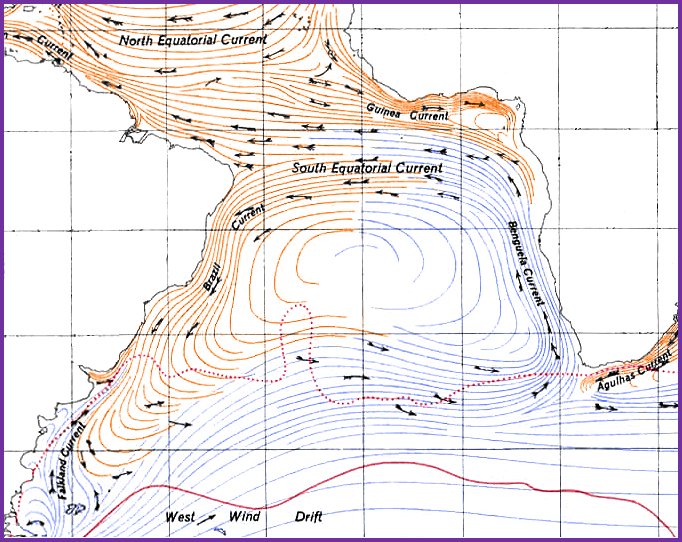
In the Age of Discovery, Portuguese Sailors—known for skill and courage in ocean navigation —often sailed the long and arduous ocean journey around the continent of Africa to Asia. During such voyages, they had to fight against two mighty ocean currents: the icy Benguela current that flowed northward along the coast of Africa while they were trying to sail south; then, after they rounded the Cape of Good Hope, they sailed north while fighting the warm and southward-flowing Agulhas Current. If the journey was successful, they reached Asia and accessed the famed Indian Spice Routes. Such accomplishments helped the Portuguese form their empire, which at various times included parts of Africa, the Middle East, India, South America, and South Asia.

...

The namesake of the Benguela Current (as it is now known) is a city in present-day Angola.  The area surrounding Benguela, due to its location near the coast and a well-traversed deep bay, has been a center of commercial trade since ancient times.  While there is no written record of the history of the area before the arrival of the Portuguese in 1546, it is believed that the area was formerly known as ombaka, which means, literally, “commercial (or ‘market’) port.” When the Portuguese colonized the area, a town was founded and named São Felipe de Benguela (Saint Philip of Benguela) after King Philip II of Spain and Portugal.

So back to ocean current: the icy Benguela Current flows from the Southern Ocean near Antarctica and moves north along the west coast of Africa. It reaches as far north as Angola (close to the city of Benguela, in case you missed that point) before it turns west and heads to South America. The Benguela Current is part of a large circulating ocean current known as the South Atlantic Ocean gyre. The western edge of the gyre is known as the Brazil Current; the Brazil current flows southward down the coast of Brazil, then turns east and flows across the ocean until it reaches Antarctica. From Cape Point in South Africa (at about 33°), the cold portion of the current known as the Benguela current flows northward along the west coast of Africa to the area around Angola/Benguela (about 16°S).

...

            Cape Agulhas…pick your ocean!

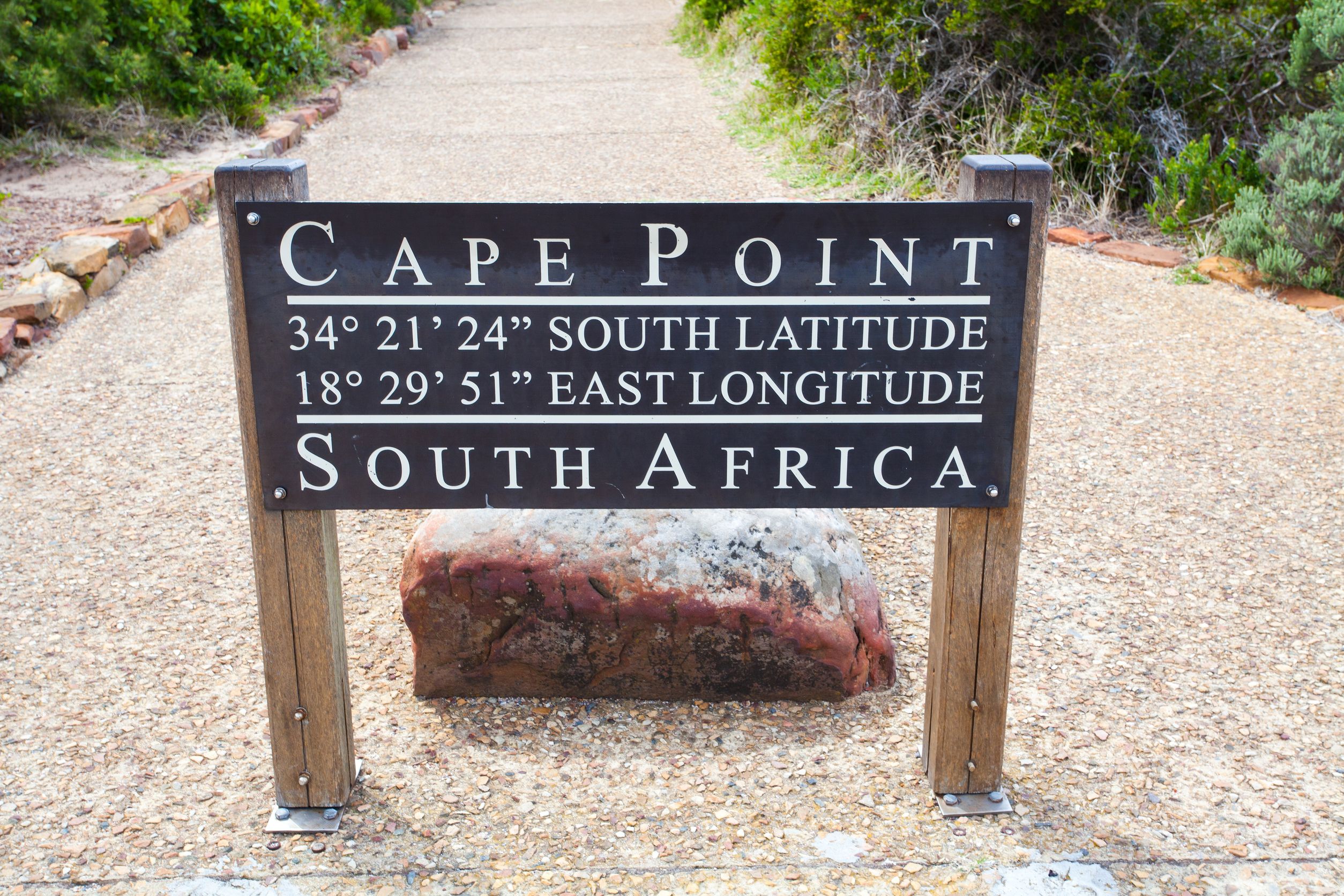
Near Cape Point, where a portion of the cold Benguela Current of the Atlantic meets the warm south- and west-flowing Agulhas Current of the Southern Pacific Ocean, the waters become wild and turbulent. It’s a common practice while on vacation in Cape Town to journey down to Cape Point, take a short hike, get your picture taken by the sign, and stare out to sea at the “place where two oceans meet.” (Hey, I did it.) However, the truth is that the ocean currents actually intermingle for hundreds of miles in either direction—both east and west of Cape Point—and that the “point where two oceans meet” is likely to be anywhere between Cape Point and about 100 miles west at Cape Agulhas (which is actually the southernmost point on the African continent and worth a visit as well).

From the department of I thought this was a wine blog:  Good point. All I can say is that my curiosity concerning Benguela Current peaked while studying the wines of South Africa. The winelands of South Africa’s Western Cape are cooled by the moist fog and gentle breezes generated by the Benguela Current, which also generates the not-so-gentle south-easterly wind known as the “Cape Doctor.”

...

Super-sharp students of wine might also have perked up with the mention of Cape Point, which is the former name of the Cape Peninsula wine district; and Cape Agulhas, a wine district located in the Cape South Coast. Cape Peninsula is a small area located on a narrow, rugged area just south of Cape Town and east of Constantia (both wine regions are easily accessed via taxi or tour bus from Cape Town). Cape Peninsula produces snappy, cool-climate white wines and is particularly adept at Sauvignon Blanc. The terroir of Cape Agulhas, about 100 miles down the coast, is also markedly maritime—distinctly cool and breezy—and known for a crisp, snappy style of Sauvignon Blanc, apricot-and-lemon laced Semillon, and a unique cool-climate style of Shiraz.

References:

The Bubbly Professor is “Miss Jane” Nickles of Austin, Texas… missjane@prodigy.net