Five Fast Facts about the Minho River

.

The Minho River (known in Spain as the Miño, but widely recognized by the Portuguese name Minho) flows south/southwest across Galicia before twisting to the west and defining a portion of the border between Spain and Portugal. At 210 miles/340 km long, the Minho is the longest river in Galicia and the fourth longest on the Iberian Peninsula (following the Douro, Ebro, and Tagus).

The river helps to define several of Galicia’s wine regions as well as Portugal’s Vinho Verde DOC and is, therefore, particularly well-known to students of wine. Read on to discover five fast facts about the Minho!

#1: Pedregal de Irimia—a spot located a few miles (kilometers) east of the tiny town of Meira—is considered to the source of the Minho River. The spot—positioned within the Serra do Meira/Cantabrian Mountains—is very close to the area where the northern edge of the Galician Massif meets the eastern edge of the Cantabrian Mountains. Pedregal de Irimia sits at an elevation of about 2,400 feet/732 km above sea level. The ancient walled city of Lugo—often cited as the river’s source—is located about 45 miles/73 kilometers downriver from Pedregal de Irimia.
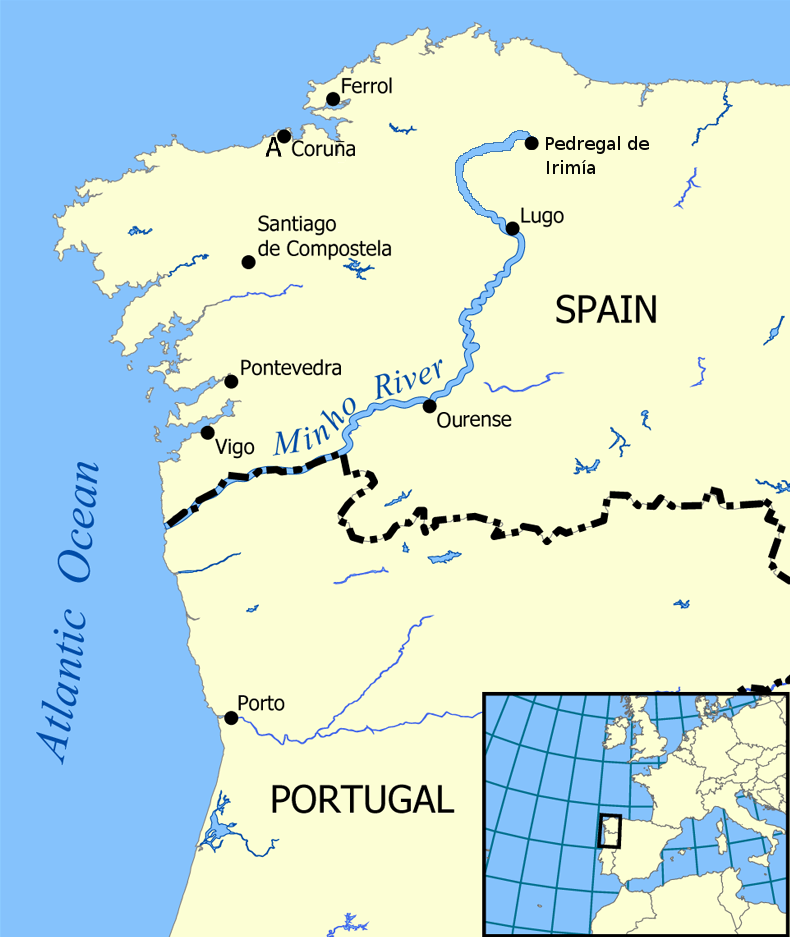
Map of the Minho River attributed to Norman Einstein via Wikimedia Commons

#2: About 17 miles/28 km south of the city of Lugo, the Minho River enters into—and slices through—the Ribeira Sacra DO. Here, the river Sil—once-upon-a-time a rich source of alluvial gold—flows into the Minho. The Sil flows southwest from León (Castilla y León) for about 140 miles/225 km until it joins the Minho in the Galician province of Ourense.

The Ribeira Sacra DO—whose name translates as Sacred Shore, most likely referencing the many churches and monasteries in the region—is known for reds and rosés based on the Mencía grape variety as well as white wines based on Godello. A rather long list of other varieties (including Garnacha Tinta, Albariño, Godello, Treixadura, Loureira, and Torrontés) are also allowed for use in the wines of the Ribeira Sacra DO.

#3: Just a few miles/kilometers after exiting Ribeira Sacra, the Minho flows into the Ribeiro DO. While this DO makes a small amount of Mencía-based red and rosé, white wines are the focus here and make up to 85% of the total production. The leading white grape varieties of the Ribeiro DO—used to create the crisp, fruity, and flavorful wines of the region—include Treixadura, Torrontés, Godello, Loureira, and Albariño.

#4: Passing through the eastern edge of the Ribeiro DO, the Minho River flows past the town of Cortegada and carves out the southern boundary of the Condado de Tea and O Rosal sub-regions of the Rías Baixas DO. These regions—characterized by terraced vineyards overlooking the banks of the river—are deservedly famous for their crisp, dry, fruity-and-floral white wines based on Albariño.
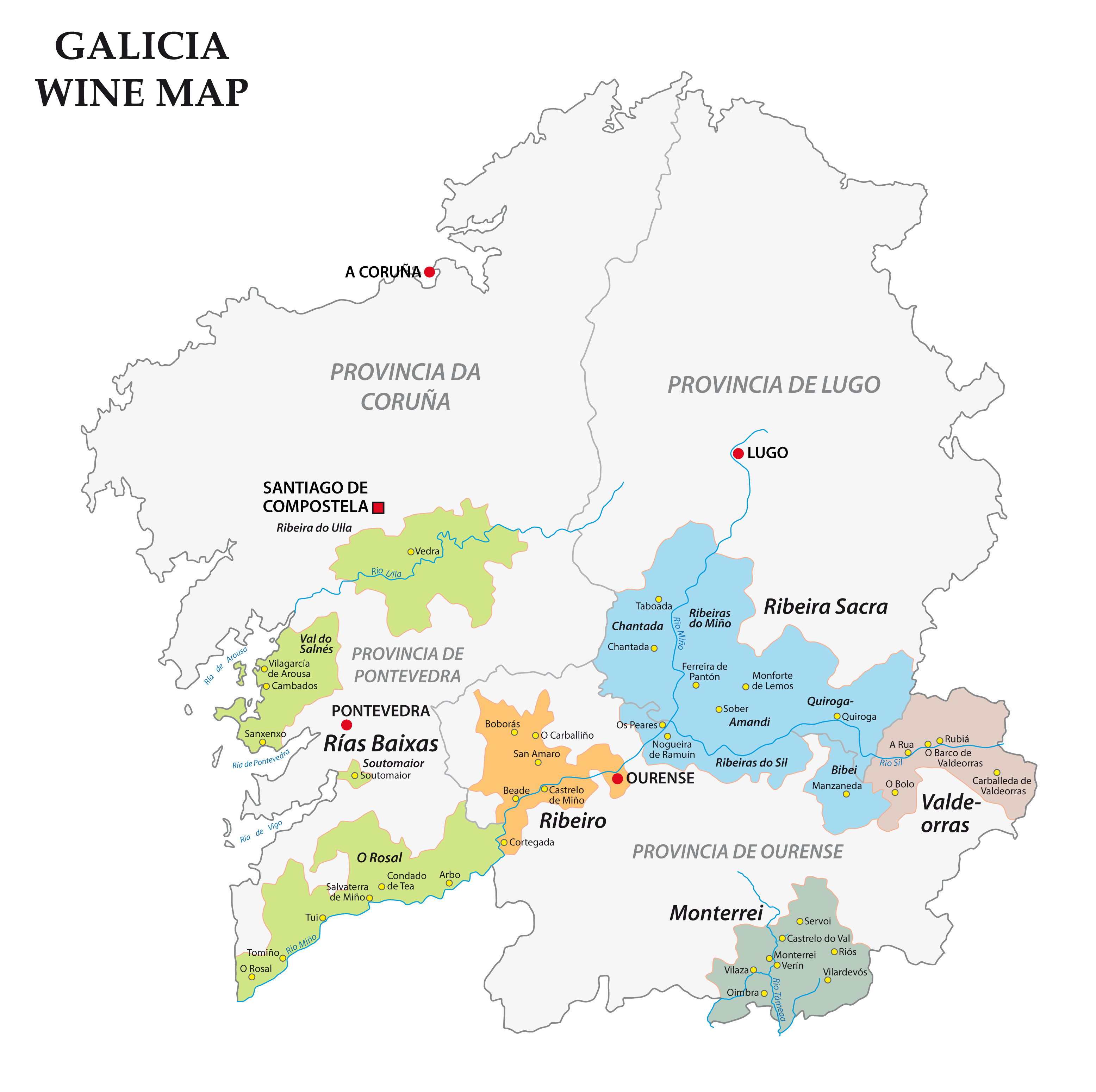
Wine Map of Galicia

#5: On its journey from to the Atlantic Ocean, the Minho River forms part of the border between Spain and Portugal. This part of the river’s journey begins just to the north of the town of Cevide—the northernmost spot in Portugal—and continues westward for about 50 miles/80 km to the sea. Here, the river defines the northern edge of Portugal’s Minho Vino Regional (regional/IGP) wine appellation as well as the Vinho Verde DOC. The Minho/Vinho Verde area is huge, extending as far south as the Douro River and halfway into the interior of the country. This is a lush, fertile area with a good deal of crops, fields, and agriculture of all kinds. Grapevines in the Minho are often trained up high pergolas—or even up and over trees, telephone poles, and fences. This practice makes excellent use of the available land and helps to protect the vines from the possibly harmful effects of the high humidity experienced throughout much of the region.

Vinho Verde is famous all over the world as an inexpensive, easy-drinking, widely accessible wine. While the name translates to green wine, the reference is to the wine’s flavor profile—the wine is meant to be consumed young, white it retains its crisp, fruity, and thirst-quenching style—and not its color (which can actually be red, white, or pink).

The Minho River reaches its final destination—the Atlantic Ocean—between the Spanish town of A Guarda and Portugal’s Caminha. This is the river’s widest point—it measures as much as mile/2 km across and at this stage is considered an estuary, complete with low-tide sand bars visible from either shore.

References/for more information:

The Bubbly Professor is “Miss Jane” Nickles of Austin, Texas… missjane@prodigy.net
(French) Wine from a Tropical Island: La Réunion

.

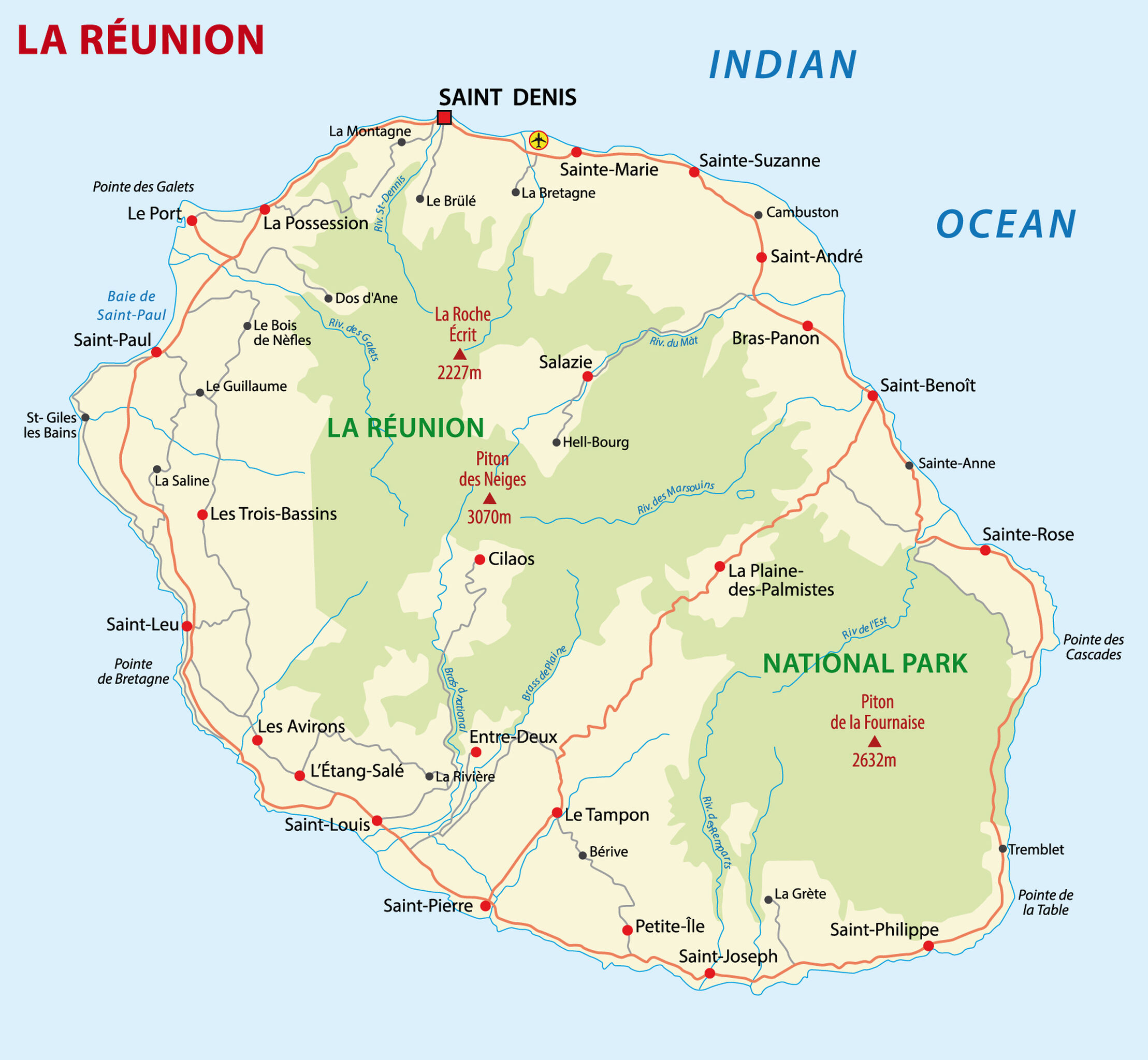
La Réunion (Reunion Island)—one of the five Départements d’Outre-Mer (Overseas Departments) of France—is located about 340 miles/550 km east of Madagascar and surrounded by the Indian Ocean. Considering its tropical-island vibe (as well as its position at 21°S latitude), it is easy to understand the fame of its locally-produced rum—which has been protected as a geographical indication—Rhum de la Réunion IGP—since 1989.

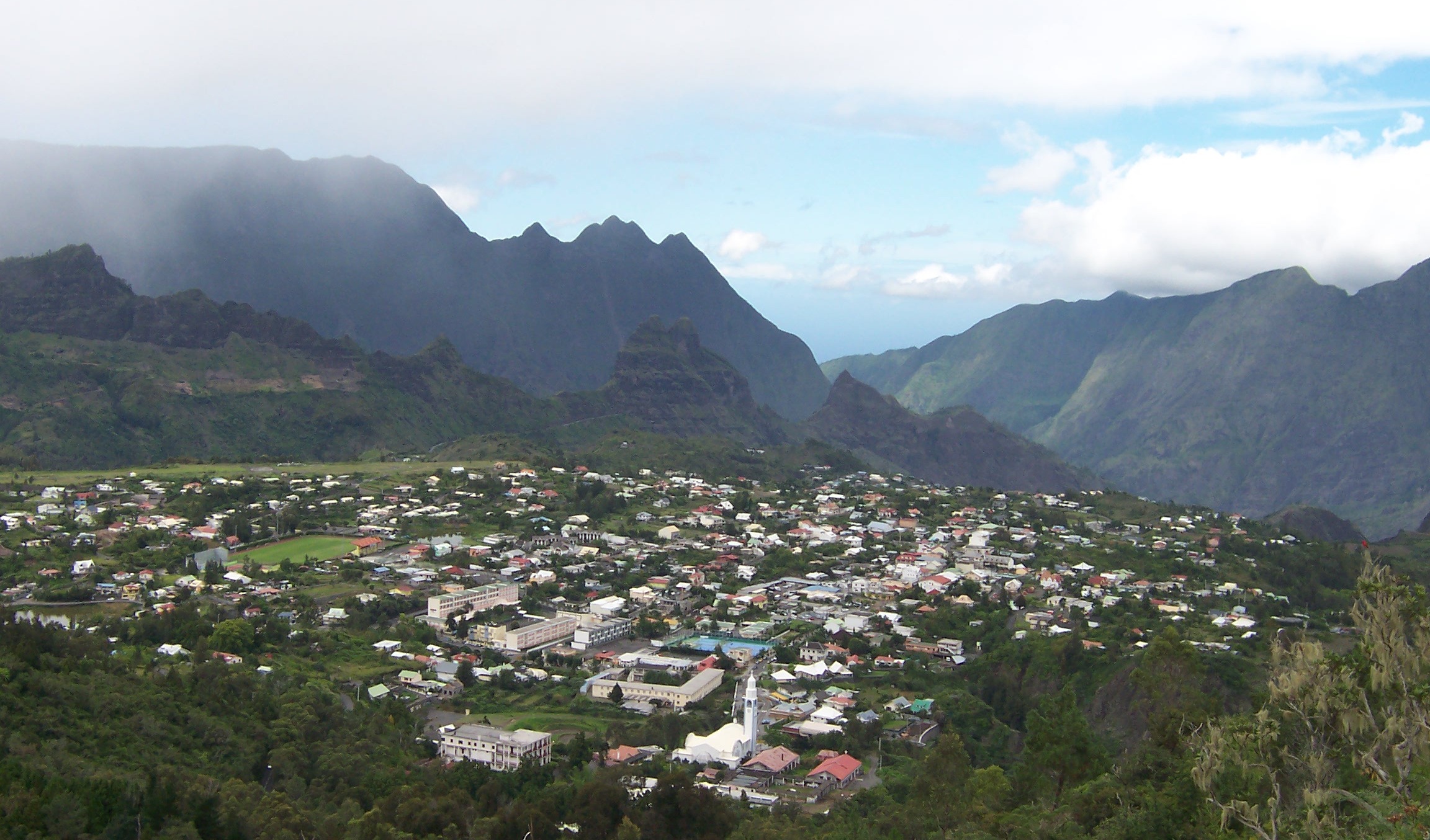
What is a bit more surprising is Vin de Cilaos—an esteemed wine produced from island-grown noble grape varieties such as Chenin Blanc, Pinot Noir, and Malbec.  Cilaos—located somewhat in the center of the island and home to 6,000 people—is one of the larger villages on La Réunion.

Vin de Cilaos can truthfully call itself a mountain wine, a high-elevation wine, and a volcanic wine. The village and its vineyards are situated in a volcanic caldera (crater) known as the Cirque de Cilaos at an elevation of 1,200 meters/3,940 feet above sea level.

Not surprisingly, Vin de Cilaos is—along with the wines from the Tahitian vineyards—one of the only French wines produced in the Southern Hemisphere. Vinifera grapes are believed to have been brought to the island in the year 1655, but most were wiped out by Phylloxera. In 1992, the Chai de Cilaos Cooperative was founded and planted over 6,000 vinifera vines—including Chenin Blanc, Pinot Noir, and Malbec—in the region. The first wine produced by the cooperative (in 1996) was a dry Chenin Blanc. Since then, other wines—including a red blend of Pinot Noir and Malbec—have followed suit. Alas, these wines are made in highly limited quantities, so if you want to try Vin de Cilaos…you’ll need to visit the island (not such a bad idea).

In addition to its fame as (French) wine-producing region, Cirque de Cilaos is a thermal spa retreat area renowned for its lentils, wildflowers, naturally sparkling water, hiking trails, and meticulous white linen embroidery—as carried on by the Maison de la Broderie de Cilaos (Cilaos Embroidery House).

Cirque de Cilaos

Grapes are grown in other parts of La Réunion as well, and a light red wine produced from Isabella grapes (a Vitis labrusca variety) is enjoyed locally. The Isabella grape variety was once-upon-a-time banned from the island, as it was believed that the wine—known as vin qui rend fou (‘wine that sends you mad’) drove people crazy. The ban was lifted in 2004.

Note: Wines from Cilaos were sometimes labeled as “Vin de Pays de Cilaos” up until 2009, when the EU disallowed the use of the title. The wines of Cilaos have never been awarded a French geographical indication, although there are rumors that an application is in process.

The Outer Limits is my series of appreciative posts about small, oddball, obscure, or out-of-the-way wine regions.

References/for more information:

The Bubbly Professor is “Miss Jane” Nickles of Austin, Texas… missjane@prodigy.net

Getting to Know Grolleau

You have  probably already met Grolleau, but you just don’t know it yet.

The Grolleau grape variety—more precisely known as Grolleau Noir, to differentiate it from its siblings/color mutations Grolleau Blanc and Grolleau Gris—is the third most widely planted red grape variety in France’s Loire Valley (after Cabernet Franc and Gamay). It has most likely made its way into your glass via a snappy rosé or creamy sparkling wine (either white or rosé) produced somewhere around Anjou, Saumur, or Touraine.

Grolleau—believed to one of the many descendants of Gouais Blanc—was first recognized as “Grolleau de Cinq-Mars” (in reference to the Central Loire Valley town of Cinq-Mars-le-Pile) in the early 1800s. It is also known to have been cultivated in the Charente Department of Southwest France around this same time, but it is assumed to be native to the Loire. The name may derive from the Old French grolle—meaning black crow—referencing the dark skin of the grapes.

Grolleau is appreciated for its reliable high yield, but this rampant fertility can pose a challenge. If left unchecked, the plant can produce huge crops of uninspiring grapes somewhat lacking in flavor and tannin—despite the lovely dark-skinned appearance of the grapes. Due to this tendency—coupled with the variety’s susceptibility to certain vine diseases—plantings of Grolleau have been declining over the last fifty years. In the 1950s, there were over 28,000 acres/11,000 ha of Grolleau planted in the Loire Valley; as of the last decade, there are just over 5,800 acres/2,350 ha (although the decline seems to have stabilized).

Nevertheless, Grolleau is widely used in the sparkling wines of the Loire Valley and persists as one of the leading grapes of region’s rosé. It is often the majority grape in the much beloved and slightly sweet wines of the Rosé d’Anjou AOC. Alas…this could be because Rosé d’Anjou is one of the few AOC wines of the region—and even the country—that allows for its use.

Grolleau-based wines tend to be high in acid, moderate in alcohol, and may show aromas/flavors of red fruit (strawberry, raspberry, cherry),  watermelon, citrus (lemon, tangerine), rose petals, and (some say) red candy.

Despite its dark reddish-black hue, the grape’s thin skins mean that Grolleau is rarely used to produce red wines. If you find one, it is likely to be labeled under an IGP—such as the Vin de Pays du Val de Loire— or a Vin de France designation. It might also be produced via carbonic maceration. (Fun fact: Grolleau is only allowed to be used in the red wines of ONE single AOC—the Anjou AOC—and even here it is limited to no more than 10% of the total blend.)

In the world of wine, one can always find the exception to the rule—and despite its penchant for bubbles and rosé, there are some serious red wines produced with Grolleau. Domaine Clau de Nel—located in Anjou—cultivates two hectares (about five acres) of 60-to-90-year-old Grolleau vines trained in gnarly, gobelet style and farmed biodynamically (Demeter Certification and all). The grapes are hand harvested, sorted in the field, and fermented with native yeasts. The resulting wine is placed in used French oak barrels and aged for at least 12 months in “ancient troglodyte cellars cut into the limestone hillside on the property.” The wine is then bottled—unfined and unfiltered. Jancis Robinson described this wine as having a “mid garnet color, a certain wildness on the nose” and as “possibly the most serious Grolleau I have ever tasted.”

Loire Valley AOCs that allow for Grolleau include the following:

  • Anjou AOC (allowed in sparkling wines; red wines may include a max. 10% Grolleau)
  • Coteaux du Loir AOC (allowed in rosé only, limited to a max of 30%)
  • Crémant de Loire AOC (no limits, but this is a bubbly-only appellation)
  • Rosé d’Anjou AOC (Grolleau is typically the majority grape, but Cabernet Sauvignon, Cabernet Franc, Malbec, Gamay, and Pineau d’Aunis/Chenin Noir are allowed as well)
  • Touraine AOC (allowed in sparkling wines and rosé only)
  • Saumur AOC (allowed in sparkling wines and rosé only)

References/for more information:

The Bubbly Professor is “Miss Jane” Nickles of Austin, Texas… missjane@prodigy.net
Wine Grape Cheat Sheets: Merlot

Cabernet TopThe Soundbyte:  Thank goodness we are many years past the hysterical-but-unfair, Sideways movie-inspired decade of bashing Merlot. While I still find myself in defense of Merlot on occasion, most of the wine-loving world has come to realize that Merlot has a lot going for it.  Merlot is loved for its supple texture, fruit-forward juiciness, and moderate tannins. It’s a great wine to sip on its own and it pairs easily with food.

Merlot is often thought of as a blending partner for Cabernet Sauvignon—and indeed, these two grapes play well together (in some of world’s greatest red wines). Merlot does just fine on its own, however, and the very qualities that make it a great blending partner can also shing in a single-variety wine.

Typical Attributes of a Merlot-Based Wine:

  • Medium tannin (as compared to many red grapes).  This is due to the large size of the grape berries, which give it a high juice-to-skin ratio
  • Smooth, soft, and supple texture…many winemakers say it’s all about the texture when it comes to Merlot
  • Rich red color…often belying the smooth character of the wine
  • Moderate-to-lively acidity
  • Fruit-forward aromas and flavors, combined with some floral, spicy, or herbal complexity
  • Lighter than Syrah and heavier than Pinot, Merlot ranks just under Cabernet Sauvignon in the rankings-by-heft.
Well, hello my little vixen. You try to look so tough and edgy, yet I know you are velvety smooth...

Well, hello my little vixen. You try to look so tough and edgy, yet I know you are velvety smooth…

Typical Aromas of a Merlot-Based Wine:

  • Fruity:  Grapes—Merlot is one of the few red vinifera wines that (sometimes) tastes like grapes:  look for aromas of Grape Jelly or Grape Jam; Berries (Blackberry, Boysenberry, Strawberry, Raspberry, Cranberry), Plum, Ripe Cherry, Currant, Fig, Prune
  • Floral:  Rose, Violet
  • Oak-Derived: Cedar, Cocoa, Cigar, Tobacco, Vanilla, Smoky
  • Herbal:  Mint, Bay Leaf
  • Spicy:  Cinnamon, Clove, Licorice, Coffee
  • Sometimes: Candied Fruit, Fruitcake, Sandalwood, Truffles, Tobacco

Where The Best Merlot is Grown:

  • The Bordeaux region of France, where it is a large part of the blend of most wines, and the predominant variety in the wines of the Right Bank (as well as those bottled under the generic Bordeaux appellations)
  • The Languedoc, Roussillon, and throughout Southern France
  • Surprise, surprise…Merlot is the most widely planted red grape in all of France (who’s Merlot-bashing now?)
  • California, particularly the North Coast Regions
  • Washington State…where NO ONE has ever dared to bash Merlot
  • Italy, especially Trentino-Alto Adige, Tuscany, Veneto, and Fruili
  • Australia, Chile, and Argentina
I'll have what she's having.

I’ll have what she’s having.

Food Affinities – Base Ingredients:

  • Beef, Veal, Venison, Pork
  • Lamb – Merlot does especially well with Lamb.  Everywhere that Mary went, Merlot was sure to go…
  • Duck, Turkey
  • Cheddar Cheeses
  • Blue Cheeses

Food Affinities – Bridge Ingredients:

  • Mushrooms, Onions, Garlic
  • White Beans – weird but really really true
  • Rosemary, Mint, other fresh and dried herbs
  • Walnuts, Pecans
  • Tomatoes, Sun-dried Tomatoes
  • Eggplant, Fennel, Beets
  • Bacon, Pancetta
  • Dijon Mustard

Note: When it comes to food pairings, by all means—drink what you like!

Are you ready to stop bashing Merlot now?  Don’t make me get out the Petrus!

The Bubbly Professor is “Miss Jane” Nickles of San Marcos, Texas…missjane@prodigy.net

Confusion Corner: Sercial, Cerceal, Cercial

Let’s face it. If you are reading about wine (specifically Spanish or Portuguese wine), and you encounter the term “Cerceal,” you are likely to assume it refers to an alternative spelling of the “Sercial” grape (best known as the leading grape of the driest styles of Madeira). At least…that is what I did, until I knew better.

As it turns out, they are two different varieties, although both white and both native to Portugal. And there’s more…another grape (unrelated) likes to go by the name “Cercial” (note the minor spelling difference). These grapes rightfully deserve their place in the Confusion Corner. Let’s see if we can clear this up…

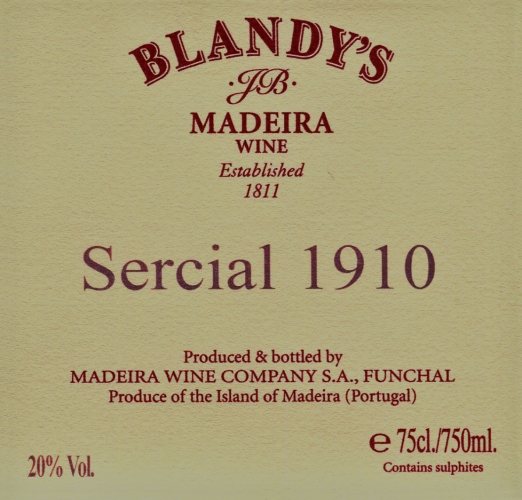
Sercial: The Sercial grape variety is well-known as one of the leading grape varieties of the Madeira DOC. It is believed to be native to the Bucelas area (near Lisbon), where it was traditionally known as Esgana Cão—or dog strangler—based (one hopes) on its outrageously high levels of acidity.

It is believed that Esgana Cão was brought from the mainland to the island of Madeira, where the name Sercial caught on. Despite the fact that the grape’s claim to fame is based on its use in Madeira, the island region accounts for only 20 hectares/49 acres of the Sercial vineyards. The Portuguese mainland boasts about 70 hectares/173 acres of Sercial; much of it grown in the Douro where it is used in both White Port and dry (non-fortified) wines.

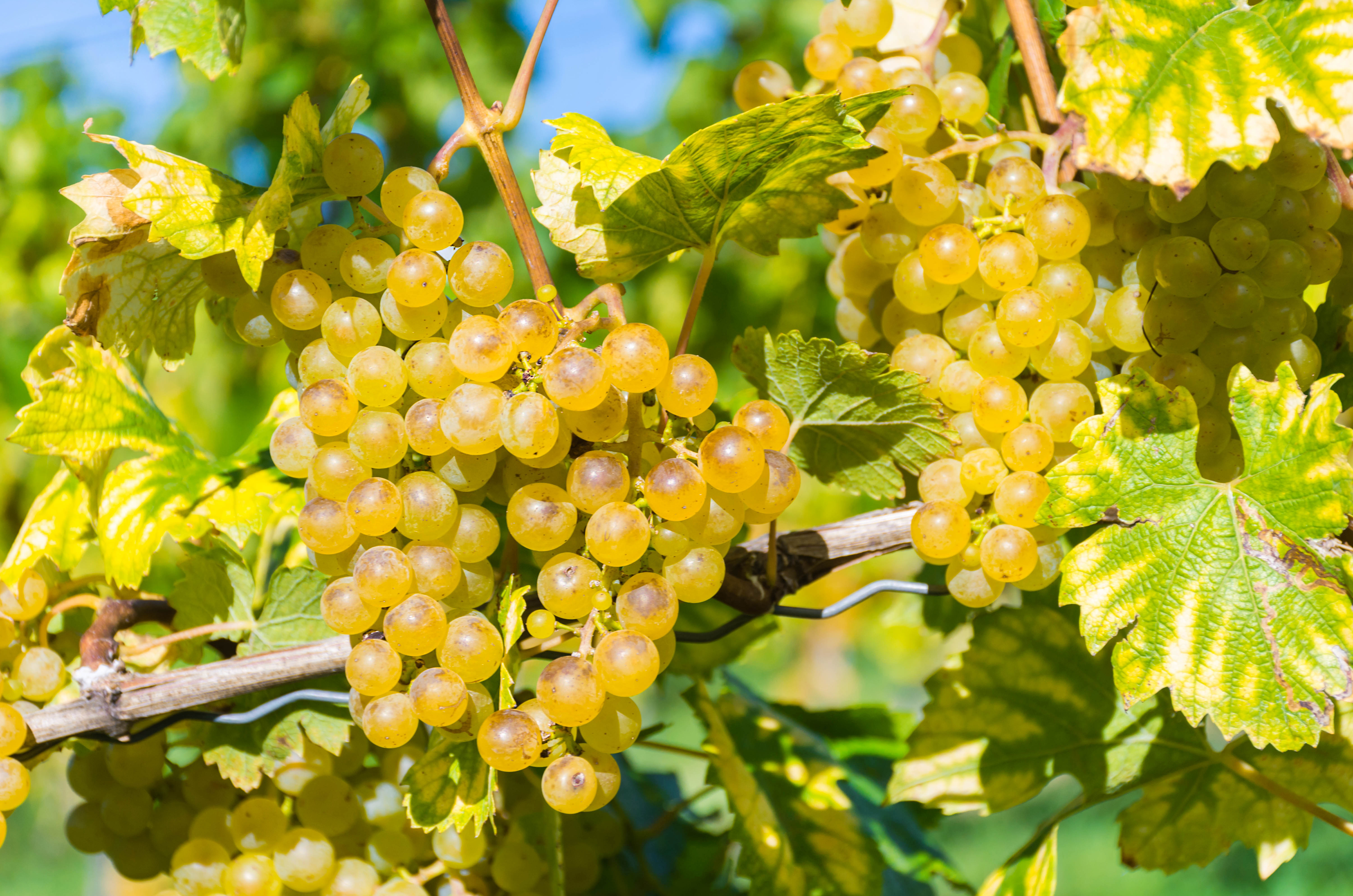
Sercial is not often found as a (non-fortified) varietal wine; but is typically used in blends. It is a late-ripening grape that has a yellow/green color when young, but ripens to a deep, golden hue. Sercial has an amazing ability to retain its acidity throughout its long growing season. The grape’s vibrant acidity is coupled with intense aromatics—including yellow fruit, white flowers, and a hint of almond—as well as an ability to age gracefully.

Sercial is not widely grown outside of Portugal. However, the amazing estate of Mas de Daumas Gassac (in France’s Languedoc) has a small plot (0.5 hectares/1.25 acres) of Sercial. In some years, the Sercial is used in the estate’s unique dry white wines; in others it is blended with Muscat Blanc à Petits Grains to produce a well-aged and well-oxidized dessert wine (vin de liqueur) known as Vin de Laurence and bottled under the Vin de France designation.

Also known as: in the Azores (Açores), Sercial is known as Arinto dos Açores. In the Minho, it is known as Esganoso. Esgana and Esgana Cão are also listed as synonyms in the Vitis International Variety Catalogue (VIVC).

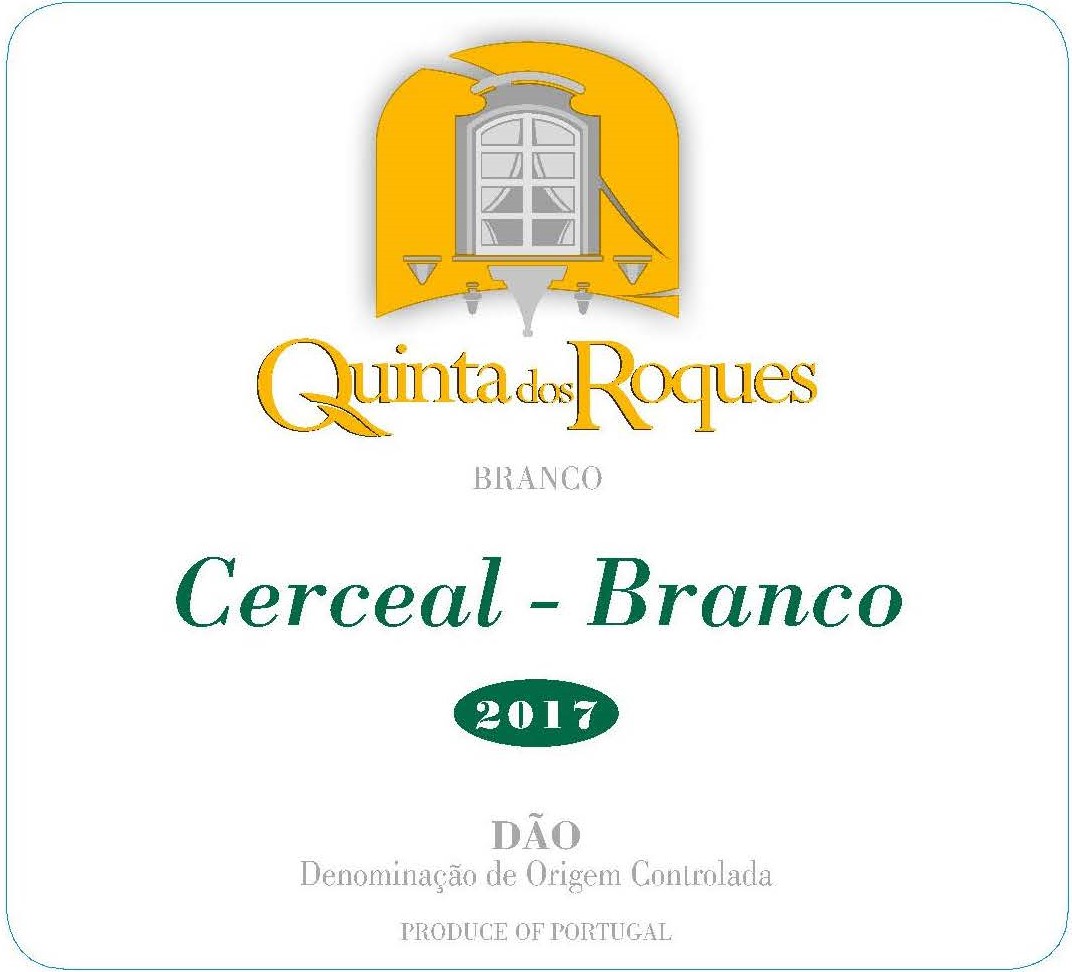
Cerceal/Cerceal Branco: Cerceal Branco is believed to be a natural cross of Malvasia Fina (white) X Tinta Pereira (red)—this, according to the VIVC. However, other references cite it as a possible cross of Malvasia Fina X Sercial.

Cerceal Branco is a late-ripening, thick-skinned variety known to produce age-worthy wines with lively acidity. These wines are known for a subtle fruit character (focusing on citrus/grapefruit, lemon, and lime) while showing a good deal of savory character (what many people refer to as “earthy” or “mineral”). 

There are approximately 113 hectares/279 acres of Cerceal Branco in Portugal. A good majority of it is grown in the Douro, as well as the Dão. Smaller amounts are grown in the Bairrada, Tejo, and Alentejo DOCs. It is often used in white wine blends, including some sparkling wines. Typical blending partners include Bical and Encruzado (both native Portuguese white varieties). It may also be seen as a varietal wine; Quinta dos Roques produces a lively example (full of gorgeous fruit and mineral aromas) in the Dão DOC.

Also known as: Cercial (in Bairrada) or Cercial do Douro.

Cercial: Cercial is a totally different grape; believed to be related to one of Portugal’s most prolific red grapes: Castelão. Cercial is native to the Colares region, where it is known as Jampal. Cercial/Jampal is an allowed variety in more than a dozen Portuguese DOCs, and is grown in and around the regions of Colares, Lisboa, Beiras, and Tejo. The grape is known to produce high-qualty, aromatic white wines redolent of fruit and flowers. Despite its promise, there are currently just 106 hectares/262 acres of Cercial/Jampal in Portugal.

Wait, there’s one more—Sercialinho: Just to keep things interesting: Sercial, Cerceal, or Cercial should NOT be confused with Sercialinho. Sercialinho is a Vital X Alvarinho cross created in the Bairrada Region sometime in the 1950s. It is believed that there are about 9 hectares/22 acres of Sercialinho in Portugal, most of it planted in the Bairrada.

Sercialinho is reported to have high levels of acidity, potentially very high sugar, and aromas of green apple, pear, and honey—and some have even compared it to Riesling. Alas, it seems to lack complexity…but who knows what the future may hold for Sercialinho?

References/for more information:

The Bubbly Professor is “Miss Jane” Nickles of Austin, Texas… missjane@prodigy.net

Five Fast Facts about the Cantabrian Mountains

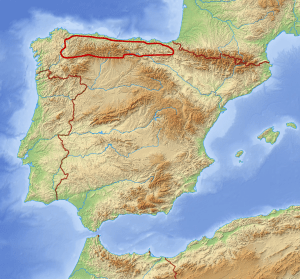
Extending across the northern coast of Spain for over 180 miles (300 km), the Cantabrian Mountains (Cordillera Cantábrica) comprise one of the major mountain ranges of Spain. These mountains are famous for providing a wind-and-rain shadow to the lands located to their south as well as defining Green Spain—the cool-and-rainy area along the coast.

While keeping our focus on the world of wine, here are five fast facts about the Cantabrian Mountains:

#1—From the Pyrenees to the Galician Massif: The Cantabrian Mountains stretch from the western edge of the Pyrenees (Navarra), through País Vasco, through a portion of the northern edge of Castilla y León, across Cantabria and Asturias, and into Galicia. The western edge of the range is typically defined as the valley of the Minho River and the point where the Cantabrian Mountains meet the eastern edge of the Galician Massif.

Geologically speaking (in terms of orogeny [mountain formation] and composition), the Cantabrian Mountains are similar to the Pyrenees. However, they are considered a distinct range.

#2—Green Spain defined: The mountains at the western-most edge of the Cantabrian Mountains—known as the Asturian Massif—join up with a series of mountains ranges known as the Galician Massif. The mountains of the Galician Massif—along with the Cantabrian Range—form part of a rather imposing wall of mountains that borders the plateau of Spain’s Meseta Central. These mountains help to keep the interior of the country “high and dry” while the area on the seaward side of the mountains—Green Spain, although the term Cornisa Cantábrica is more likely to be heard in Spain—remains lush, rainy, and temperate.

This cool-climate area—home to many of Spain’s favorite white, fizzy, and light-red wines—includes a large portion of Galicia, Asturias, and Cantabria, as well as the northern section of País Vasco. The DOs of Rías Baixas, Ribera Sacra, and Riberio as well as the three txakolinas (Arabako Txakolina DO, Bizkaiko Txakolina DO, and Getariako Txakolina DO) could all be considered wines of Green Spain.

#3—Three sections of the Cantabrian Mountains: The Cantabrian Range has three distinct sections. The westernmost section—extending into Galicia—contains the foothills and mountains of the Asturian Massif.

The center region contains the impressive Picos de Europa. This region contains the Torre Ceredo, located on the border between Asturias and Cantabria and topping out at 8,690 feet (2,650 m) above sea level.

The easternmost portion of the mountains—stretching eastward across Navarra to the western edge of the Pyrenees—is sometimes referred to as the Basque Mountains. The mountains here are incredibly old and eroded, topping out at Aizkorri (Basque for bare stone), a limestone summit reaching 5,023 feet (1,528 m) in height.

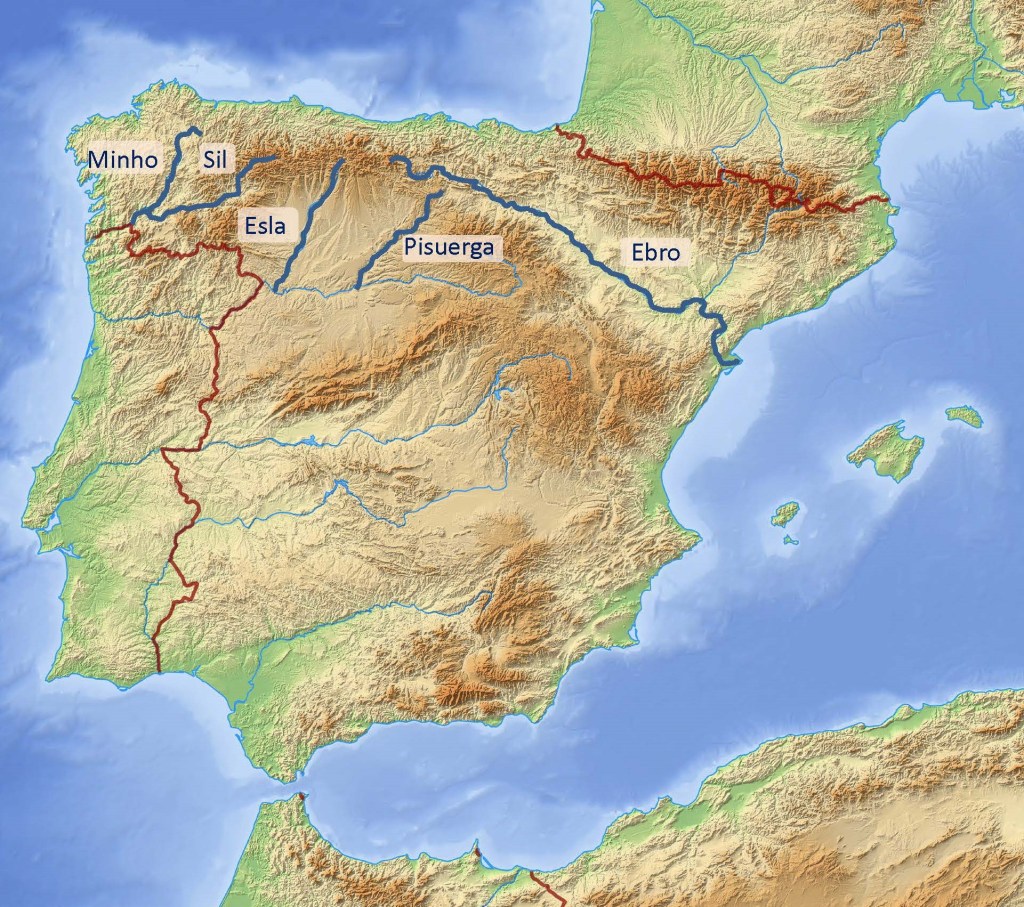
#4—Wine Rivers: The Cantabrian Mountains are the source of several important wine-related rivers. These include the following:

  • The Ebro (flows east/southeast through the Rioja DOCa before emptying into the Mediterranean Sea)
  • The Minho (flows south then west, defining part of the border between Spain and Portugal while outlining Portugal’s Vinho Verde DOC as well as Spain’s Rías Baixas DO)
  • The Sil (flows through Bierzo and onward through the Valdeorras and Ribeiro DOs before joining the Minho)
  • The Pisuerga (flows through the Cigales DO before joining the Duero)
  • The Esla (courses through the Tierra de Léon DO before joining the Duero).

#5—Heroic viticulture in the Cantabrian Mountains: Located in the Cantabrian Mountains of Asturias, the Cangas VCIG (Vino de Calidad Indicación Geográfica) appellation has been designated as practicing Viticultura de Montaña ( mountain viticulture). Mountain viticulture (sometimes called heroic viticulture) is so-defined by an organization known as CERVIM (Centro de Investigación, Estudio, Salvaguarda, Coordinación y Valorización de la Viticultura de Montaña/Center for Research, Study, Safeguarding, Coordination and Valorisation of Mountain Viticulture).

According to CERVIM, aspects of mountain viticulture include vine cultivation at elevations above 1,640 feet/500 m, vines planted on slopes with a minimum of 30° of incline, vines planted on terraces or embankments, and topography that prohibits mechanization.

Other wine regions have been recognized by the CERVIM organization as practicing mountain viticulture include Ribeira Sacra (Galicia, Spain); Priorat/Priorato (Catalonia, Spain); Banyuls (Roussillon, France); Portugal’s Douro Valley and the Mosel in Germany.

References/for more information:

The Bubbly Professor is “Miss Jane” Nickles of Austin, Texas… missjane@prodigy.net

Wine Geo: Anatomy of a (Wine) River

Rivers are a big deal to wine students. Rivers define regional and national borders; carve out valleys, gorges, and ravines; provide water for irrigation; move and mold the soil; and moderate the climate (to name just a few of their tricks).

Being a wine geo nerd, I thought it would be interesting to take a closer look at the anatomy of a river, with a nod to a few of the many wine regions defined by their river(s).  As such, here is a quick dive into the anatomy of a river, from head (source) to tail (delta):

The Headwaters: The beginning, or source, of a river is known as its headwaters. Headwaters can be formed from a small trickle bubbling up from an underground stream, an outlet from a lake or pond, an area fed by melting mountain snow, or a place where several small streams flow together.

Upstream/Downstream: If you want to head upriver you need to point in the direction of the river’s source (headwaters). If you are heading downriver, you are paddling towards the river’s mouth (end). An area described as “upper” will be closer to the source of a river than a “lower” area. (This is often confusing, as we tend to think of upper or lower in terms of elevation.)

It is quite common for wine regions to be named in part due to their position on a river.  Some examples include Oberösterreich/Niederösterreich (Upper Austria/Lower Austria), the Lower Long Tom (proposed AVA), and the Upper Goulburn GI (Victoria, Australia).

The Riverbank: The area right next to the river is called the riverbank—or (in more scientific terms) the riparian zone. The banks of a river are typically fertile areas, frequently replenished by areal flooding. However, in the world of wine some of the prime river-adjacent areas are located on elevated plateaus above the river or on steep hillsides leading down to the river. Spain has several appellations named after riverbanks (riberas); these include the Ribera del Duero DO, the Ribera del Guadiana DO, and the Ribera del Júcar DO. 

The Tributaries: A tributary is a river the feeds into a (typically larger) river rather than reaching its end in an ocean or lake. Many of the world’s most impressive rivers gain most of their water from their tributaries. For example, France’s Loire River is fed by close to 80 smaller rivers, including the Sèvre, the Maine, the Allier, the Sarthe, the Loir, and the Cher. Tributaries are sometimes referred by as left-bank or right-bank tributaries. The terms refer to the location of the tributary as one is looking downstream (facing the mouth/end, rather than the source/beginning of the river). 

Several well-known wine regions are named for the tributaries of famous rivers. These include Muscadet Sèvre-et-Maine AOC (the Sèvre and the Maine are both left-bank tributaries of the Loire) and the Saar Grosslage (named after a right-bank tributary of the Mosel).

The Delta: The end of a river—where it meets an ocean, lake, or wetland—is known as its mouth or delta. As it reaches its end, a river typically slows and spreads out into a wide area. As this occurs, the river is no longer able to carry large amount of sediment and it leaves behind deposits of rich soil.

For this reason, the deltas of the world often coincide with centers of civilization (such as Lower Egypt’s Nile Delta) and/or fertile nesting grounds for birds and other wildlife (such as the Guadalupe Delta Wildlife Management Area of southern Texas).  In the United States, the Mississippi Delta AVA (located partially on the delta of the Mississippi River in parts of Louisiana, Mississippi, and Tennessee) is a center for enological research specializing in native North American grapes.

If a river ends at the sea, it forms an estuary—an area where saltwater mixes with fresh water—as it heads into the ocean. Spain’s famous Rías Baixas DO is named after a series of drowned river estuaries (the upper rías).

References/for more information:

The Bubbly Professor is “Miss Jane” Nickles of Austin, Texas… missjane@prodigy.net

The Valentine’s Day “Secret Weapon” Wine


The Valentine’s Day “Secret Weapon” Wine


My favorite wine for romance is Brachetto d’Acqui DOCG. Use any brand you like but the absolute romantic-est is Rosa Regale by Banfi Vintners.  Just look at it…the bottle is elegantly shaped, the clear glass means you can see the beautiful clear garnet-red color of the wine, and as if that weren’t enough to make it just sing “Valentine!” the black and gold label has a picture of a red rose!


This is the everybody loves it wine of your dreams.  From Piedmont, Italy and grown in the company of some mighty heavy hitters, Brachetto is the wine to bring on a date.  Trust me on this one.


This wine has all the ingredients you need in a romantic wine …it’s pinkish-red, bubbly, lightly sweet, a perfect match for chocolate and low in alcohol.  Wink, wink, that low in alcohol bit will come in handy in case the date is a success.  As if that weren’t enough, the slight sweetness in this wine and the raspberry-strawberry flavors make it a perfect match for milk-chocolate dipped strawberries…imagine the possibilities.


The aromas of this wine are easily recognizable and always consistent—the first to hit are fruity scents of raspberry and strawberry, followed immediately (sniff above the rim of the glass) by a strong scent of rose perfume.  I have been known to describe this aroma as a haunting memory of roses, rose-honey potpourri, or wedding bouquet.


I tell my students that this wine can be the center of a picture-perfect seduction—the Valentine’s Day Secret Weapon—if they will just do this: First, make some hand-dipped milk-chocolate strawberries. Put them in a pretty box and show up for your date with the strawberries and a bottle of Brachetto. After your sweetheart opens the door, say, “Hey baby, I’ve got the bubbly and the chocolate strawberries … everything you wanted for Valentine’s Day.” If your gal (or guy) is anything like me, they’ll say “Oh yeah? Where are my roses???” to which you reply, “In the bottle, baby … in the bottle.”


After you demonstrate the roses in the wine aromas, the rest is up to you!


Happy Valentine’s Day to All – and if you happen to find yourself on your own this year, buy yourself a bottle of Brachetto d’Acqui, and repeat after me, “who cares!”

The Bubbly Professor is “Miss Jane” Nickles of San Marcos, Texas… missjane@prodigy.net

Spotlight: Re-write (Tips for Transforming your Mangled, Messy Notes into an Awesome Study Tool)

In all my years of teaching, I have found that the students who claim to have “studied really hard” and yet fail to reach their goals have one thing in common: they did not take notes. They may have re-read the text a thousand times, dried up a hundred highlighters, and listened to a year’s worth of podcasts—but they did not take notes.

Here at the Bubbly Professor, we believe strongly in the power of notes. It starts with a proper reading of the textbook (ideally before you attend a class or webinar on the subject matter)—and taking written notes.

In this article, we’d like to offer up a few ideas on another best practice: the re-write. Used properly, a re-write (or three) can transform your notes—even if they started out as a mangled mess of scribbles—into a streamlined study tool.

For starters, here are a few basic pointers:

  • Read over your notes two or three times before you attempt your first re-write. This will certainly give you a head start with memorization, but the real goal here is to ensure that you understand the context and see the “big picture” surrounding the information.
  • Use a fresh, designated notebook or file for your re-writes. You should expect this notebook or file to be highly useful during your revision.
  • Rewriting is not the same thing as re-copying. Your notes should be transformed in the re-writing process, and this will take some effort. This is especially important if you have made the mistake of taking liner notes—meaning you’ve copied something from the book or something that your instructor said basically word-for-word.

Idea #1: Create a Shrinking Outline: The first step in creating a shrinking outline is to re-write your notes into outline form—your first outline. Start by identifying the key concept in a section of your notes and—using the key concept as your section header—add the supporting details. Make sure that you paraphrase the pertinent information in clear, simple terms and in your own words.

Study this outline for a few days (or weeks, or whatever your timeline allows), and then create your second outline. Shrink this outline so that it includes just the key concepts and eliminates the supporting details. When studying from this outline, use active recall to fill in the supporting details. Refer back to the first outline to judge your progress.

Your third (and perhaps final) shrinking outline should contain just a list of prompts or key words. This final outline might remind you of the process of creating a deck of flash cards (and once completed, it may be used in the same way). Use this outline for self-testing, once again referring back to your first outline to make sure you’re capturing all the information that you want to learn.

Idea #2: Create Cloze Exercises: Don’t be frightened off by the obscure terminology: a cloze exercise is just a fill-in-the-blank exercise. (The terminology is believed to have been derived from the law of closure, as used in Gestalt Theory.)

Despite the weird-sounding name, cloze exercises can easily be created via a re-write—and they are an excellent study tool.

To create cloze exercises, follow the steps outlined above to create your first set of outlined notes (alternatively, you could start with your messy, mangled notes if they are clear enough). Re-write your notes or your outline leaving out the key words or phrases that you’d like to commit to memory. Put the answers on a separate page. If you are typing your notes, create a new file and blank out the key words; your original file can serve as the answer key.

Here are a few examples:

  • The main grape of the Chianti DOCG is _______________________; which must comprise a minimum ________________ of the finished wine.
  • The only EU country to have an AOC-designated rum is _______________; the name of this product is __________________.

One of the reasons that fill-in-blank notes are so effective is that they allow you to use the awesome power of the active recall study technique.

TL/DR: Please take notes. Re-write them effectively. Use them for revision. They can—and should—be one of your best study tools!

The Bubbly Professor is “Miss Jane” Nickles of Austin, Texas… missjane@prodigy.net
Confusion Corner: Saint-Macaire

.

Saint-Macaire: It’s a grape, it’s a place, it’s an appellation…but despite the name of that appellation—Côtes de Bordeaux-Saint-Macaire AOC—it is NOT one of the sub-zones of the Côtes de Bordeaux AOC. As such, Saint-Macaire is a perfect subject for Confusion Corner!

Let’s take a look at the many faces of Saint-Macaire:

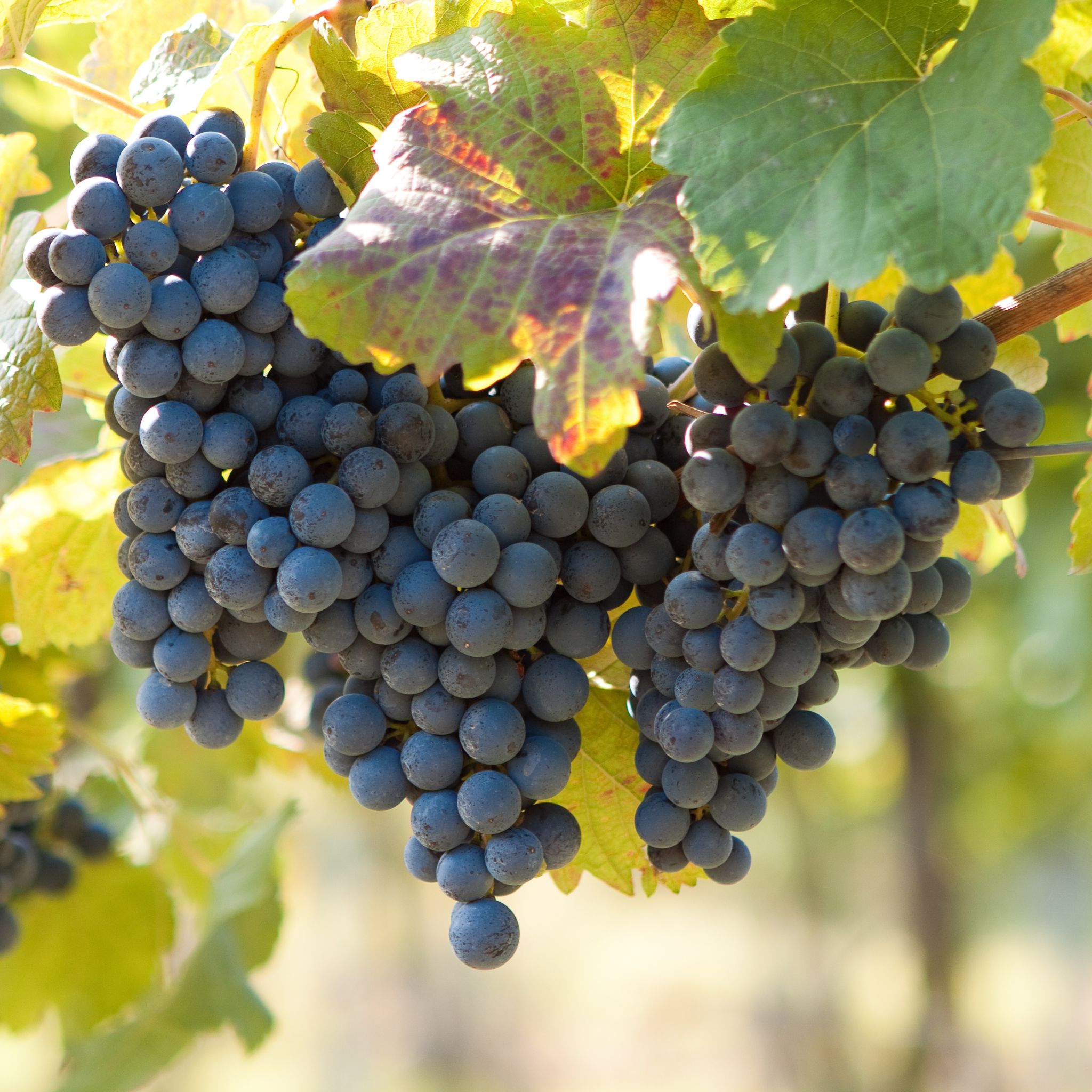
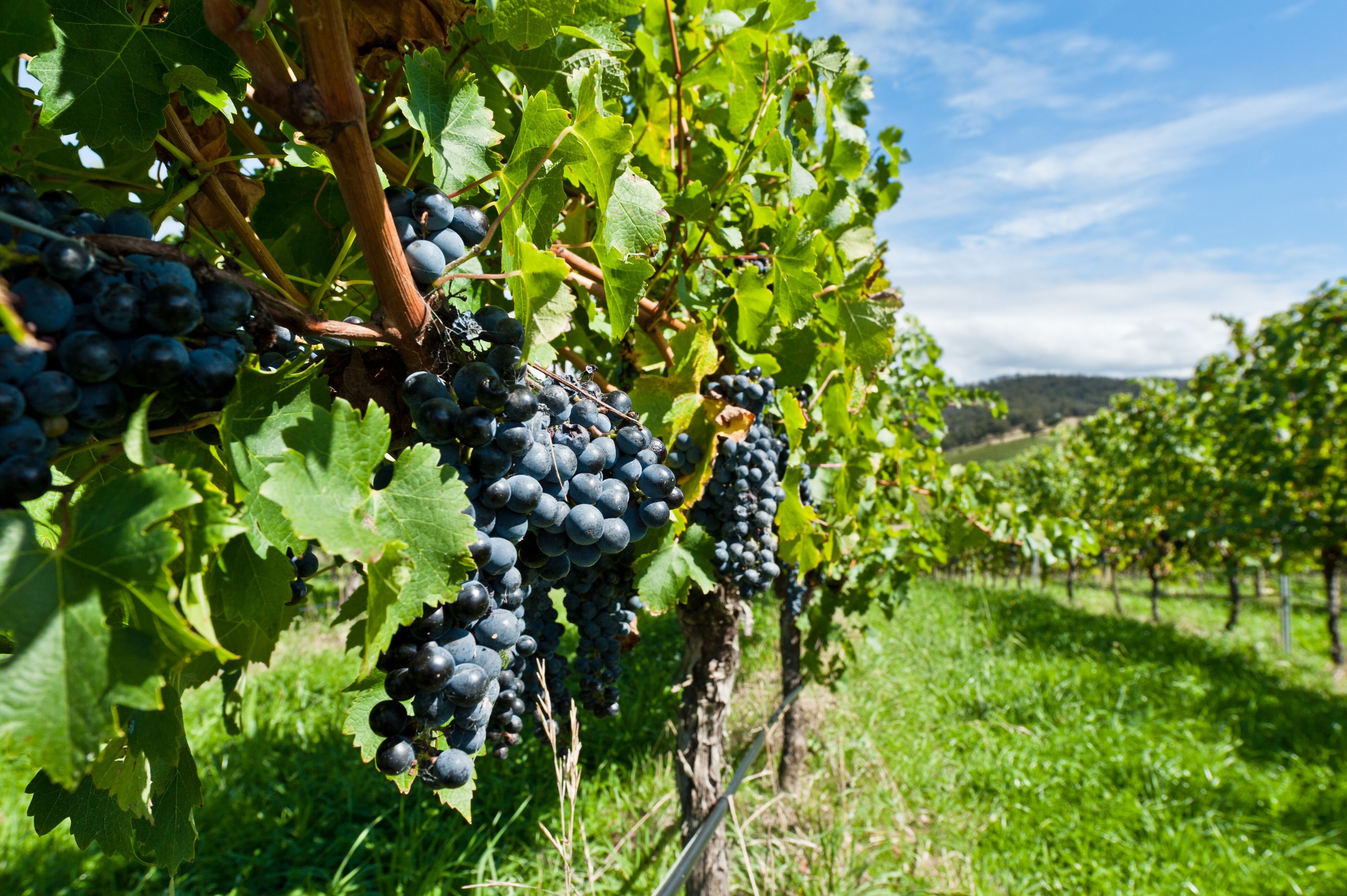
It’s a grape: Saint-Macaire is a super-obscure red grape, believed to have originated somewhere in the area around Bordeaux. It was once-upon-a-time grown in small amounts on Bordeaux’s Right Bank and known for producing soft, fruity wines with a good snap of acidity and a deep red color. However, the grape was not widely re-planted in Bordeaux in the years following phylloxera and eventually, it was nearly forgotten.

Official statistics tell us that these days, only about 1 hectare of Saint-Macaire remains planted in all of France. It is not approved for use in any of the modern AOCs of Bordeaux—including its namesake, the Côtes de Bordeaux-Saint-Macaire AOC—but it may end up in the wines of the Atlantique IGP or a Vin de France.

.

Outside of France, there are a few estates in California that grow Saint-Macaire—these include O’Shaunessy Estate Winery in Napa’s Howell Mountain AVA and Sonoma’s Hanna Winery. Due to its historic stature as a lost grape of Bordeaux, Saint-Macaire is included in the list of grapes approved to be used in Meritage—as defined by the Meritage Alliance—and once in a great while, I’ll find it listed on a Meritage label.

Australia’s Calabria Family Winery (formerly known Westend Estate) grows a few acres of Saint-Macaire in Victoria—and is believed to be the only estate in Australia growing the grape.

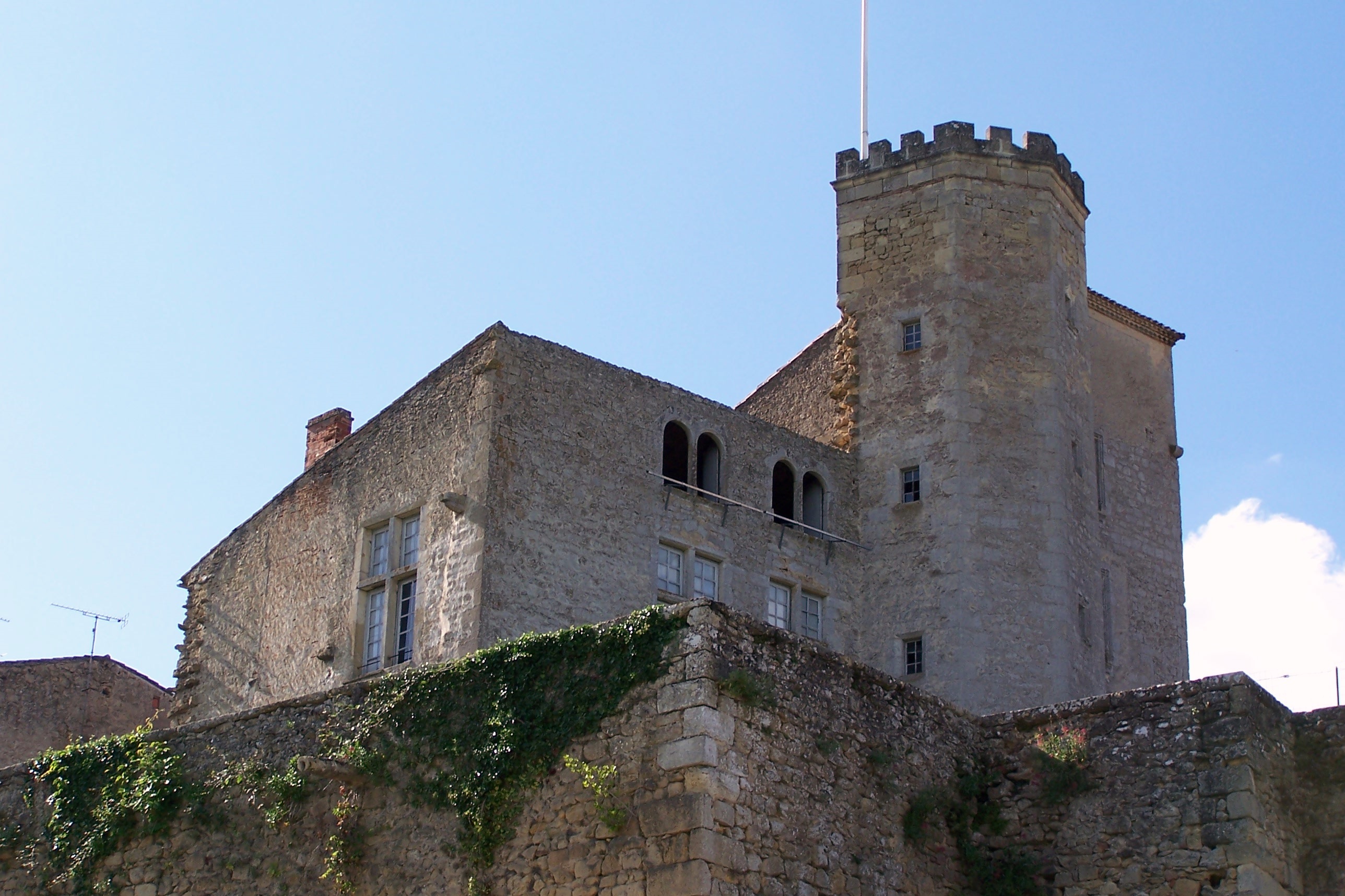
It’s a place: Occupying a 2-mile (3-km) stretch of the northern bank of the Garonne River in France’s Gironde Department, Saint-Macaire is a tiny commune (population: 1,196).  In addition to its vineyards (planted mainly to Muscadelle, Sauvignon Blanc, and Sémillon), the area’s claim to fame is the Château de Tardes, a Monument Historique (national heritage site) and castle dating from 13th century. The building was rebuilt—complete with a hexagon-shaped tower and spiral staircase—into a Renaissance-style mansion in the centuries that followed.

Photo of Château de Tardes by Henry Salomé via Wikimedia Commons

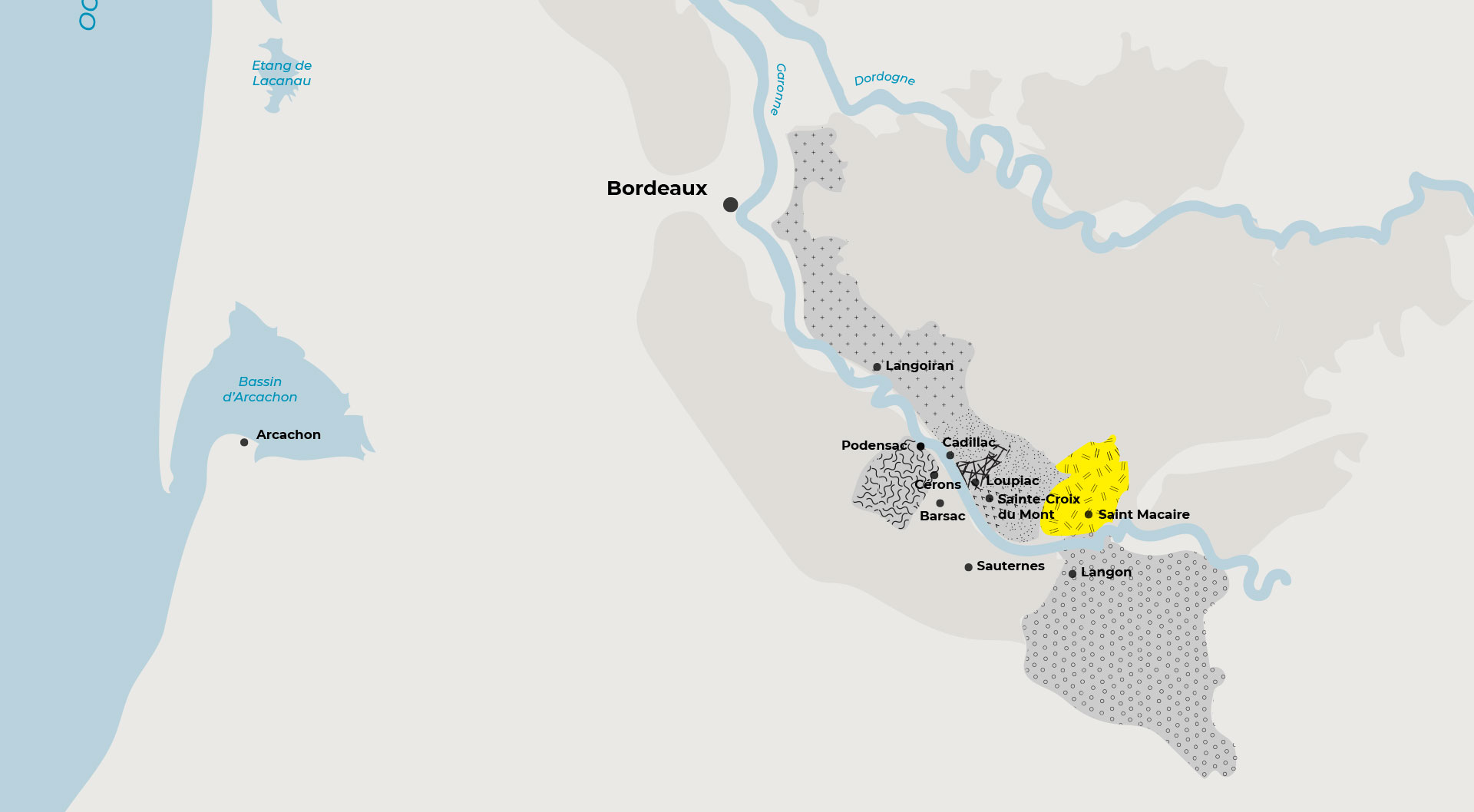
It’s an appellation: Nestled between the Garonne River and the surrounding Entre-Deux-Mers AOC, the Côtes de Bordeaux-Saint-Macaire AOC is located on the softly rolling (south-facing) hills found along the eastern edge of Bordeaux. The Côtes de Bordeaux-Saint-Macaire AOC is approved for the production of white wines only. Dry wines are allowed and are defined as having less than 4 g/L (0.04%) of residual sugar. However, the area is best-known for its sweet (moelleux) and even sweeter (liquoreux) versions of white wines. Produced using ultra-ripe grapes (often affected by botrytis or allowed to dry after harvest), the sweet wines of the area known for notes of ripe pear, toasted almonds, bees wax, tropical fruit, dried apricot, honey, and fig.

It is NOT one of the sub-zones of the Côtes de Bordeaux AOC: Despite the similarity in their names, the Côtes de Bordeaux-Saint-Macaire AOC is not a sub-zone of the Côtes de Bordeaux AOC. The Côtes de Bordeaux AOC, established in 2009, has five sub-zones—Francs, Cadillac, Castillon, Blaye, and Sainte Foy—all of which are located quite close to Saint-Macaire. Each of these subzones may append their name to the “Côtes de Bordeaux AOC” title; this means that the name of wine bottled under the Francs subzone (as an example), could be listed as “Francs—Côtes de Bordeaux AOC.” And thus, the confusion reigns.

However, Saint-Macaire has not joined the the club of the Côtes de Bordeaux AOC. One clear definition between the appellations is that the Côtes de Bordeaux AOC (and its five sub-zones) are all approved for the production of red wines, while the Côtes de Bordeaux-Saint-Macaire AOC is only approved for white wines. (Note: Three of the Côtes de Bordeaux subzones—Francs, Blaye, and Sainte Foy—may produce white wines in addition to reds.)

Map of the Côtes de Bordeaux-Saint-Macaire AOC via http://www.sweetbordeaux.com

Hopefully, this post cleared up some of the confusion regarding Saint-Macaire. It’s really quite simple: Saint-Macaire is a grape, a place, and an appellation—but it is not one of the sub-zones of the Côtes de Bordeaux AOC, despite sharing the good portion of a name and being located in a similar spot.

Any questions?

References/for more information:

The Bubbly Professor is “Miss Jane” Nickles of Austin, Texas… missjane@prodigy.net