Cape Kidnappers and the Farewell Spit

This post, along with my last post on Poverty Bay and the Bay of Plenty, is a result of my wandering mind while studying wine…I tend to wonder how “Poverty Bay” acquired such a name, and why Nelson (on New Zealand’s South Island) has a land feature known as the “Farewell Spit.” If these kinds of things inquire your mind as well…read on!

Farewell Spit: Nasa Satellite Image

Farewell Spit: Nasa Satellite Image

Sunny Nelson and the Farewell Spit

Nelson—a region on the South Island of New Zealand and a wine-producing area as well—enjoys one of the sunniest climates in the country, due to the rain shadow of the West Nelson Mountains.  Tucked behind an area known as Golden Bay, the region seems to be a wonderland for natural beauty and tourism (and it is). So why…does it include a feature known as the “Farewell Spit?” Just sounds nasty.

A spit doesn’t sound as weird when one uses the full  terminology: sandspit.  A sandspit is a type of coastal landform found along the coast where the direction of the shore changes, causing the ocean current to spread out and deposit sand. The longest spit in the world—at 68 miles long— is the Arabat Spit in the Sea of Azov (Crimea).

Nelson’s Farewell Spit (known to the Maori as Onetuhuna) on New Zealand’s South Island is approximately 20 miles long. It is made up primarily of sand eroded from the Southern Alps and deposited into Golden Bay. The name “Farewell Spit” was derived from the name given to the area by Captain James Cook as he departed NZ NelsonNew Zealand for Australia in 1770. The Cape was the last landform the crew was able to see as they sailed away, and the maps produced from his visit showed the area as the “Farewell Cape.”  The name stuck among English speakers and today the sandspit is known as the “Farewell Spit.” The New Zealand Department of Conservation administers the area as a sea bird and wild life reserve.

  • From the wine department: Nelson is one of the smaller regions in terms of wine production; with just 2,700 acres (1,120 ha) of vines, this region produces a mere 2.4% of New Zealand’s wine. The region, known for being the only wine growing area on New Zealand’s South Island that is located to the west of the Southern Alps, still enjoys its “sunny Nelson” reputation due to the presence of smaller mountain ranges that protect its west and south sides from excessive rainfall, while the Southern Alps cradle it to the east. Nelson grows a little bit of Pinot Noir, but focuses on Chardonnay and Sauvignon Blanc as well as a spattering of aromatic whites such as Gewurztraminer, Riesling, and Pinot Gris.

Hawke’s Bay and Cape Kidnappers

Cape Kidnappers

Cape Kidnappers

Cape Kidnappers is a headland located in the south-east extreme of the Hawke’s Bay region on New Zealand’s North Island. A headland is a narrow piece of land that projects from a coastline into the sea; sometimes otherwise known as a cape, bluff, or promontory. Cape Kidnappers extends from Clifton–a small beach town and camping area–into the Pacific Ocean.

Cape Kidnappers takes its English-language name from Captain James Cook’s 1769 voyage to–and around–New Zealand aboard the ship Endeavor. With the caveat that this may be only one side of the story, it was named after an attempted kidnapping. As the story goes, when the Endeavor was anchored off-shore, a crewmember named Tiata was in the water beside the ship when a Māori fishing boat pulled alongside and attempted to drag him aboard. Sailors from the Endeavour opened fire on the fishing boat, killing and injuring several of the Māori. The surviving Māori sped off, and Tiata returned to the Endeavour. Cook, who described the region as having steep white cliffs on either side, thus named the area “Cape Kidnappers.”

NZ Hawkes BayCape Kidnappers is now a protected area and home to several colonies of the Australasian Gannet. The bird reserves are closed to the public, but may be viewed from the beach which is which is accessible by foot, off-road vehicle, or kayak.

The Māori name for Cape Kidnappers is Mataupo Maui, meaning “the fish hook of Maui.” Another name, used less often, is Tapuwaeroa, which refers to “long footsteps” left behind by the giant Rongokako.

  • From the wine department: Hawke’s Bay is one of New Zealand’s  largest wine-producing regions in term of production. The region enjoys an overall maritime climate, but its location in the wider portion of the country means that it is, in spots, quite a bit sunnier and warmer than other parts of the country. For this reason, along with its now-famous gravelly, well-drained soils (particularly in the Gimblett Gravels area), Hawke’s Bay has a reputation for red-Bordeaux blends featuring Cabernet Sauvignon and Merlot, as well as Syrah–mainly grown in the areas further inland. The areas closer to the coast produce Chardonnay and Pinot Gris as well as plenty of wine using NZ’s signature grape–Sauvignon Blanc.

Bonus question: Why is part of the ultra-cute town of Westport known as Cape Foulwind? Cape Foulwind is a headland on the New Zealand’s South Island, located close to the art-deco town of Westport (itself located on New Zealand’s west coast overlooking the Tasman Sea). The headland was previously named Rocky Cape, but was christened Cape Foulwind by Captain James Cook after a strong wind off the cape blew the Endeavour quite a distance out to sea.

References:

 The Bubbly Professor is…”Miss Jane” Nickles of Austin, Texas

Poverty Bay and the Bay of Plenty

Vineyards in New Zealand's Gisborne/Poverty Bay area (photo via http://www.nzwine.com/)

Vineyards in New Zealand’s Gisborne/Poverty Bay area (photo via http://www.nzwine.com/)

This post is totally based on my own curiosity about geography—which pops up at random times during wine studies—such as last night while I was reviewing the wine map of New Zealand. I noticed that Gisborne is also known as Poverty Bay. What place on earth would want to be known as Poverty Bay?

To me, this is a burning question, in need of well-researched answers—and some wine-related context as well! There’s a fine line, it seems, between a wine geek and a geography geek; and we might as well throw history geek in there as well, because the name Poverty Bay, and its (perhaps) better half up the road a bit, the Bay of Plenty, relate back to Captain James Cook (1728-1779), a captain in the British Royal Navy who made three voyages to the Pacific Ocean, and is believed to be the first European to reach Australia and the Hawaiian Islands and to circumnavigate New Zealand.

Poverty Bay

...

There is a lovely series of bays where the city of Gisborne, on New Zealand’s North Island, meets the South Pacific Ocean.  The largest of these is known as Poverty Bay, which stretches for about 6 miles south to a place called Young Nick’s Head. (This too must be explained…it seems that the area, a headland, was the first land sighted by the crew of Captain Cook’s ship, The Endeavour, on October 7, 1769. A reward of a barrel of rum and the right to name the landmass had been offered to the first crewman to sight land; the reward was claimed by 12-year-old Nicholas Young.)

Later that day, the ship’s crew went ashore.  They encountered the residents of the land, the Maori, and it did not go well. The first meeting led to the death of 6 Maori, and the crew, quite battered themselves, returned to their ship without any of the provisions they had hoped to acquire. For this reason, Captain Cook gave the area the name “Poverty Bay.” Perhaps they should have stayed with Maori name, which at the time was Teoneroa; today it is Te Kuri o Paoa.

From the department of I thought this was a wine blog: These days, Gisborne/Poverty Bay is the third largest producer of wine (in terms of volume) in New Zealand, and yet it seems to be somewhat obscure. Perhaps it’s the out-of-the way location. The area currently has 4,735 acres (1,915 ha) of vines. Chardonnay is the most widely planted variety, at about 2,312 acres (936 ha). Pinot Gris is next, with 950 acres (381 ha). Gewurztraminer, Merlot, and Viognier are widely planted as well. New Zealand’s super-star grape, Sauvignon Blanc, actually comes in around sixth place in Gisborne, with about 138 acres (56 ha) planted.

Vineyards in the Waikato/Bay of Plenty area (photo via http://www.nzwine.com/)

Vineyards in the Waikato/Bay of Plenty area (photo via http://www.nzwine.com/)

Being part of the widest part of the North Island, Gisborne records some of the most sunlight hours and warmest overall temperatures in New Zealand, so much so that the grapes here are often the first in the country to be ready for harvest. Gisborne is also the easternmost part of New Zealand, meaning the vineyards here are the first vineyards in the world to greet each new day.

The Bay of Plenty

After the unfortunate encounter at Gisborne, Captain Cook’s crew sailed north to what is now known as the Bay of Plenty. Here he was able to get the provisions he needed, and noted that it was an area “full of plantations and villages” that was “a bay of plenty.” Bay of Plenty is still a lush area, with orchards of kiwi fruit, avocadoes, and citrus, not to mention the vineyards and abundant seafood nearby. The Māori name for the Bay of Plenty is Te Moana-a-Toi (“the sea of Toi”), in honor of the Maori explorer Toi-te-Huatahi.

In the interest of the “wine” part of this blog: The regions of Bay of Plenty and its neighbor-to-the-west, Waikato, are generally lumped together when discussing the wine of the area. These regions, located just south of Auckland, currently have a tiny but growing wine industry—mainly small vineyards tucked between fruit orchards and dairy farms. Chardonnay is the leading grape variety here, followed by Cabernet Sauvignon and Sauvignon Blanc.

...

The area is one of the warmer regions in New Zealand, owing to its more northerly location (remember this is the Southern Hemisphere),  the width of the land mass, and the protection of the Hakarimata Mountain Range  The soils are quite fertile, due to the wide floodplain of the Waikato River and several other rivers.  Some areas around Waikato/Bay of Plenty were previously swampland, made accessible for agriculture via large drainage programs implemented by European settlers.

Stay tuned for more on New Zealand’s landmarks—such as Cape Foulwind, the Farewell Spit, and Cape Kidnappers (complete with wine information from the regions of “Sunny Nelson” and Hawke’s Bay).

 The Bubbly Professor is “Miss Jane” Nickles of Austin, Texas… missjane@prodigy.net

The Icy Benguela

...

I’ve been curious about the Benguela Current for a while. My original curiosity about the Benguela Current was about the name —how did it get that very cool name? It seems it all begins with Portuguese sailors in the 1500s.

In the Age of Discovery, Portuguese Sailors—known for skill and courage in ocean navigation —often sailed the long and arduous ocean journey around the continent of Africa to Asia. During such voyages, they had to fight against two mighty ocean currents: the icy Benguela current that flowed northward along the coast of Africa while they were trying to sail south; then, after they rounded the Cape of Good Hope, they sailed north while fighting the warm and southward-flowing Agulhas Current. If the journey was successful, they reached Asia and accessed the famed Indian Spice Routes. Such accomplishments helped the Portuguese form their empire, which at various times included parts of Africa, the Middle East, India, South America, and South Asia.

...

The namesake of the Benguela Current (as it is now known) is a city in present-day Angola.  The area surrounding Benguela, due to its location near the coast and a well-traversed deep bay, has been a center of commercial trade since ancient times.  While there is no written record of the history of the area before the arrival of the Portuguese in 1546, it is believed that the area was formerly known as ombaka, which means, literally, “commercial (or ‘market’) port.” When the Portuguese colonized the area, a town was founded and named São Felipe de Benguela (Saint Philip of Benguela) after King Philip II of Spain and Portugal.

So back to ocean current: the icy Benguela Current flows from the Southern Ocean near Antarctica and moves north along the west coast of Africa. It reaches as far north as Angola (close to the city of Benguela, in case you missed that point) before it turns west and heads to South America. The Benguela Current is part of a large circulating ocean current known as the South Atlantic Ocean gyre. The western edge of the gyre is known as the Brazil Current; the Brazil current flows southward down the coast of Brazil, then turns east and flows across the ocean until it reaches Antarctica. From Cape Point in South Africa (at about 33°), the cold portion of the current known as the Benguela current flows northward along the west coast of Africa to the area around Angola/Benguela (about 16°S).

...

            Cape Agulhas…pick your ocean!

Near Cape Point, where a portion of the cold Benguela Current of the Atlantic meets the warm south- and west-flowing Agulhas Current of the Southern Pacific Ocean, the waters become wild and turbulent. It’s a common practice while on vacation in Cape Town to journey down to Cape Point, take a short hike, get your picture taken by the sign, and stare out to sea at the “place where two oceans meet.” (Hey, I did it.) However, the truth is that the ocean currents actually intermingle for hundreds of miles in either direction—both east and west of Cape Point—and that the “point where two oceans meet” is likely to be anywhere between Cape Point and about 100 miles west at Cape Agulhas (which is actually the southernmost point on the African continent and worth a visit as well).

From the department of I thought this was a wine blog:  Good point. All I can say is that my curiosity concerning Benguela Current peaked while studying the wines of South Africa. The winelands of South Africa’s Western Cape are cooled by the moist fog and gentle breezes generated by the Benguela Current, which also generates the not-so-gentle south-easterly wind known as the “Cape Doctor.”

...

Super-sharp students of wine might also have perked up with the mention of Cape Point, which is the former name of the Cape Peninsula wine district; and Cape Agulhas, a wine district located in the Cape South Coast. Cape Peninsula is a small area located on a narrow, rugged area just south of Cape Town and east of Constantia (both wine regions are easily accessed via taxi or tour bus from Cape Town). Cape Peninsula produces snappy, cool-climate white wines and is particularly adept at Sauvignon Blanc. The terroir of Cape Agulhas, about 100 miles down the coast, is also markedly maritime—distinctly cool and breezy—and known for a crisp, snappy style of Sauvignon Blanc, apricot-and-lemon laced Semillon, and a unique cool-climate style of Shiraz.

References:

The Bubbly Professor is “Miss Jane” Nickles of Austin, Texas… missjane@prodigy.net


Whole Lotta Ancellotta

...

The Ancellotta grape is native to Italy’s Emilia-Romagna area and used in small amounts in some styles of Lambrusco. When I read that, I thought to myself, “Now there’s an obscure grape variety”!

As first impressions often are, I was wrong! Italy has over 11,000 acres of Ancellotta, and while that can’t compare to Sangiovese’s 200,000 acres, it certainly doesn’t place it at the bottom of the very long list of grapes grown in Italy.

The Ancellota grape is a vigorous red grape known for small, very dark berries. The high level of anthocyanins in the skins mean that this grape is often used, in small amounts, to add a punch of color to otherwise lightly hued red wines. This feature also means that the grape is sometimes used in concentrated musts used for coloration. Besides its color and structure, Ancellotta grapes are known for ripe red fruit flavors and aromas, such as plum, blackberry, and blueberry; as well as a spiciness characterized as “sweet spice” or “baking spices.”

...

Ancellotta is perhaps best known as a minor allowed component of several styles of Lambrusco. It is allowed to be used up to 15% in the blend of Lambrusco Salamino di Santa Croce DOC and Lambrusco Mantovano DOC. It’s also allowed, up to 15% in Lambrusco di Modena DOC and Lambrusco di Reggiano DOC. In Colli di Scandiano e di Canossa DOC, it may be used in Lambrusco—but only those produced with a minimum of 85% of either the Lambrusco Montericco or Lambrusco Grasparossa variety.

But here’s where it gets interesting: did you know that Ancellotta is required to be at least 30% of the blend of Reggiano Rosso DOC? True fact! Plus, it is allowed to be up to 60% of the blend. So that’s where the 11,000 acres of Ancellotta are headed! The rest (40—70%) of the Reggiano Rosso DOC blend may be Cabernet Sauvignon, Fogarina, Malbo Gentile, Marzemino, Merlot, Sangiovese, or various members of the Lambrusco grape variety.

...

The Ancellotta grape variety is also planted in Brazil where it is believed to cover at least 1,000 acres, mainly in the Serra Gaúcha area.  At the Don Guerino Winery in Alto Feliz, it is used in “Top Blend,” a gran reserva blended red wine, alongside Merlot, Teroldego, Tannat, and Cabernet Sauvignon. Don Guerino also produces a 100% varietal Ancellotta that has been described as having a deep intense color, aromas and flavors of plum, blackberry and spice; great structure, and ripe tannins.

Ancellotta is also grown in Switzerland. It is often used, in small amounts, for its color-enhancing quality in the Pinot Noir of the Valais region. It is also used in the blended wine known as Dôle. Dôle, which must contain a combined minimum of 85% Pinot Noir and/or Gamay, is considered to be among the finest wines of Switzerland. Other grapes used in Dôle may include Carminoir (a recent Cabernet Sauvignon X Pinot Noir cross), Merlot, Syrah, and—you guessed it—Ancellotta.

References:

The Bubbly Professor is “Miss Jane” Nickles of Austin, Texas… missjane@prodigy.net
English PDO Wine – Who Knew?

...

We’ve been hearing a lot about English wine lately – especially sparkling wine. I’ve even heard that wineries in Sussex have applied for PDO status. When I heard that I thought that English wines must have truly arrived – who would have imagined a PDO wine from England!

Little did I know that English Wines have had PDO status since 2007. Welsh wines have a PDO as well. And both regions—England and Wales—have had PGI status for wine, also since 2007. We’re going to have to get used to using terms like Chapel Down, West Sussex, and Hush Heath in relation to quality wine.

Who knew?

The PDO for English wine specifies that the wine must be produced 100% using grapes that are grown in England at a maximum elevation of 220 meters (722 feet) above sea level. Enrichment (chaptalization) is permitted within certain guidelines, as well as sweetening (after fermentation). Acidification is not allowed (although exceptions can be made in exceptional years at the discretion of the Commission). The list of approved grape varieties has about 80 grapes —including both vinifera varieties and hybrids.

...

English PDO sparkling wine  must be produced using the traditional method.  Chardonnay, Pinot Noir, Pinot Noir Précoce, Pinot Munier, Pinot Blanc, and Pinot Gris are the only varieties allowed for use in English PDO sparkling wine.  The wine must spend at least 9 months aging on the yeast lees in the bottle before being disgorged.

The main difference between the PDO and PGI standards seems to be that there are no limits on the elevations for grape growing for PGI wines. Other production regulations are similar, yet a bit less stringent in terms of yields (100 hl/ha allowed as opposed to 80 hl/ha), enrichment, and sweetening. English PGI sparkling wines also have a long list of allowed varieties (as compared to the short list of six allowed in the PDO).

Here’s a few more fast facts on wines from England and Wales:

  • Number of vineyards: more than 470
  • Number of wineries: more than 135
  • Average annual production (2010-2014): 3.77 million bottles
  • Acreage under vine: 4,940 acres (2,000 hectares)
  • Largest single vineyard: Denbie Wine Estate (165 acres/177 hectares)
  • ...

    Style of wines produced (approximate): 66% sparkling, 24% still white, 10% red/rosé

  • Most widely grown grapes: Chardonnay (21%), Pinot Noir (19%) and Bacchus (9%)—followed by Seyval Blanc, Pinot Meunier, Richensteiner, and Müller-Thurgau.

The United Kingdom (which includes England, Wales, Scotland, and Ireland—at least for now) has protected many of its products with geographical indications and designations of origin. They include 62 different foods—including Traditional Cumberland Sausage, Stilton Cheese, and Cornish Clotted Cream—as well as Irish Whiskey, Scotch Whisky, six types of cider and three types of beer (Kentish Ale, Kentish Strong Ale, and Ruland Bitter). Other protected products include Native Shetland Wool, East Kent Goldings Hops, and Anglesey Sea Salt.

Who knew?

References:

The Bubbly Professor is “Miss Jane” Nickles of Austin, Texas… missjane@prodigy.net
Marselan from Marseillan

Photo of Marselan Grapes by Vbecart Photography, via Wikimedia Commons

Photo of Marselan Grapes by Vbecart Photography, via Wikimedia Commons

I first heard of the grape variety Marselan while studying – for the first time – the wines of China. China, as you may have heard, recently became the world’s second-place country in terms of vineyard holdings – coming in on the list right after Spain, and before France. While many of China’s vineyards are dedicated to table grapes, wine grapes, including vinifera varieties, now account for at least 10% of the vines. Of the vinifera varieties grown, Cabernet Sauvignon dominates, followed by Carmenère, Merlot, Chardonnay, Cabernet Franc, Shiraz, Gamay, Grenache, and Marselan.

There it was: Marselan – a grape variety I had never heard of before – so of course I had to investigate…

Marselan is a vinifera cross (Cabernet Sauvignon X Grenache) created in 1961 by French ampelographer Paul Truel. Truel was working in Montpellier, France at the Institut National de la Recherché Agronomique (INRA). His goal was to create a high yielding grape with large berries of at least moderate quality. Marselan produces grape berries of small-to-medium size, so the variety was shelved and not expected to have a future in commercial wine production.

However…by the 1990’s viticultural priorities had shifted, and disease resistance, particularly to threats such as powdery mildew and coulure, brought Marselan out of cold storage. The grape was approved by the French as a commercial variety in 1990 and in 2007 was approved by the TTB (United States) as a varietal wine name.

At its best, Marselan is said to combine the finesse and quality of Cabernet Sauvignon with the heat tolerance and high yield of Grenache. According to Jancis Robinson’s book “Wine Grapes,” varietal Marselan “tends to produce deeply colored and highly aromatic wines that have supple tannins and the potential to age.”

In addition to its plantings in China, Marselan is planted – albeit in small amounts – throughout the south of France. It is allowed to be up to 10% of the blend in the wines of the Côtes du Rhône AOC, and is produced as a varietal wine in the Languedoc. Small plantings may also be found in California, Argentina, Arizona, Spain, Uruguay, and Brazil.

The grape was named “Marselan” by its creator, in homage to the town of Marseillan, France. Marseillan is the home of the phylloxera-free vine collection of Domaine de Vassal, operated by the INRA. Domaine de Vassal provided the parent Cabernet Sauvignon and Grenache vines from which the original Marselan was bred.

References:

  • Robinson, Jancis (et al): Wine Grapes. New York, 2012: Harper Collins Publishers
  • Robinson, Jancis and Harding, Julia: The Oxford Companion to Wine, 4rd Edition. Oxford, 2015: The Oxford University Press
  •  http://www.winechina.com/en/

Roll on, Columbia, Roll on!

Map of the Columbia River watershed, with the Columbia River Highlighted. Map via the USGS, modified by Kmusser, via Wikimedia Commons

Map of the Columbia River watershed, with the Columbia River Highlighted. Map via the USGS, modified by Kmusser, via Wikimedia Commons

The Columbia River is well-known to wine lovers as the namesake of The Columbia Valley AVA. The Columbia Valley AVA is the largest AVA in Washington State, and a portion of the AVA dips down across the Oregon border as well. Another namesake, the Columbia  Gorge AVA – a tiny AVA located just to the east of Mount Hood – is also shared by the two neighboring states.

But the Columbia River extends well above and beyond its namesake wine regions, and is a treasure trove of interesting stories for geography geeks and travel buffs as well as the legions of wine lovers already familiar with the name.

The Columbia River flows for over 1,243 miles, beginning in the Rocky Mountains of British Columbia in Canada. From there it flows northwest through a glacial valley between the Canadian Rockies and the Columbia Mountains to a town named Canoe; here the Columbia takes a sharp turn to the south around the northern edge of the Selkirk Mountains and begins its 200-mile trek into eastern Washington State.

Once in Washington, the Columbia River flows south/southwest for about 100 miles to the town of Deer Meadows.  Just after the point of confluence with the Spokane River, the Columbia River takes a sharp turn to the west and forms a huge “C” formation covering much of interior Washington State. This section of the river, known as the “Big Bend” was formed during the Missoula floods. Before the floods, the river took a much straighter path towards the southwest.

Crown Point, Columbia Gorge

Crown Point, Columbia Gorge

To the south of the “Big Bend,” in the wine country of eastern Washington State, the Columbia is joined by the Yakima River as the Yakima flows eastward down from the Cascades. The Yakima River catches the Columbia just after it rounds a small bend hugging the Horse Heaven Hills AVA. From here, the Columbia continues its trek to the Pacific Ocean, forming over 300 miles of the border between the states of Washington and Oregon from the Yakima Delta to the sea.

Near Washington’s Tri-Cities area, the Columbia River is joined by the Walla Walla River. Walla Walla is another name familiar to wine lovers, being the namesake of the Walla Walla River Valley AVA, a sub-region of the Columbia Valley AVA and one of the three AVAs shared between Washington State and Oregon.

The Walla Walla River is short in length – just 61 miles long – but of great importance to the wines of the area. The Walla Walla River begins in as two separate forks in the Blue Mountain range of northeastern Oregon. From there, the two forks run westward to Milton-Freewater, which was built along its banks. The Walla Walla River runs northwest and eventually meets the Columbia River for the journey westward towards the sea, but along the way it deposits the famous basalt stones – the rocks – which gave the newly-anointed “Rocks District of Milton-Freewater AVA” both its name and its famous terroir.

Shoshone Falls

Shoshone Falls

Another river familiar to wine lovers, the Snake River, joins the Columbia River near Washington State’s Tri-Cities area. The Snake River, at 1,078 miles long, is the Columbia River’s longest tributary. The Snake River actually begins several states over, in Wyoming’s Yellowstone Park. From Wyoming, the Snake flows across the width of Idaho. About mid-way through its trek across Idaho, the Snake River flows over Shoshone Falls – a waterfall that, at 212 feet high, is actually 45 feet higher than Niagara Falls. Shoshone Falls is often called “the Niagara Falls of the west” – although I am sure many citizens of Idaho wonder why Niagara Falls is not known as “The Shoshone Falls of the east.”

About 120 miles west of Shoshone Falls, the Snake River flows past Boise, and not too far after that,  takes a sharp turn north and forms the border between Idaho and Oregon. The Snake River Valley AVA is located along this border. The Snake River Valley is currently Idaho’s only AVA, although a second – Lewis-Clark Valley – has been proposed for northern Idaho/eastern Washington State. After leaving Oregon and forming a small portion of the Idaho/Washington State border, the Snake River turns west and joins the Columbia River.

Map of the Snake River watershed with the Snake River Highlighted. Map via the USGS, modified by Shannon1 via Wikimedia Commons.

Map of the Snake River watershed with the Snake River Highlighted. Map via the USGS, modified by Shannon1 via Wikimedia Commons.

The Columbia River, along with its tributaries the Walla Walla River, the Snake River, and the Yakima River (as well as many others not mentioned here) plays a huge roll in Pacific Northwest viticulture. Through their waters, they provide for the irrigation that makes viticulture even a possibility in much of the region. Over the centuries they have deposited alluvial soils, formed breathtaking waterfalls, sliced gorges through mountains and even delivered the namesake “rocks” to one of the area’s newest AVAs. Roll on, Columbia, Roll on.*

*Roll On, Columbia, Roll On is an American folk song written by Woody Guthrie in 1941. The popular song glamorized the building of a series of dams and the harnessing of hydroelectric power from the Columbia River under the American Public Works program of the New Deal.

The Bubbly Professor is “Miss Jane” Nickles of Austin, Texas… missjane@prodigy.net

The Land of the Landes

Maritime Pines in the Landes Forest

Maritime Pines in the Landes Forest

All good wine students know about the Landes Forest—that region of tall pines bordering the Bay of Biscay to the south and west of the Bordeaux wine region. The Landes—now the most extensive forest in France at 5,400 square miles (14,000 square km)—helps to somewhat moderate the Atlantic Ocean’s cold, maritime influence on the vineyards of Bordeaux.

However, even the sharpest wine student might not know the history of the region, including how local sheep-herders used to wear stilts to navigate the land, and the fact that the forest is largely man-made.

The area we now know as the Landes forest was once covered by moors and marshlands.  The area, basically a swamp surrounded by shifting sand dunes, was sometimes known as the “Moor of Bordeaux.” Not surprisingly, the area was sparsely populated. Another nickname given to the region was “the Sahara of France” due to the fact that it was notoriously difficult to travel across—as many pilgrims making their way from the north down to the Camino of Saint James needed to do.

Beginning in 1801, the marshes were drained via a vast system of canals, the land was cleared, and pine tree plantations were established. This stabilized the sand dunes and created arable land suitable for farming. The local economy benefited through farming (mainly corn) as well as new opportunities in the timber, pine resin, and paper industries.

Jean Louis Gintrac - Inhabitants of the Landes (circa 1808)

Jean Louis Gintrac –
Inhabitants of the Landes (circa 1808)

The benefits of the man-made Landes Forest went beyond the area’s new industrial prowess, as it was soon discovered that the near-by wine region of Bordeaux also benefited. This is due to the area of the Landes forest closest to the Médoc that shelters the vineyard regions from the bracing cold and howling breezes that blow in from the Atlantic. Thus, the vineyards of the Médoc are now able to fully ripen the Cabernet Sauvignon and Merlot that form the basis of the region’s red wines.

The Landes forest is one of the largest man-made forests in all of Europe, as well as a unique example of a man-made landscape that continues to benefit its region and the surrounding areas. The timber, pine resin, and other related industries are still active in the area, although a good portion of the region is now given over to tourism.

The area is also home to a large protected area of forests and coastlines that includes the Landes de Gascogne Regional Natural Park (Parc Naturel Régional des Landes de Gascogne). The park provides ample opportunities for hiking, cycling, and picnicking, and contains a bird sanctuary and a museum. The museum, L’Écomusée de la Grande Lande, focuses on the history as well as the architectural and cultural heritage of the region including, of course, the vineyards and wines of Bordeaux.

The Bubbly Professor is “Miss Jane” Nickles of Austin, Texas… missjane@prodigy.net
References:

Map of the Landes de Gascogne by Cabaussel, via Wikimedia Commons

Map of the Landes de Gascogne by Cabaussel, via Wikimedia Commons

White–ish: Albariza Soil

....

….

Albariza, the word: According to Miriam-Webster.com, the word “albariza” is “borrowed from Spanish, a noun derivative from the feminine form of albarizo meaning “white-ish, or off-white.” Derived from the word albar (“white”) plus the attenuating (limiting) suffix –izo.

Albariza, the soil: According the Oxford Companion to Wine, albariza is “A local, Andalusian term for the white, chalky-looking soil typical of parts of the Jerez region of southern Spain. It appears dazzling white in summer, and has the characteristic of drying without caking, slowly releasing moisture to the vines during the growing season.”

Albariza, for wine lovers: If you are a wine lover, you probably already know a few things about albariza soil. Such as, it is a particularly fine conduit for the Palomino grape, and grows the grapes that will become some of the finest examples of Fino Sherry—and other types of Sherry as well.   It is the main soil type found in the Jerez-Xérès-Sherry DO, found in over 90% of the vineyards of the region.  This figure used to be much lower, but over the years inferior vineyards were replaced—either by other crops such as sunflowers or alternative uses such as the harvesting of solar energy—leaving behind the high quality, albariza-rich vineyards to rule the area.

.....

…..

Albariza is a unique soil, made up primarily of limestone rich in calcium carbonate that, according to geologists, is “almost chalk,” but it is still too young to be true chalk. Yet, to us mere mortals, calling it “chalk” is “close enough,” and you’ll find most people—even viticulturists—referring to albariza as a “chalky” soil. Clay and sand (silica) are found in smaller amounts; these components give its somewhat mottled “white-ish” appearance as opposed to pure, bright white.

The unique properties of the soil allow it to soak up rainfall—which typically occurs in Jerez in the winter—and absorb it like a sponge. Later, the upper levels of the soil “bake” into something of a hard crust or cap, trapping the water below. Over the long, hot, and dry Jerez summer, the trapped water is slowly released, nourishing the vines and making irrigation unnecessary.  The unique white-ish color of the soil also benefits the vines by reflecting sunlight back up to the vines, increasing the rate of photosynthesis.

All of the above might not be new information if you are already a wine enthusiast or dedicated student of wine—which is just fine because there is so much more to know about albariza. Read on for a few more fascinating facts about albariza:

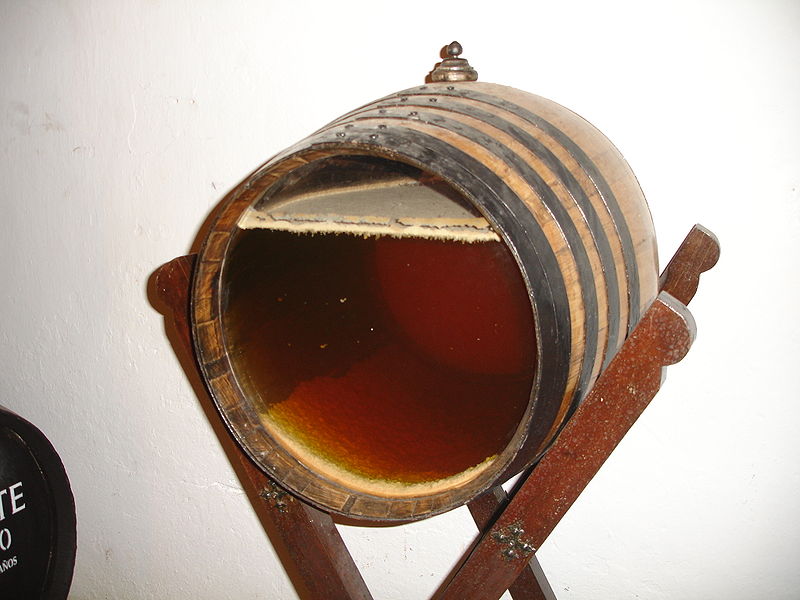
  • The finished product...

    The finished product…

    Albariza soils are categorized according to the percentage of calcium carbonate-rich limestone/chalk in the soil. Alabarizone soil is mostly clay but contains about 10% limestone. Tosca soils have about 40% limestone/chalk, while lantejuela contains about 50%. Tajón has the most – up to 80% limestone/chalk, giving it the brightest white appearance. However, tajón soils are not ideal for vineyards, as the soil can become very hard, which can lead to chlorosis (a condition where leaves produce insufficient chlorophyll).

  • The ideal version of the soil for vineyards contains about 25% limestone/chalk at the surface, and 40-60% starting a few feet below the surface. Geologists, of course, have many more subsets and ways of looking at albariza, including the composition of the remainder of the soil components as well as specific minerals and nutrients.
  • The finest albariza soils are characteristically loose and easy to work; in geology speak this is described as being “friable.” This friability allows a vine’s root system to spread far and deep into the ground. Roots as long as 38 feet (12 meters) have been reported in layers of albariza soil which themselves reach a depth of 20 feet (6 meters).
  • To maximize the amount of rain water “captured” in the soil, the soil in albariza soils are often “banked up” to create reservoirs to capture rain. In spring, the soils are leveled out again.
  • Albariza soil can hold up to 34% of its weight in water.
  • Albariza is also found in parts of Penedès, where it produces grapes for exceptional Cava; and in Montilla-Moriles, where the vineyards are mostly planted to the Pedro Ximénez variety.

 References:

The Bubbly Professor is “Miss Jane” Nickles of Austin, Texas… missjane@prodigy.net

Lisbon – Cherry Pits and All

Elevador de Santa Justa

Elevador de Santa Justa

When in Lisbon…when in Rome…what we’re trying to say is, when traveling, its a nice idea to try to do as the locals do! “Going local” is excellent advice for any traveler, and during my short stay in Lisbon I tried my best to act like a local, which to me meant having my morning coffee on the terrace at the Café A Brasileira, riding the yellow trams out to the Belém district to get Pastel de Nata at the Pastéis de Belém, and taking the Elevador de Santa Justa up to Carmo Square. (That last one might actually be a bit touristy – but it was very cool.)

Another thing I learned to appreciate in Lisbon was Ginjinha, the traditional morello cherry liqueur of Portugal. Many shops will serve a drink of Ginjinha to customers and it is often homemade, but the coolest way to drink Ginjinha is at one of the many storefront Ginjinha bars in Lisbon.  If you happen to be new to Lisbon, and suddenly find yourself wondering why everyone is standing around, sipping red liquid from tiny plastic cups, surrounded by a sea of cherry pits – congratulations, you’ve stumbled upon a storefront Ginjinha Bar!

Yellow Trams in Lisbon

Yellow Trams in Lisbon

Ginjinha is made by infusing ginja berries (as sour Morello cherries are locally known) in brandy. Sugar is also added, along with cinnamon and, perhaps, other ingredients. Ginjinha is traditionally served in a shot form with a piece of the fruit in the bottom of the cup. If you didn’t get a cherry in the bottom of your cup – ask for one!

Not surprisingly, there are numerous stories about the origins of Ginjinha, however, most people are content to give credit to Francisco Espinheira, a Galician friar who lived at the Igreja de São Domingos (Church of St. Dominic) in the Santa Justa area of Lisbon. As the story goes, the friar had the idea to soak some cherries in the local aguardente (Portuguese brandy) along with some sugar and spices. The rest, as they say, is history in terms of the popularity of the drink, and the Igreja de São Domingos went on to become the first place in the city to sell Ginjinha.

A Ginjinja in Lisbon (of course)

A Ginjinja in Lisbon (of course)

As a matter of fact, the neighborhood around the church remains one of the best places to sample Ginjinha, for tourists and locals alike. Here, carved into the side of a building across the square from the Teatro Nacional D. Maria II you’ll find a counter front with the name “A. Ginjinha” painted in an arch across the top. Hand the gentleman at the counter a euro, and be sure and tell him “obrigado” or “obrigada” if you are female. You might get a glass shot glass, but if it’s a busy time it will be plastic. Never mind…just find yourself a spot of the sidewalk, sip the delightful cherry liqueur and – don’t be shy – eat the cherry and then spit the pit out on the sidewalk for those who journey behind you to trample upon.

Homemade Ginjinha is common, although there are many commercially produced varieties. Ginjinha Portuguese has been awarded PGI status by the European Union and one particular version, Ginjinha de Óbidos e Alcobaça, has applied for PGI status as well.

The Bubbly Professor is “Miss Jane” Nickles of Austin, Texas… missjane@prodigy.net